Showing posts with label More Point Arena. Show all posts

Monday, February 28, 2022

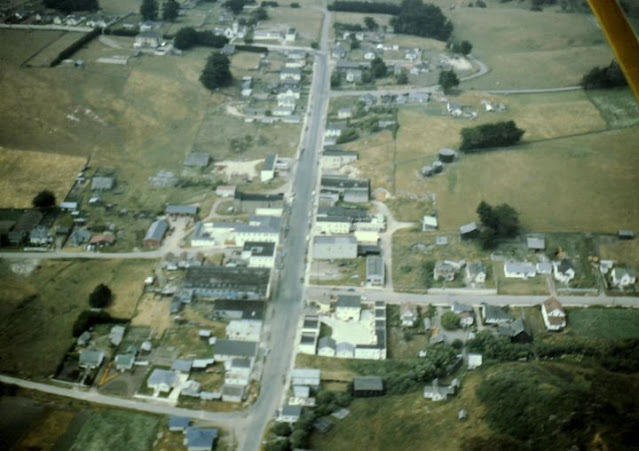
Point Arena Time Capsule, 1950


    Facebook is often maligned, and I suppose rightfully so, but I'm grateful for Facebook more often than not. In the case of this photo, it's special to me in a way that it would be for few. It was taken by a family friend, Jimmy Morrison, from his light airplane flying over the south end of Point Arena sometime in late 1949 but more probably in 1950. So far I'm the one providing the estimate of when it was taken based on my knowledge as a seven-year old at that time with familiarity with certain Point Arena landmarks. 

    But let me devote some words to Jimmy Morrison. When we arrived in Point Arena September 10, 1949, Jimmy was an auto mechanic at the Union 76 station, owned and operated by Jack Pelascio and his son Jim. At the time the Pelascios owned quite a lot of Point Arena, besides the Union 76 station the Point Arena Theater on adjacent property, and the old high school building and its land. 

    The picture was posted on Facebook by Jimmy's stepson, David Weymouth, who added: 
I couldn’t have had a better stepfather. His parents were so poor in New York City that they had to give him to a farm family in upstate NY to work for them when he was in the fourth grade. That was the extent of his schooling. But he always read a lot and saw a bit of the the world in and after the war in the military and Coast Guard. He never went far financially but was a fine person and wonderful for my mother.

    At the photo upper left, just above the open fields, stands the former Point Arena High School building. When we arrived from Southern California, we parked our trailer on the left (east) side of the building on a concrete slab which may have been a combined tennis and outdoor basketball court. I feel certain that the silvery object by the building is our trailer, which in 1951 we moved to the front of the building after we had moved into one large room at the left front of it. 

    I wrote about our life in the Old High School here.


Thursday, May 02, 2013

A Star is Born!


It only took 70 years for me to make my singing debut. Fittingly, it was in the Point Arena Theater, where in the decade of the 1950s I watched over 1,000 movies, most of them forgettable B-grade Westerns. Most of you reading this have no idea what these Westerns were like, and they were so forgettable, all I can remember is that towards the end the brave settlers were just about to be overrun by the murderous red savages, when faintly, far away, a bugle could be heard announcing the eminent, just in the nick of time, arrival of the Cavalry. We all jumped, and whooped, and cheered in our seats, as the blood-thirsty redskins were bloodily vanquished.

Actually, in those days almost no blood spilling appeared on screen. It was like everyone died of internal injuries.

But as usual, I digress. However, let me continue a digression that may get me back on track. On the screen on that stage at that time there were often moments of movie magic we called musicals. As my buddies groaned while the singers broke into song, and the dancing commenced, my mind immersed me in the wonders that the composers, lyricists, choreographers, directors, singers, and dancers intended for me. I watched “Seven Brides for Seven Brothers” so intently as a twelve-year old in 1954 that by the end of the third showing (the best films were shown twice Saturday and once Sunday) I had almost all the lyrics committed to memory. Since Mom cleaned the theater, brother Ron and I got to watch all the films for free.

And here’s the track again. I easily developed a facility for remembering songs, and even today (in my mind) can recall and hear songs I haven’t heard in fifty years. So about two months ago Alice and I went to the Point Arena Theater for a live performance of Steve Martin’s play, “Picasso at the Lapin Agile”. All we knew about the play prior to arrival at the theater was that Steve Martin wrote it – that got our attention! – and that one of our favorite people, Blake More, had a part and had told us the week before that we would enjoy the show.

For Alice and I, the show had an unusual beginning that no one but us noticed: we arrived late, as usual, and as is usual for Point Arena plays, it began late, and for some strange reason the combination of our lateness and the play’s late start got us front row seats. Two of the performers, Bryn Harris and her father, Wayne, were “warming up” the crowd: Bryn was singing French songs to Wayne’s accompaniment on the harmonica. Pretending to be an impromptu street performer, Bryn passed a hat and a few dollars were thrown in. “Now,” said Bryn, “let’s do a sing-along in English.” Turning to her father, she said, “Play the ‘lonely’ song,” and Wayne began “Are you lonesome tonight?” I started singing along, and Bryn overheard me and motioned me to stand with her and sing.

When you’re seventy, you have already done all the “first times” in your life, but I had never spontaneously sung before an audience. Years ago I had participated in karaoke arranged by brother Ron and his wife Kathy at my step-mother Ruth’s 80th Birthday party in Fortuna. I sang Hank Williams’ “On the bayou” and encored “If you’ve got the money, honey, I’ve got the time.” Now I found myself singing from memory with this young lady, Bryn, and soon realized that Bryn had stopped singing and moved into the audience, leaving me alone to carry on, just as the song reached its emotional climax:

“Do the chairs in your parlor seem empty and bare?
Do you gaze at your doorstep and picture me there?
Is your heart filled with pain, shall I come back again?
Tell me dear, are you lonesome tonight?”

With an unwarranted confidence, I sang louder and more dramatically, reminding myself to keep my mouth open, don’t rush, and don’t forget to breath. The applause as I finished surprised me, and I grinned and waved briefly, then took my seat. After just a moment, Bryn came over, pulled a dollar from the collection hat, said “You earned it,” and put it in my shirt pocket.

Over the next week I met friends who had been at the performance, and several said that they didn’t know I could sing like that. “That makes two of us,” I replied.

(Photo courtesy of Scott Ignacio)

Sunday, April 27, 2008

Everything I Know I Learned While Fishing

It’s a good thing I did a lot of fishing when I was young, and learned everything then, because sad to say I haven’t done much fishing for many years now.

When I was a school boy in Point Arena, 1949-1960, I never thought about going fishing, I just went. Unlike modern-day anglers, or even many during my boyhood, fishing only required a minimum of equipment (meaning it only required a minimum of cash), and a lot of time. Time I had, money I didn’t, so fishing was a perfect choice.

As a pre-teen, fishing consisted of catching trout in Point Arena Creek (also known as Shit Creek, because the waste water from the sewer ponds went into it, or Sweetwater Creek, again because the waste water from the sewer ponds went into it), which flowed along the southern edge of town.

Sweetwater Creek was small. You could step across it in most places. Its banks were well protected with stinging nettles growing amongst the thick willows. About two-thirds of the way up Mill Street the creek went over a small falls, only about a three-foot drop, but that was enough to stop the trout from going further upstream.

We soon stopped fishing further upstream and just concentrated on a half-mile stretch from the falls to where Soldani’s cattle made a crossing about a hundred yards from the sewer ponds. At that point there was still over a half mile of creek between the sewer ponds and the ocean, but we never fished down there.

I guess the thought of catching fish swimming amongst sewer pond overflow put us off.

We never talked about it, we just never went there.

The trout fishing was pretty good without expanding our territory.

We outfitted ourselves with wrapping string for fish line that we begged from whoever was working the counter at Gilmore and Stornetta’s General Merchandise Store. In the 1950s, many of the things we bought at the store were wrapped in paper and tied with string. We would tie the string to a four to five-foot willow pole, tie a leader with hook to the string, and as soon as we dug a couple of dozen worms we were ready to fish.

A note for the historical record.

Usually it was Jackie Gilmore or his wife, Sue, or my buddy Bob Seymour’s mother, Floe, working the cash register. For several years, Taylor and Doris York, the parents of my fishing buddy, Chuck York, worked in the store before they took over running Titus’ Sweet Shop. Doris was one of Jackie’s older sisters. Her sister Merle, and Merle’s husband Wendy May, also worked in the store. Now and then we would be waited on by one of Jackie’s parents, Orin or Leona Gilmore, although they owned the store and spent most of their time in the raised office area a third of the way in on the right-hand side.

In those days, in the little town of Point Arena, this small general merchandise store provided the total financial support for four or five families. Then there was the McMillen General Store just down the street, and it supported another four families. As times passed, and their competition became the national retailers in Santa Rosa seventy-five miles away (almost a two-hour drive), profit margins were squeezed and eventually the two stores barely supported one family each as owner/operators. Finally the out-of-area big stores like Costco, then the added competition of the Internet, only left a market big enough for one store to survive, and Jackie and Sue closed Gilmore’s, then later sold it and the building was converted into the Coast Community Library.

Back to fishing.

Most of the good fishing spots on Sweetwater Creek were easy to reach, particularly when we were careful not to brush the stinging nettles. We approached each fishing hole quietly. Most of them weren’t much bigger than a large bathtub. We put a worm on the hook, and then tossed it into the water. Usually something happened immediately.

Often our worm would be swarmed by sticklebacks, minnow-sized fish with three needle-sharp spines on their backs that would nibble and worry the worm until it was torn from the hook. When it looked like stickleback were hitting the worm, we would pull it out of the water, usually with a stickleback or two hanging on, and let the sticklebacks fall off on the ground, and eventually die.

We would toss the worm back in, or rebait our hook if necessary, and hope that a trout would get to it first instead of the sticklebacks. As soon as a trout struck the bait, we would bring the tip of our willow pole fishing rod up to set the hook, because the trout would spit the worm out immediately otherwise.

If we were successful hooking the trout, a short battle would ensue. Our main concern was keeping the trout from wrapping the line around underwater roots, while also keeping it from catching in the branches above. If we could prevent entanglements, the trout was quickly ours.

As much as we learned stalking the wily trout, our real education began with ocean fishing, usually from the Point Arena Wharf or the rocks north of the wharf. We usually caught perch or greenling (sea trout) from the wharf, and perch, greenling, and cabazone or the occasional ling cod from the rocks.

Our fishing gear was very inexpensive because of the continuing chronic cash shortages. Our biggest investment was a 100-yard ball of braided cotton line (90¢), and a dozen leaderless 6/0 black hooks (25¢). Bait was abalone guts and trimmings preserved with rock salt we collected and stored in a large crock, and took fishing in a coffee can. For sinkers we went to the local gas service stations. The mechanic at Pelascio’s Union 76 station, the late Jimmy Morrison, would toss old spark plugs replaced during engine tune-ups into a box in the garage, and we took what we needed for sinkers. Our tackle boxes were gunny sacks, and the only additional gear we needed we found on the rocks, pieces of drift wood to wrap our lines.

Casting our lines was simple. We would unwind line from the stick, being careful not to tangle or catch in on the rocks or around our feet, then swing the line with hook, bait, and sinker over our heads, then release it hopefully to fly out and land where we intended. We tried to hit deeper holes between patches of seaweed, and if we were successful we would take in the slack and hold the line in our hand and wait.

As soon as we felt a couple of sharp tugs, we would yank the line back to set the hook, then pull it in hand over hand, dragging the fish over and through the seaweed. If all went well we would pull in a flopping fish. After we took it off the hook, which sometimes was quite a chore if the fish swallowed the bait and was hooked deeply, we put the fish in a small tide pool to keep it fresh while we continued fishing.

It was on these fishing trips on the rocks where we gained the wisdom that has guided our lives so well. Our first lesson was that whatever we needed for a successful fishing trip we had to plan and bring with us. We didn’t have a car in those days, and anything we forgot or didn’t think of was at least a round-trip hour’s walk away. The other side of the issue, of course, was that anything we brought with us we had to carry in our gunny sacks on our long walk to and from the rocks. If we had a good day fishing, the weight of the fish would be added to the weight in our sacks, so in packing to go fishing we had to make allowances for possible success and the weight of fish in our sacks.

We realized that for an overall satisfying fishing experience, we didn’t want to take everything with us, just the right things.

This then led us to the learning process we soon labeled, “If, maybe, and next time.” While we were fishing, killing time listening to the Giants on my transistor radio, or eating our lunches/snacks, while waiting for a bite, we would often remark about something: for instance, “If we carried some water with us, we sure wouldn’t be so thirsty right now.”

“Maybe we can find some bottles to fill with water.”

“Next time we’ll have water with us when we feel thirsty.”

One time we caught our late friend, Jimmy Hedden, eating our frozen bait shrimp raw.

“If we always brought a tin of kippered herring with us, maybe next time Jimmy will leave the bait shrimp alone.”

Our assumption was that we would remember to bring water in bottles, or kipper snacks, or whatever, the next time. The reality was that we would often forget what we planned, and when we were thirsty again, or run out of bait, then we would remember.

“If we would bring a piece of paper and a pencil every time, and write stuff down, then maybe we would remember it the next time.”

What this did, of course, was give us the opportunity to add a pencil and paper to the growing list of things to forget the next time.

However, as our youth passed slowly and unhurriedly, and we joked about “if, maybe, and next time,” I think we learned a lot about other people and ourselves out of the independence and challenges of our fishing experiences.

But I can hear protests from those who read this far: “My husband/significant other/boyfriend, Gavin, has started going fishing with his friends, and he isn’t acting any wiser. In fact, he seems dumber.”

I can see the problems already. Anyone named Gavin is from a generation or two after mine. Gavin and his friends were never allowed to just go fishing by themselves. They didn’t have an opportunity to scrape together a buck or two and rig a fishing outfit, then walk a mile or two to the ocean by themselves.

Gavin and his friends were organized, supervised, and authorized to go fishing. They didn’t have the exertion of walking a mile or two carrying their fishing gear, then the frustration of finding they had forgotten something, then the satisfaction of figuring how to work around whatever was forgot, the elation of doing it all themselves, and increased confidence from being at the ocean on their own.

I’ve seen fishermen who have started fishing later in life. They buy expensive, very powerful boats, outfitted with every convenience known to man, and space age fishing gear. Fishing just becomes another competition: bigger, faster, costlier – more fish are caught quicker, trophy fish are sought – and a day fishing is anything but cheap relaxation.

If the fish aren’t biting, the day’s fishing is a failure.

When we went fishing, if the fish weren’t biting we spent the time chatting and philosophizing, and still had a great time. We didn’t rush anywhere, because there was nowhere else we had to be, and we weren’t late for anything.

We would run over the rocks because it was fun, not because we had to hurry somewhere.

Our parents trusted us not to do anything dumb enough to get ourselves killed or badly injured, and knew we would be home by suppertime.

Maybe even with some fish to add to the family food supply.

Friday, April 25, 2008

When PG&E Came to Town

Not long after we moved into the old abandoned high school building, in early 1950 Pacific Gas & Electricity (PG&E, aka Pacific Graft & Extortion) came to Point Arena in a big way. Up to that point in time the generating plant on Windy Hollow Road on the north side of Point Arena stood by itself to provide power to Point Arena only.

That all changed with the building and opening of the Point Arena Radar Station. PG&E sent in large construction crews with heavy equipment. They used the large open space on the west side of the old high school building as a parking area for the equipment. The space had been graveled at one time, but neglected, and now with the heavy equipment parked and moving over it, it soon became primarily mud and mud puddles. After a period when it went from bad to worse, PG&E brought in gravel and spread it generously on the mud and in the mud puddles. It helped. Now when we walked we crunched over gravel, instead of splashing through mud.

Our main purpose for the large, open, flat area, when it wasn’t covered with PG&E equipment, had been as a playground. In dry weather it wasn’t too bad before they put the gravel down. After the gravel, it was a worthless playground the year around. However, that didn’t stop us from trying to make it work. It was so big, so open, so flat, it was hard to give up on it.

It was good for baseball until the batter hit the ball. If it was a grounder, it would never take a straight, predictable hop. If it was a fly ball, trying to keep your eyes on the ball while running over gravel was an accident in progress. Usually a few fast running steps was all it took to lose your balance and fall onto the jagged rocks. When you took your eyes off the ball to save yourself from falling, the ball usually found you. Either way, a thoughtful friend like Bob Seymour would shout, “Way to go, Grace!” as you picked yourself up and inspected the torn knee of your pants, and the blood seeping from the cuts.

I can still see a semi-circular scar on the heel of my right palm where a sharp rock peeled the skin back when I tried to break a fall with my hand.

It didn’t take long until we gave up playing baseball on the gravel, and used the baseball diamond on the Elementary School grounds. It was actually a fair baseball field, with an ancient wooden backstop, and fragmented pieces of chicken wire occasionally stopping foul balls, wild pitches, or errant throws before they landed in the cypress trees beyond.

The faults of the school baseball field really didn’t bother us except during the rainy season. The field had been in heavy use for so long that the pitcher’s mound was a hole, the batter’s box was a hole, and the first, second, and third bases, and the basepaths, were in holes. The holes weren’t very noticeable, and weren’t problems until it rained and water accumulated. The flooding field didn’t stop our games, but we did have to improvise. The pitcher and batter would move to adjacent areas of higher ground, and if the puddles weren’t too big, the bases would move to the closest almost dry ground.

Trying to field ground balls in the mud, and chasing down fly balls was still challenging, but when you inevitably slipped and fell, landing in soft mud was much nicer than on sharp gravel.

My brother Ronald and I still played in our graveled yard when it was just the two of us. Sometimes we would disagree about whether a pitch was a strike, or how many strikes we had, or if we had struck out. Not very often, but every now and then, a disagreement would lead to a fight. Since I was much bigger than Ronald then, I would win our fights even though he was tough and scrappy.

One day I pushed him down, and started to walk away towards our house. The next thing I remember was lying face down on the ground, and the back of my head hurting quite painfully. I put my hand where it hurt, and when I brought my hand back it was covered with blood.

Even at his young age, Brother Ronald had excellent hand/eye coordination, and a good throwing arm. He invariably precisely hit whatever he was throwing at. In this case he was throwing a rock he picked up out of the gravel, and his target was my head.

When I saw the blood on my hand I let out loud cries, which brought Pop running from our room in the old high school building and to my rescue, I thought. However, he ran right past me and started spanking my brother. As I moaned and cried louder, Pop spanked Ronald harder.

About then I heard Mom call from the doorway, “Stop spanking that one and get the other one to the Medical Center before he bleeds to death.”

Pop reluctantly stopped spanking Ronald and stood me up to look at the back of my head. Mom brought a wet towel, and cleaned the blood away to uncover a shallow two-inch gash.

“It’s going to need stitches,” was Mom’s verdict, which inspired me to resume crying even more loudly, more from the thought of getting stitches than from the pain, which was already subsiding.

Pop drove me downtown to the Medical Center. We still didn’t have a doctor, but the School Nurse, Helen Greco, was on duty. She cleaned and shaved around my wound, applied a generous amount of stinging disinfectant, closed it with three stitches, and bandaged it firmly.

Pop looked me over and said, “I think you’ll live.”

I thought it would be a good time to start crying again to see if Pop would resume spanking Ronald, but Pop and Mrs. Greco were chatting with each other, and with me, and I felt the time for crying had passed.

Even if it would get Pop to spank my brother some more.

Wednesday, April 23, 2008

Honey, You Just Became a Lumberjack

The summer of 1949 we were living in a trailer park in Newhall, north of Los Angeles near Santa Clarita. I had no idea where the town of Newhall was in relation to our trailer park. We were surrounded by a combination of scrubby brush in what was probably a desert, or a close imitation of one. Scattered around the trailer park were drilling rigs and oil well pumps.

We arrived with less than a month of school before the summer break, and although Mom took me to the school the day after we arrived, I guess it was too close to being the end of the school year, and I wasn’t admitted. I liked school, and meeting kids and playing, so I was actually sad about not going to school in Newhall.

About half a mile from the trailer park, maybe nearer, was a railroad track which crossed a trestle bridge over a shallow stream that later in the year would probably be dry. Ronald and I, and new friends in the trailer park, rode our bikes to the stream, and competed to see who could peddle all the way across without stopping. Whether we made it all the way, or stopped, or fell off into the water, either way we got completely soaked.

Our parents didn’t mind that we got our pants or shirts wet, but getting our shoes wet was a different matter. Children’s shoes were the most relatively expensive clothing items our families owned, so most of us had only one pair. Getting our shoes soaking wet didn’t help their longevity. We usually thought about taking them off before they got wet right after we got them thoroughly wet.

On most of our trips to the stream we would see several tramps, or hoboes, camped under the trestle, usually cooking something on a small fire. We never went close to their camp, and never talked to any of them. For their part, they just ignored us as we sat on our bikes and watched them. If any of them had ever moved our way, I’m sure we would have all been off in a flash pedaling furiously back to the trailer park.

In retrospect, they probably didn’t want anything to do with us, because we would have told our parents, and they would tell the police, and the police would have made them move on. Homeless people were not a protected group in those days.

Mom listened to the radio as she worked, usually to variety shows like Hoagy Carmichael. She wrote many songs, and was always trying to get one to the attention of a famous singer to record and make her rich and famous. I still remember several of them.

There’s a moon shining down on the chaparral,
Moonlight casts its spell,
On the old ranch well.
And the quaint pepper trees
By the big corral,
Lacey shadows weave
Like a wedding veil.

Although I’m alone
In this moonlit wonderland
I still feel your kiss
And the touch of your hand.

So I’ll hold you again
As the shadows fall
And the moonbeams dance
On the chaparral.

(59 years have passed, but the song memory in my head tells me I got every word right. Who knows, Mom? Maybe through the wonder of the Internet hundreds or thousands of years from now someone will see this and sing your song again. I wonder if people then will be capable of feeling wistful loneliness, or if everyone will be in instant communication with whomever they want whenever they want. I hope not. Loneliness is too precious an emotion to lose. "Absence makes the heart grow fonder." )

Mom had a good singing voice, and more than once she went to Hollywood on the bus and appeared on the Hoagy Carmichael Show. I'm sure “Moon Shining Down on the Chaparral” was one of the songs she sang on his show, and I think she got $20 and an orchid. Mom kept the orchid in our refrigerator for a long time.

In August we got a letter from Uncle Walter, the second oldest of my thirteen Combs uncles and aunts. Pop was youngest of Grandma and Grandpa’s seven sons, and next to the youngest of fourteen siblings.

Uncle Walter had moved to Gualala, on the coast in northern California, a couple of years earlier. His letter was probably very chatty about his wife Ruth and their five daughters. Even though Pop’s family was huge – I was the 42nd grandchild, brother Ronald born eleven months and four days later was the 44th – the family had concentrated around Bakersfield, and everyone stayed in touch.

Pop was very interested in his relatives, and what they were doing, and had a remarkable memory for names, dates, and events. He wrote many letters, and more than any other family member, kept family members up to date on what the rest of the family was doing.

Taking all that in, out of that particular letter, one part was memorable and became part of our family legend. Near the end of the letter, Uncle Walter wrote: “You ought to come up here. The sawmills are hiring.”

When Mom read that, she turned to Pop and said: “Honey, you just became a lumberjack.”

Mom was weary from the moving every few months, chasing oil wells from one dusty southern California town to the next. She said, “I’m tired of planting flower gardens for someone else to enjoy.” I remember her planting flower seeds at the trailer parks, the seeds sprouting and flowers blooming, then Pop hooking up the trailer to our old Buick and heading off to the next trailer park.

Mom was ready to settle down.

Pop hooked up the trailer for what turned out to be its last long journey. It’s about five hundred miles from Newhall to Point Arena, which Uncle Walter said was about fifteen miles north of Gualala, and would be better for us than Gualala where he lived, because Point Arena had the schools. Five hundred miles is a long day’s journey today, but in those days, and pulling a trailer, it was an odyssey. I think the trip took us four or five days, and several tires – I remember Pop saying that even with the war over for four years, you still couldn’t get decent tires.

When we got to the Jenner Grade north of the Russian River, where Highway 1 was (and is) a narrow winding road tentatively clinging to the steep hillsides above the crashing waves of the Pacific far below, Mom was overcome by looking at the narrow road, the steep cliffs, and Pop working the car and trailer around the sharp turns. Mom told Pop to stop and let her and Ron and me out, then she took Ron and me firmly by the hand, and for the next hour or two we walked over the worst parts of Jenner Grade.

Pop and the trailer were waiting for us where the road finally got better, and we got back in the Buick and completed our journey to our new life. When we got to Point Arena, Pop arranged with the property owner, old Jack Pelascio, for us to park our trailer on a former tennis court next to the old abandoned high school building, where we could easily hook up to electricity, water, and the sewer.

Mom liked the location because we were only a hundred yards from the four-room Point Arena Elementary School.

We arrived on a Saturday, September 10, 1949. The following Monday Ronald and I were in school, with about 28 other students in the combined 1st and 2nd grade class taught by Mrs. Mae Phillips.

While we were in school, Pop visited Uncle Walter, who lived in the Old Milano Hotel (since burned down) on the north side of Gualala, and owned and operated a small general store (since burned down too) on the bluff above the Gualala River just south of today’s Oceansong Restaurant.

Uncle Walter introduced Pop to the manager of the Empire Lumber Company which was located less than a mile further up the Gualala River, and the following day Pop had a job working in the woods setting chokers near the Wheatfield Forks on the south fork of the Gualala.

We were home.

Tuesday, April 22, 2008

New Doctor in Town

One of our favorite family activities when we lived in the old abandoned high school was playing board games. Among other children we preferred “Monopoly”, but with Mom and Pop our favorite game was “Clue.” We all became adept at stratagems, such as calling out items in our own hands to determine the murder, murder weapon, and murder room, without tipping off the others.

“Miss Scarlett with a knife in the Billiard Room.”

One evening while the four of us were playing Clue on our dinner table in the center of the room that was kitchen, dining room, living room, and bedrooms, Mom fainted and fell from her chair.

A doctor had just moved into town, and lived in Ed McMillen’s old house. After his wife, Myrtle died of cancer, Ed moved into an attic room and rented the rest of his house to the new doctor. Pop sent me to hurry and bring back the doctor.

I ran as fast as I could and banged on his door. It was about seven in the evening, and he answered the door immediately. I told him to come quickly, my mother was unconscious.

The doctor told me to contact our family doctor, and have him take care of Mom.

We didn’t have a family doctor. The only doctor in the area was old Doc Huntley, and he lived in the country on Mountain View Road towards Manchester, over five miles away, and had been retired for years.

I ran back home to tell Pop the doctor wouldn’t come.

Without a word, he stood up, and walked quickly out the door and down the street to the doctor’s house, with me running behind. When he reached the house, Pop banged on the door, and then threw it open. The doctor was standing just inside, and Pop barked out, “My wife needs a doctor.”

“I’m not her doctor.”

“Get your bag.”

The doctor didn’t move, so Pop looked around and spotted a black bag on the table. “Is that your bag?”

“Yes.”

Pop grabbed the bag with one hand, and the doctor’s arm with the other, and pulled him out the door and up the street to our home without saying another word. Pop walked fast, holding the shorter, slightly built doctor under the doctor's arm, and it seemed to lift and propel him forward as they went. I could barely keep up.

Pop pulled the doctor into our one-room home, and finally let him loose when they reached Mom, still lying on the floor. The doctor checked Mom’s pulse, and her eyes, and her chest with his stethoscope, and said: “She’s OK. She should come around soon.”

He propped her legs up, and made her comfortable, and soon her eyes opened, and Mom started to sit up.

The doctor told her not to sit up yet, to just stay down and relax, and then told Pop that she didn’t seem to be sick, that she must have fainted.

Pop asked what to do next, and the doctor said probably nothing, just let Mom take things easy for a couple of days, and see how it went.

Pop asked the doctor what he owed him, and the doctor shrugged his shoulders, so Pop pulled out a five dollar bill. The doctor still didn’t do or say anything, so Pop put it in his bag, and handed the bag to the doctor.

Without another word the doctor left.

A couple of weeks later Pop was in McMillen’s General Store, where the widower Ed, Ralph and his wife Sadie, and Lloyd McMillen all worked. Pop asked Ed how the new doctor was doing, and Ed said that he had moved out and left the area. Apparently he never had any time to himself, day or night, when he wouldn’t be interrupted to make a house call or take care of some emergency. Being the only active doctor within forty miles was too much of a strain, so he had decided to go back to the city and work in a hospital.

Pop asked if Ed had found a new tenant, and when Ed said he hadn’t, Pop negotiated a lease for us on the spot. Within a week we had packed all our meager belongings and moved them into the Ed McMillen house, and parked our trailer nearby next to the clothes line.

Being in a real house again was nice, and quite a change after living a year and a half in the trailer in Lawndale, Carpentaria, Newhall, and Fosters Park, going to two schools in the First grade, and then living in the abandoned high school for three years.

All in all though, my brother Ron and I had enjoyed our travels and the adventure of living in a large abandoned high school. I think Mom was the most appreciative of moving into a real house. We now had a kitchen, dining room, living room, two bedrooms, and a bathroom, instead of areas within a large room. We had a normal hot water heater, instead of water lines running through the firebox of the old wood burning cook stove. Mom had an electric stove, and an oil-fired heater instead of using the wood cook stove for cooking and heat too.

Civilization had overtaken the Combs family.
Thursday, February 28, 2008

Honor Private Property Rights – California Marine Sanctuaries

My parents with my brother and I moved to Point Arena in 1949. We would go with Pop “rock picking” abalone, and I remember how Pop had to work hard wading among the rocks to find legal-sized abalone. I also remember how good abalone picking was on the Pedretti and Stornetta ranches where we were often invited by the owners to pick abalone and to fish from the rocks.

The reason fishing was so good was so few people were allowed by the land owners to fish and pick abalone on their property. In essence, landowners like the Richardsons, Ratcliffs, Stornettas, Pedrettis, Leporis, and others, were operating their own marine sanctuaries. Their families and friends didn’t take enough fish and abalone to make a difference. They constantly repaired fences damaged by trespassers, patrolled their properties to chase away poachers, and were far more effective and less costly to taxpayers than an army of game wardens.

The difference a change from private to public access can make is obvious on the Stornetta property turned over to the Bureau of Land Management. Abalone were rapidly depleted, and the land trashed. What the Stornettas did without cost to taxpayers, the government can’t afford.

Now the public wants fishing restricted on private lands, and not on public. This makes no sense. The private owners take very little from the ocean resources, pay large property tax bills, and spend their own money to reduce damage caused by the public. Restricting them on their own property would deprive them of valuable property rights they have enjoyed, and paid taxes on, for a very long time.

It would make more sense to make marine sanctuaries primarily in areas now open to the public, because those are the areas that have suffered the most over the years.

Thursday, July 06, 2006

Point Arena Apprentice Poker Players


The door of the Point Arena Hotel bar (now called the Sign of the Whale) still features the etched “girl in the champagne glass” window. Inside, the long bar on the right looks the same as when Pop and Mom, with Puddles hanging on Pop’s pants leg, would two-step through “The Blacksmith Blues,” or whatever else was playing on the juke box, early 1950’s. It didn’t matter the song or the beat, Pop and Mom with their versatile two-step were up to the occasion.

The Japanese glass fishing net floats still line the top of the mirror behind the bar. When we arrived in Point Arena in 1949, the time when glass floats were commonly found on the beaches had already passed. The hand-blown floats began their journey to the Northern California coast when they were torn or rotted loose from fishing nets in Japan. The floats entered the Humboldt Current and were carried north, then eastward below the Aleutian Islands, down the Alaskan and Canadian coast, and finally washed ashore on Manchester Beach.

The juke box used to be against the wall next to the restaurant entrance, just before where the shuffleboard table had been set against the left wall. That’s where brother Ron and I, still a couple of years from being teenagers, polished skills that few of the bar regulars could top, especially after they had a couple of drinks. In the center of the rear part of the barroom had stood a bumper pool table, another game that Ron and I soon mastered to the point we could easily beat most inebriated adults. And most of the sober ones too.

None of that is there anymore. The big fireplace at the back doesn’t look like it has been fired up since the law was changed and minors were barred from California bars in the mid 1950’s, about the same time it was made legal for Native Americans to buy booze.

A few years ago Alice and I watched a movie, "Life on the Rez,” made by local Pomo Indian high school students. One of the scenes was shot at the door of Sonny’s liquor store next to the Hotel bar. The film narrator, pointing at the bottles of liquor, says “look what the White Man has done to the Indian.” At that point I burst out laughing. The people around me probably thought, “What an insensitive White Man, doesn’t he realize how terrible alcohol is for Indians?” I laughed because I remember how the Indians and other do-gooders thought it was so horrible that Indians couldn’t buy alcohol, so they got the law changed. Bad White Man!

Lest I seem insensitive, I’m an alcoholic who hasn’t had a drop of alcohol in over twenty-five years, with no one to blame but me for my drinking, and I give myself a lot of credit for not drinking now. My mother died of cirrhosis of the liver at age 52, so I do give a damn.

At the back of the barroom is the door to the restrooms. Go through and down past the restroom doors to the door at the back. Go through it, then turn right, go in another door, and you’re in the worst kept secret of Point Arena in the 1950’s, the Point Arena Hotel poker room. It’s not much now, it wasn’t much then. Just a round table with a green felt top surrounded by half a dozen chairs. Gene Price, the son of the owners Fred and Flora Price, would invite me and friends for a game of poker whenever we had a little time on our hands. We’d come in the back way, through the door from the rear parking lot, and have a game of nickel ante, quarter limit, poker. Besides Gene and myself, nicknamed “Kraus,” the usual gang was Chuck “Chaswick” York, Dale “Dink” Withrow, Gene Bowman, and Lester “Fester” Ball. At times we were joined by Rick “Gassy” Arbogast, Bruno Fistolera, and others who I will remember and add as memory serves me. We spent many happy years playing poker to basically trade a twenty dollar bill amongst ourselves.

As an aside, I once accused Lester Ball of cheating. I had forgotten that you don't accuse anyone if they are bigger, stronger, or meaner than you. Lester was all three.

Each of us had our favorite game. Mine was seven-card stud, high and low hand split the pot. Dale was the youngest and most aggressive; he liked five-card, or seven-card, or nine-card No Peekee, where you got all your cards dealt to you face down, and played in turn until you beat the hand before you, or ran out of cards. A pair of aces early meant a lot of raises on every round. You could be into the pot for a lot of money before you saw your first card.

Some of the other favorites were the usual, like draw poker Jacks or better to open, five-card stud, five-card and seven-card stud roll your own hole card, and seven-stud low hole card wild. Some times we played games with an excess of wild cards, like Acey-Deucy or Dr. Pepper, maybe even draw poker with one-eyed Jacks wild, but for the most part we stuck to the basics.

Sometimes our games wouldn't last as long as we wanted. There would be a knock at the door, and a voice would announce, "The big boys are going to play now." Fred Price, Sonny Buti, John Wolstenholm, Spence Withrow, and others, would come in with a sack of silver dollars - Fred Price brought back silver dollars every time he went to Reno - give us a moment to finish and clear our stuff - see who was winning, razz us about something - then the big money would change hands. Before the first hand was dealt, we would be out and looking for our next adventure.

The purpose of our poker games was not to obsess over the twenty dollars we traded back and forth, but to have an excuse to sit down and needle each other and tell stories. We were already into reminiscences, even in our tender teens. We fished a lot together, so we had a lot of fishing stories. We all knew everyone in town, so it was easy to gossip. Our trips to the Garcia River to the good swimming hole at Franci’s were legends in our own minds.

The swimming, and diving from the trees, stumps, and rocks, was just a sidelight of our trips. The most important part was swimming underwater to catch a bunch of crawdads by hand, because that was lunch after we boiled them on the beach in a can we kept hidden in the trees, over a driftwood fire. And the most significant thing about lunch was that it gave us another excuse to sit around and tell more tales, after which we would have - another poker game!

One of the tales we told, and embellished, was about one of our younger days when we bicycled from Point Arena up Windy Hollow Road, and when we crossed the Garcia on the temporary summer crossing bridge, we decided it was too hot and that we needed a swim, even though we hadn’t brought our swim suits. We rode and walked our bicycles up the gravel bar to the Franci swimming hole, took off our clothes, and jumped in. We were soon splashing, diving, and having a great time, when I became aware of a strange sound – feminine laughter. It was easy to spot where the laughter was coming from. The open meadow on the hillside on the south side of the Garcia was covered with squaws and their children, who had walked over to the river from the Garcia Rancheria, the newer of the two Garcia River Indian reservations. They were sitting there on the hillside, pointing and laughing at us. Our bikes – and our now very important clothes – were on the gravel bar on the north side, about fifty feet across in the open from the river bank. Our frolicking and diving stopped. We thought it would not be long before we would have to make a mad rush in the nude across to our clothes, then into the bushes to get dressed. We didn’t know how long our spectators would be there. With us as entertainment, probably as long as we were there to amuse them. It was summertime, and it wouldn’t be dark for seven hours.

We quickly hatched a plan. We told Charley Van Horn’s visiting cousin, Tink, to run and get all of our clothes and bring them to us in a grove of brush we could crawl into from the river bank. Tink made it clear what he thought of our plan. We tried to convince Tink of the logic of our plan. He was the only one of us who didn’t live here, he would be going back home in a week, so he wouldn’t be around to suffer embarrassment like we would. Also, he was the littlest, so he wouldn’t be exposing as much as the rest of us. Tink, however, was inordinately proud of what he would be exposing, and felt in that regard he was as big as or bigger than any of us. Truthfully, at that time, at our ages, our exposure concerns were much ado about nothing. Which was probably why the squaws were laughing so hard.

It didn’t take long for us, lying there now feeling very cold because of inactivity, to come up with our next plan. Draw straws. But when the time came to draw for the short straw, no one would take the chance.

On to the next plan. Every man for himself! We decided on the count of “three” we would all make a mad rush for our clothes. “One, two, three” - no body moved. We counted again, same result. One more time – nothing happened.

At about this point, I realized it would not be long before I wouldn’t have to worry about exposing myself. At the rate my private parts were shrinking, the cold was either going to make them disappear or they were going to drop off. It was then I exhibited the leadership skills that are born of desperation. Under cover of river bank brush, I slipped from the water into the brush, accompanied by laughs and hoots from our audience. The rest of the guys quickly followed. We worked our way through the brush, which had a generous share of blackberry vines, to a point closest to our clothes. There, without too much hesitation, I ran and grabbed my stuff and ducked back into the brush. More laughing and shouting.

Then each of the guys did the same, accompanied by louder and louder laughter and shouts. When we were decently dressed, we quickly and quietly grabbed our bikes and pedaled furiously down the sandbar out of sight.

Once out of sight, it was our turn to laugh. At ourselves.

Even then, I think we all knew another legend had been made.

Thursday, February 16, 2006

The House We Built


The house we built at 425 Main Street, Point Arena - still standing over sixty-five years later.
(It looked bigger then - it does have a full-size basement)

Our family bought three acres at the corner of Main and Lake Streets, Point Arena, California, that went down over the sidehill behind to border Windy Hollow Road. I think we bought it in 1954, and the whole family pitched in to buy it. Ronald and I chipped in money from our savings accounts we had built up delivering the Santa Rosa Press Democrat for several years.

The first thing we did was help Pop dig a well by hand. He started digging with a pick and shovel at the base of the hill near the most northerly part of our property near Windy Hollow Road. Ron and I pulled the buckets of dirt out of the hole and dumped them. Pop struck water at about four feet (the well was very close to a wet, marshy area). Pop knew before he started digging that we weren’t going to have any trouble finding water.As Pop kept digging, the water poured in faster. He had to keep a pump running constantly, or stop digging. The well was five feet wide, and when Pop dug down about sixteen feet, he said it was time to quit.

Pop built a wooden form, and we used a cement mixer to pour a concrete casing with holes in the sides near the bottom to let the water flow in.

Next, we drew up plans for the house. Pop roughed out the dimensions on a piece of typewriter paper, then gave me (12 years old then) a piece of poster paper about two by three feet. Pop’s instructions to me were simple. Measure everything carefully to scale, draw sharp right angles, and be very neat. I took the poster paper, my No. 2 pencil and sharpener, gum eraser, protractor and compass, and steel edged fifteen-inch ruler, and in a couple of days completed the drawing. Anyway, I thought the drawing was complete. Unfortunately, Pop found I made a side dimension wrong, so I flipped the poster paper over and did a corrected drawing on the other side. The second time it passed review, so Pop tacked it onto a piece of plywood, and we started building.

We began by digging a full-sized basement. No other house built on flat land in Point Arena had a basement, but we were going to have one. Pop borrowed a plow horse, harness, and clam-shell scraper (it looks like a wheel barrow without a wheel, is pulled by the horse, and also is known as a Fresno Scraper) from a local rancher and saw mill worker, Johnny Remstedt. Johnny lived with his wife, son, and some very lovely daughters about a mile north of us on Windy Hollow Road. I think Donna, the youngest of the pretty Remstedt daughters, had named the horse Prince.

By the by, Windy Hollow is well named. The hollow runs due north from our old property to the Pacific Ocean, and the wind comes unimpeded all the way from the Arctic across the Pacific, and it builds up speed as it funnels down the ever narrowing hollow until it reaches full force as it hits the exterior wall of the bedroom Ron and I shared.

Ron and I spent quite a bit of the summer of 1954 digging the basement, with the horse doing most of the work. Ron and I would alternate, one working the horse and clam-shell scraper, while the other used a mattock to loosen the dirt. Working the horse was fun. We looped the reins behind our neck, grasped a handle with each hand, and tilted the handles up enough to get the scraper to bite into the dirt. When the scraper was full of dirt, we dropped the handles and used the reins to guide the horse to the dirt pile. To dump the dirt, we just lifted the handles up high and flipped them forward to turn the scraper upside down. We then stopped the horse, righted the scraper, guided the horse back down the ramp into the basement, and repeated the process.

After a couple of weeks of good digging, Pop started checking the depth each day when he got home from the saw mill. One day he spent quite a bit of time checking all around the hole, then told Ron and I that it was deep enough, we could stop digging.

That was a very happy, sad moment. It had been fun working Prince, and it was kind of sad to realize that the part of the project we had been so useful on was done. The next phase would be done mostly by Pop and a skilled carpenter named Henry Eddy. Ron and I would be working as unskilled helpers. But the house, our home, was becoming more real each day.

Ron and I were still valuable workers. We were good at mixing concrete in the cement mixer, and we poured a lot of concrete – the floor of the basement, the basement walls, the foundation – all concrete, all mixed by us in the cement mixer. It wasn’t until many years later that premixed concrete trucks replaced portable cement mixers in the Point Arena/Gualala area.

When the foundation was poured, the next really important project we helped on was putting down the wooden floor. As soon as the floor was finished, we moved into the basement and lived there, because the floor also served as a roof for the basement. Now we could live in the basement while completing the house above.

Wednesday, February 15, 2006

The Old High School


We left southern California for northern California in the summer of 1949. But what we really left behind was moving our trailer to the next town and entering the next school every three months, as Pop chased oil field work from one drilling rig to the next. On September 10, 1949 we parked our trailer on a concrete slab, once a tennis court, next to a big old abandoned two-story building that had been the Point Arena High School from the early 1900’s until about 1936, and temporarily the elementary school until the early 1940’s. After a few months in the trailer, Pop arranged for us to rent one big room in the old high school building and we moved in.

The room was about forty feet by fifty feet, with an area about ten feet wide at the rear separated from the rest by a partition that ran about three quarters across. Mom and Pop had their bed in the southwest quadrant, the stove, sink, and dining table were in the southeast quadrant, and a couch and easy chairs formed our “living room” on the south side of the partition. Younger brother Ronald and I had our bunk beds in the partitioned area in the northwest quadrant. A door to the central hall and staircase was in the northeast quarter, giving us access to two very large bathrooms, and another door led into what had been the science and shop room. The center of the room had a laboratory table with sinks and Bunsen burner hose connections, and the walls had pegs and painted silhouettes of the tools that were to be hung there.

Our little family of four were the only inhabitants of this building, which to me at age seven was enormous and exciting. There was a large room, similar to our room, at the southeast corner that I never entered, and never saw anyone enter. It was fascinating to look at it through the dirty windows, full of old furniture. Up the staircase, with its beautiful wooden banister perfect for sliding, were two large and two smaller classrooms. One of the large classrooms had an upright piano, and Mom would use it sometimes to pick out notes for the songs she wrote and was hoping to one day sell and become famous. There was a balcony centered on the north side over the main entrance. We didn’t go on the balcony very often. It was probably the only part of the old building that was a bit dangerous.

California State Highway One passed on the north side about one hundred feet from the building, and there was a concrete walkway from the sidewalk which went through a hedge, past a flagpole, ending at the front entrance. A finely box-trimmed cypress hedge ran along the north and west sides of the grounds, next to the sidewalk and highway on the north side, and provided good shelter from the constant north winds. Across Highway 1 was St. Aloysius Catholic Church, and going east from the church was an open field, then a small house, the rectory and St. Paul’s Methodist Church, and then the Point Arena Elementary School. We only lived in the old abandoned high school for about three years, but in memories it seems like we lived there much longer.

I remember we got our hot water from our wood burning cook stove, which also heated the room. On bath days we would put a large galvanized wash tub on the floor near the stove, and run a hose from the sink to fill it. Mom and Pop would have their baths, removing some water from the tub with a bucket and adding hot water as needed, then Ronald and I would have ours. When finished, we would scoop water from the tub with a bucket until it was lightened enough for us to pick it up and dump the remainder into the sink.

The building was torn down while I was away in the Air Force, I guess about twenty five or thirty years ago. I know it’s gone, but not really. A part of me will always live there.