Ann Coulter noticed that The New York Times just recycled an article about the supposedly high murder rate for returned Iraq and Afghanistan veterans.
In January a year ago The New York Times ran an article about the “high murder rate” of veterans of Iraq and Afghanistan service. I immediately noticed that The New York Times didn’t provide any murder rates statistics from civilian populations, or even from the military. All The Times article contained were anecdotes.
I posted “New York Times Blows Military Murders Report” on January 13 last year.
Before writing my post, I made a cursory review of internet sites, the sort of thing I would have expected The Times to do as a minimum, and found what I expected: murder is primarily an activity of young males. The veterans of Iraq and Afghanistan are predominantly young males. Therefore, to make an apples to apples comparison, all we need do is answer a very simple question: What was their murder rate, and how did it compare to the murder rates of other young males?
The murder rate for military veterans was easy to compute: 8 per 100,000 per year. What should that rate be compared to? A typical American city rate?
I decided to be nasty, and compare it to two California cities with high murder rates, Oakland and Richmond in the San Francisco Bay Area. It was no contest. The Oakland and Richmond rates for young males were about ten times higher than the veterans’ rate.
Then I thought I would compare the rates to more “civilized” American cities, but instead I chose New York and San Francisco. The San Francisco murder rate for young males was three times higher than the veterans. The New York rate for all males, which includes babies through old men, was double the veterans’ rate.
Obviously, at this point in my investigation I was thoroughly disgusted with the sloppy reporting and institutionalized biases of The New York Times. Actually, such thorough disgust with The New York Times and other main stream media is nothing new for me. I had previously been disgusted by CBS News and perky Katie Couric and their fraudulent reporting of veteran suicides (go to my post totally debunking their article), another post exposing the Associated Press for fraudulently reporting that the Heritage Foundation ranked Europe as the economically freest region of the world, and a swarm of bloggers including me jumped all over The New Republic for publishing lurid and defamatory stories written by Private Scott Beauchamp supposedly based on his ongoing experiences in Iraq entitled “Baghdad Diarist.”
So far it looks like a scorecard of sort of winning one out of four. The New Republic decided not to stand behind the “Baghdad Diarist,” although the last I knew they still did not run a retraction. Katie Couric and CBS News stand by their report, even though it is a statistical abomination. And this year’s Heritage Report on the freest economies of the world is still characterized by the media as concluding that Europe is the freest region, even though an analysis of the Heritage rankings by countries and regions easily demonstrates that North America is the freest region.
Just as it did last year.
I feel like I'm shoveling fecal matter against the tide, but will keep on shoveling because it's fun to have a battle of wits with unarmed opponents, and the increasing financial problems of the main stream media indicate they are losing their death-grip on "truth."
Maybe we bloggers are doing them in, one kilobyte at a time.
Showing posts with label MSM Attack Blogging. Show all posts
Showing posts with label MSM Attack Blogging. Show all posts
Wednesday, January 14, 2009

Tuesday, July 01, 2008
Michael Kinsley Sank by Swift Boat
To Swift-Boat or Not
Time Magazine, Thursday, Jun. 12, 2008 By MICHAEL KINSLEY
Michael Kinsley remarks early in his article that “Swift-boat is shorthand for the brilliant, despicable Republican campaign strategy in 2004 that turned John Kerry's honorable service in Vietnam into a negative factor in his campaign. “
Then Kinsley dismisses any arguments about the merits of Kerry’s service:
I for one remember the Swift-Boat campaign – it is seared, seared in my memory.
Just like John Kerry’s memory of Christmas 1968 in Cambodia.
This was the version of his Swift Boat exploits that John Kerry gave on the floor of the Senate in 1986 in a “carefully prepared 20-minute oration against aid to the Nicaraguan contras.”
(Kerry’s Cambodia Whopper, Washington Post, By Joshua Muravchik, Tuesday, August 24, 2004; Page A17)
The president he referred to, Richard Nixon, would not take office for another month. The Khmer Rouge were a couple of years away. None of Kerry’s supporters corroborated his searing memories of any Cambodian incursions.
I don’t see anything wrong with Swift-Boat veterans or anyone else making an issue of Kerry’s truthfulness about his Christmas in Cambodia claims, do you, Mr. Kinsley?
If you do, Mr. Kinsley, are you opposed to seeking out truth, or only opposed when a Democrat is challenged? Do you think Kerry told the truth about his 1968 Christmas in Cambodia?
We soon learned that there was no way a Swift Boat would have gone unnoticed into Cambodia. One, the border was well marked and patrolled; you just didn’t stumble across it, because the Mekong flows directly out of Cambodia into Vietnam. Two, a Swift Boat is large and extremely noisy; only a fool or a Democrat would even conceive of one being used for clandestine activities.
But enough of beating on a deserved loser for the lies he told repeatedly over a period of three decades.
Is it fair that Michael Kinsley gives Republicans sole credit for a campaign strategy in 2004 that turned a man’s honorable military service into a negative factor in his campaign?
If you think the answer is yes, then I'm not going to waste precious time in this fascinating blog arguing with you.
Like Hell I’m not!
There was an organized effort by Democrats in 2004 – and before – to denigrate George W. Bush’s service as a fighter pilot in the Texas Air National Guard. This effort was despicable at many levels.
The first is that at the time George Bush and John Kerry volunteered for duty, serving as a National Guard fighter pilot, even in peacetime, was far more dangerous than Swift Boat service. George Bush went through hazardous pilot training, and then was assigned to fly aircraft intercept missions, often in all weather conditions and at night.
The critics of his service must not have ever served in the military to be so ignorant of the dangers of flying fighter aircraft intercept missions at night and in foul weather.
In contrast, when Kerry chose Swift Boats, their mission was coastal, and only later were Swift Boats assigned riverine warfare duties. Even then, the threat from the Viet Cong was minimal, since they had no ships or guns that posed credible threats to the fast, armored and well-armed Swift Boats.
The cause célèbre of the Democrat’s attack on George Bush’s military service was the forged Texas Air National Guard (TANG) letters that CBS News and Dan Rather rushed before the American public. Unfortunately for CBS News and Dan Rather, the American viewing public included both computer and military experts. The computer experts immediately identified features in the letters that could not have been produced by the typewriters used by squadron military administrative assistants at the time they were purportedly written, and the military experts identified the use of Army terminology instead of Air Force.
Now only Dan Rather, and probably Michael Kinsley, believe that the TANG letters were genuine. And probably only Mr. Kinsley believes that they were the work of "independent" operatives unconnected to John F. Kerry's campaign.
So, Mr. Kinsley, what’s the score?
The Swift Boat Veterans for Truth exposed obvious Kerry lies.
On the other hand, Democrats engaged in a campaign to smear George Bush’s military service that ignored the inherent dangers of flying fighter aircraft, and attempted to pass off forged documents to discredit his service.
Isn’t it odd that you are offended by the one, and not the other?
Are you a seeker of truth, or just another Democrat tool?
Time Magazine, Thursday, Jun. 12, 2008 By MICHAEL KINSLEY
Michael Kinsley remarks early in his article that “Swift-boat is shorthand for the brilliant, despicable Republican campaign strategy in 2004 that turned John Kerry's honorable service in Vietnam into a negative factor in his campaign. “
Then Kinsley dismisses any arguments about the merits of Kerry’s service:
If you remember the Swift Boat Veterans for Truth campaign and don't see anything wrong with it--or if you believe it was the work of "independent" operatives unconnected to George W. Bush's campaign--I'm not going to waste precious space on the back page of a national newsmagazine arguing with you.
I for one remember the Swift-Boat campaign – it is seared, seared in my memory.
Just like John Kerry’s memory of Christmas 1968 in Cambodia.
"I remember Christmas of 1968 sitting on a gunboat in Cambodia. I remember what it was like to be shot at by Vietnamese and Khmer Rouge and Cambodians, and have the president of the United States telling the American people that I was not there; the troops were not in Cambodia. I have that memory which is seared -- seared -- in me."
This was the version of his Swift Boat exploits that John Kerry gave on the floor of the Senate in 1986 in a “carefully prepared 20-minute oration against aid to the Nicaraguan contras.”
(Kerry’s Cambodia Whopper, Washington Post, By Joshua Muravchik, Tuesday, August 24, 2004; Page A17)
The president he referred to, Richard Nixon, would not take office for another month. The Khmer Rouge were a couple of years away. None of Kerry’s supporters corroborated his searing memories of any Cambodian incursions.
I don’t see anything wrong with Swift-Boat veterans or anyone else making an issue of Kerry’s truthfulness about his Christmas in Cambodia claims, do you, Mr. Kinsley?
If you do, Mr. Kinsley, are you opposed to seeking out truth, or only opposed when a Democrat is challenged? Do you think Kerry told the truth about his 1968 Christmas in Cambodia?
We soon learned that there was no way a Swift Boat would have gone unnoticed into Cambodia. One, the border was well marked and patrolled; you just didn’t stumble across it, because the Mekong flows directly out of Cambodia into Vietnam. Two, a Swift Boat is large and extremely noisy; only a fool or a Democrat would even conceive of one being used for clandestine activities.
But enough of beating on a deserved loser for the lies he told repeatedly over a period of three decades.
Is it fair that Michael Kinsley gives Republicans sole credit for a campaign strategy in 2004 that turned a man’s honorable military service into a negative factor in his campaign?
If you think the answer is yes, then I'm not going to waste precious time in this fascinating blog arguing with you.
Like Hell I’m not!
There was an organized effort by Democrats in 2004 – and before – to denigrate George W. Bush’s service as a fighter pilot in the Texas Air National Guard. This effort was despicable at many levels.
The first is that at the time George Bush and John Kerry volunteered for duty, serving as a National Guard fighter pilot, even in peacetime, was far more dangerous than Swift Boat service. George Bush went through hazardous pilot training, and then was assigned to fly aircraft intercept missions, often in all weather conditions and at night.
The critics of his service must not have ever served in the military to be so ignorant of the dangers of flying fighter aircraft intercept missions at night and in foul weather.
In contrast, when Kerry chose Swift Boats, their mission was coastal, and only later were Swift Boats assigned riverine warfare duties. Even then, the threat from the Viet Cong was minimal, since they had no ships or guns that posed credible threats to the fast, armored and well-armed Swift Boats.
The cause célèbre of the Democrat’s attack on George Bush’s military service was the forged Texas Air National Guard (TANG) letters that CBS News and Dan Rather rushed before the American public. Unfortunately for CBS News and Dan Rather, the American viewing public included both computer and military experts. The computer experts immediately identified features in the letters that could not have been produced by the typewriters used by squadron military administrative assistants at the time they were purportedly written, and the military experts identified the use of Army terminology instead of Air Force.
Now only Dan Rather, and probably Michael Kinsley, believe that the TANG letters were genuine. And probably only Mr. Kinsley believes that they were the work of "independent" operatives unconnected to John F. Kerry's campaign.
So, Mr. Kinsley, what’s the score?
The Swift Boat Veterans for Truth exposed obvious Kerry lies.
On the other hand, Democrats engaged in a campaign to smear George Bush’s military service that ignored the inherent dangers of flying fighter aircraft, and attempted to pass off forged documents to discredit his service.
Isn’t it odd that you are offended by the one, and not the other?
Are you a seeker of truth, or just another Democrat tool?
Thursday, May 08, 2008
MSM Obsession with Veteran Suicide
Our Main Stream Media (MSM) are obsessed with trying to make stories out of active and veteran military matters, as long as they’re not positive.
CBS News and Perky Katie Couric hyperventilated over a story about an “epidemic of veteran suicides,” in which CBS News unwittingly proved that veterans committed suicide at the same rate as comparably aged American males, and at a far lower rate than the rates for many nations, regardless of age and sex.
Instead of reporting an epidemic of veteran suicides, CBS News would have been much more informative if they reported that Russians committed suicide at a rate of 34 per 100,000 per year, almost double our predominantly male veterans, or that French males regardless of age have a higher suicide rate (27.5).
Or how about reporting that veterans commit suicide at a lower rate than same-aged American males? In an Associated Press article in The San Francisco Chronicle: “VA mental health chief sorry about 'Shh!' on suicidal vets,” by Kimberly Hefling, Associated Press, May 7, 2008, information was buried in the article that demonstrated Iraq and Afghanistan veterans have a lower suicide rate than American civilian males. Of nearly 500,000 veterans who fought in Afghanistan and Iraq and then left the military from 2002 to 2005, 144 took their own lives, for a suicide rate of 9.6 per 100,000 per year.
The suicide rate for American males was 17.9 in 2002, or almost double the rate for Afghanistan and Iraq veterans.
Why don’t our Main Stream Media provide a context and perspective on issues like veteran suicides?
Is it because they can’t, or that they don’t want to?
Hint: I can do it, and all I have is an internet connection giving me access to Google.
CBS News and Perky Katie Couric hyperventilated over a story about an “epidemic of veteran suicides,” in which CBS News unwittingly proved that veterans committed suicide at the same rate as comparably aged American males, and at a far lower rate than the rates for many nations, regardless of age and sex.
Instead of reporting an epidemic of veteran suicides, CBS News would have been much more informative if they reported that Russians committed suicide at a rate of 34 per 100,000 per year, almost double our predominantly male veterans, or that French males regardless of age have a higher suicide rate (27.5).
Or how about reporting that veterans commit suicide at a lower rate than same-aged American males? In an Associated Press article in The San Francisco Chronicle: “VA mental health chief sorry about 'Shh!' on suicidal vets,” by Kimberly Hefling, Associated Press, May 7, 2008, information was buried in the article that demonstrated Iraq and Afghanistan veterans have a lower suicide rate than American civilian males. Of nearly 500,000 veterans who fought in Afghanistan and Iraq and then left the military from 2002 to 2005, 144 took their own lives, for a suicide rate of 9.6 per 100,000 per year.
The suicide rate for American males was 17.9 in 2002, or almost double the rate for Afghanistan and Iraq veterans.
Why don’t our Main Stream Media provide a context and perspective on issues like veteran suicides?
Is it because they can’t, or that they don’t want to?
Hint: I can do it, and all I have is an internet connection giving me access to Google.
Friday, May 02, 2008
San Francisco Chronicle's Misleading Reporting of Veteran Suicide Trial
Recently I had a frustrating experience trying to correct very poor and biased reporting of a trial in San Francisco on charges brought against the Veterans Administration by two lawyers for two veterans advocate groups concerning veterans' suicides.
(Below is my original letter I sent on April 23, 2008 that The San Francisco Chronicle ignored)
Editor
“More than 120 veterans of the wars in Afghanistan and Iraq commit suicide every week,” according to veterans advocates, began a San Francisco Chronicle front-page story: VA stalls on care while 18 veterans a day commit suicide, judge is told, by Bob Egelko, Chronicle Staff Writer, Tuesday, April 22, 2008.
That’s terrible. Terrible journalism, that is. The rate of 18 veterans a day committing suicide is for all veterans, not just veterans of the wars in Afghanistan and Iraq. For comparison purposes, the acknowledged VA veteran suicide rate is 19 per 100,000 per year, which is about the same or lower than the suicide rates for both sexes in entire countries: Japan, Belgium, Finland, Cuba, France, Austria, Korea, and Switzerland.
In US male veterans to all males comparisons, which is the closest I could get to “apples to apples,” the entire male populations of over forty nations have higher or similar suicide rates than our veterans (the rate for all American males is 17.9). Our active duty military suicide rate is 11 per 100,000 per year, about half our civilian rate for same-age males. From an analysis of suicide statistics, it actually shows it is safer from a suicide perspective to be a veteran or serving on active military duty.
True, but you’ll never see that in a Chronicle headline on the front page.
(I e-mailed the following letter after waiting several days and not getting a response to my orignal letter above.)
Editor
I sent a letter to the Chronicle Editor April 22, 2008 about errors in a Chronicle story about a lawsuit by veterans advocates. More recent Chronicle news stories on the trial are bringing out that plaintiffs' lawyer Arturo Gonzalez does not understand that the Veterans Administration suicide numbers are for all 26 million veterans, not just the 1.7 million Iraq and Afghanistan combat veterans (whose 144 suicides over a four-year period produce a very low suicide rate of 2 per 100,000 per year, less than one-quarter of the general population rate). I don't understand how Gonzalez's ignorance of such a basic fact could prevent the judge from throwing this case out immediately. As a minimum the Chronicle should correct its previous reporting on this issue and set the record straight.
(A Chronicle columnist informed me that the Chronicle had run a correction on April 26, 2008, the day after the Chronicle had run an article by the columnist containing similar erroneous information from Mr. Erspamer, lawyer for one of the plaintiffs. The San Francisco Chronicle ran the correction two days after I had informed them of the error in their original April 22, 2008 story on veteran suicides.)
Correction:
-- An article on Tuesday about the trial of a lawsuit by veterans' groups over health treatment mischaracterized a government report that 18 veterans a day commit suicide. The report referred to veterans of all wars, not just the wars in Iraq and Afghanistan.
(I dashed off an immediate reply.)
I found the correction, but it doesn't tell the story. Both lawyers, Erspamer and Gonzalez, according to quotes that both you (the columnist) and Bob Egelko ran with, said that the 18 suicides a day were Iraq and Afghanistan combat veterans.
Don't you think there is a story to be told about how you and the court were given misleading information, information that supposedly formed the major basis for this issue to be brought to court?
The article didn't "mischaracterize" the government report about veteran suicides, the veteran advocates' attorneys did.
(I had copied the Chronicle's Readers Representative on the above message, and at this point he entered the discussion.)
Mike ...
Since you copied me on this, let me jump in. I might be misreading, but I don't see anywhere that Erspamer or Gonzalez asserted 18 suicides per day for Iraq/Afghanistan vets -- at least not in Bob Egelko's stories or Chuck Nevius' column. The lawyers' comments referred to 18 per day for veterans, period. The Iraq/Afghanistan qualifier was the paper's mistake. It mischaracterized, not the lawyers.
In the Egelko story, Erspamer was described this way: "He said veterans are committing suicide at the rate of 18 a day - a number acknowledged by a VA official in a Dec. 15 e-mail - and the agency's backlog of disability claims now exceeds 650,000, an increase of 200,000 since the Iraq war started in 2003."
That line was interpreted in the editing process to mean veterans of Iraq and Afghanistan -- the paper's error. In the Nevius column, the Erspamer quote is: "If you add up the veterans' suicides among those who served in Iraq and Afghanistan and compare it to the total combat deaths, the veteran suicides are higher," says Erspamer, who introduced a VA e-mail at the trial that showed an average of 18 vets a day are committing suicide. "The VA doesn't want that out."
There might be a little ambiguity there, but strictly speaking Erspamer's not saying 18 a day attributable to Iraq/Afghanistan. Now as to your point about whether Erspamer is misleading the court, I think the jury's out on that, to steal a phrase. Using rough numbers of five years of war and 4,000 combat deaths, it would take slightly over 2 suicides per day among Iraq/Afghanistan vets to exceed the combat figures. e.g.: 4000/(5*365). My arithmetic might be faulty here, so feel free to critique, but my point is that it would be possible to exceed the combat death toll without ever approaching the 18 suicides per day figure.
Hope I'm not confusing things.
(Again I sent the immediate reply below.)
Thank you for your reply to my concerns. Although I profoundly disagree with your analysis and conclusion, I appreciate you took the time to respond. I hope you will carefully and with an open mind consider what I present below. I gleaned these five items from the Chronicle this week. The last item is courtesy your e-mail.
I begin my comments and analysis after the fifth item. I added the bold highlighting to the items.
Item 1
Item 2
Item 3
Item 4
Item 5
(My reply to the Readers Representative.)
I guess you don’t read your own paper. In an AP release April 25 covering this trial (my Item 3, first paragraph), the VA states that “144 combat veterans of Iraq and Afghanistan committed suicide between October 2001 and December 2005.” That’s 36 a year, e.g. 144/4, compared to 4,000 combat deaths in five years.
I can understand why your reporter, Bob Egelko, was confused about the 18 suicides per day being by veterans of Afghanistan and Iraq (my Item 4, second paragraph). That’s what Ronald Maris, a University of South Carolina sociology professor, apparently told U.S. District Judge Samuel Conti in San Francisco, according to Egelko’s April 23 report.
Clearly Gonzalez was misleading the court. When the VA stated the 144 veteran suicides in four years involved Iraq and Afghanistan service, Gonzalez contested that and contended that 18 veterans per day were committing suicide (my Item 3). That was then countered by the VA, but it is obvious that Gonzalez was referring to suicides by Iraq and Afghanistan veterans.
Based on information I gleaned from the pages of the Chronicle this past week, is the jury still out, as you say, that Erspamer, Maris, and Gonzalez were providing misleading information? If so, the jury must be deaf, dumb, and blind, and have no nose for news.
By the way, Dick, can’t anyone at the Chronicle critically analyze statistical information? Veterans committing suicide at the rate of 18 per day * 365 days = 6570 per year.
6570 veteran suicides per year divided by 26,000,000 veterans = 0.000253
0.000253 * 100, 000 = 25 veteran suicides per 100,000 per year.
Suicide rates are conventionally expressed as the number of suicides per 100,000 persons per year.
A couple of months ago CBS News did an exhaustive five-month study of veteran suicides and determined rates of 18 to 20 per 100,000 per year. In their ignorance of world suicide rates, Katie Couric and crew trumpeted their finding as an “epidemic of veteran suicides,” even though the rate they found was low by world standards. Suicide Epidemic Among Veterans: A CBS News Investigation Uncovers A Suicide Rate For Veterans Twice That Of Other Americans
(My hint to CBS News – Katie, the suicide rate for veterans is twice that of other Americans, because over half of the other Americans are females, and less than ten percent of veterans are females. Also, Katie, a large percentage of other Americans are sub-teen children, and none of the veterans are.)
This link is to my blog post trying to correct CBS News and Perky Katie Couric for the hash they made of reporting veteran suicides. They did the same thing as the Chronicle, and ignored the facts to preserve the bashing of the Bush administration.
As a basis for comparison, eight nations have suicide rates above 25 per 100,000 per year regardless of gender or age (Russia’s is 34, according to the World Health Organization), and Japan’s at 24 per 100,000 per year is only slightly lower. Use this link to check on my statistics. I Googled it, just as any quasi-competent journalist would.
Using the CBS News veteran suicide rate, roughly twenty nations have higher all population rates. In fact, the suicide rates for all males in thirty-seven nations are as high or higher than the American veteran rate.
Comparing apples to apples, at least twenty-one nations of the world have higher male suicide rates than American veterans, and those rates include the males of those nations of all ages – you know, like babies and sub-teens, and middle-aged men, all who have traditionally low suicide rates.
Even France, with its health system that is lauded by believers in national health systems, has a suicide rate for all French males of 27.5, or ten percent higher than our veterans’ rate which is heavily skewed towards aging Vietnam era men. Older men have relatively high suicide rates because of illness and infirmity.
I’m sure someone at the Chronicle in an editor position must be aware of this sort of information. Or should be.
There is a real news story in all this, but it doesn’t look like the Chronicle is capable of digging it out, no matter how hard I try to assist.
(Below is my original letter I sent on April 23, 2008 that The San Francisco Chronicle ignored)
Editor
“More than 120 veterans of the wars in Afghanistan and Iraq commit suicide every week,” according to veterans advocates, began a San Francisco Chronicle front-page story: VA stalls on care while 18 veterans a day commit suicide, judge is told, by Bob Egelko, Chronicle Staff Writer, Tuesday, April 22, 2008.
That’s terrible. Terrible journalism, that is. The rate of 18 veterans a day committing suicide is for all veterans, not just veterans of the wars in Afghanistan and Iraq. For comparison purposes, the acknowledged VA veteran suicide rate is 19 per 100,000 per year, which is about the same or lower than the suicide rates for both sexes in entire countries: Japan, Belgium, Finland, Cuba, France, Austria, Korea, and Switzerland.
In US male veterans to all males comparisons, which is the closest I could get to “apples to apples,” the entire male populations of over forty nations have higher or similar suicide rates than our veterans (the rate for all American males is 17.9). Our active duty military suicide rate is 11 per 100,000 per year, about half our civilian rate for same-age males. From an analysis of suicide statistics, it actually shows it is safer from a suicide perspective to be a veteran or serving on active military duty.
True, but you’ll never see that in a Chronicle headline on the front page.
(I e-mailed the following letter after waiting several days and not getting a response to my orignal letter above.)
Editor
I sent a letter to the Chronicle Editor April 22, 2008 about errors in a Chronicle story about a lawsuit by veterans advocates. More recent Chronicle news stories on the trial are bringing out that plaintiffs' lawyer Arturo Gonzalez does not understand that the Veterans Administration suicide numbers are for all 26 million veterans, not just the 1.7 million Iraq and Afghanistan combat veterans (whose 144 suicides over a four-year period produce a very low suicide rate of 2 per 100,000 per year, less than one-quarter of the general population rate). I don't understand how Gonzalez's ignorance of such a basic fact could prevent the judge from throwing this case out immediately. As a minimum the Chronicle should correct its previous reporting on this issue and set the record straight.
(A Chronicle columnist informed me that the Chronicle had run a correction on April 26, 2008, the day after the Chronicle had run an article by the columnist containing similar erroneous information from Mr. Erspamer, lawyer for one of the plaintiffs. The San Francisco Chronicle ran the correction two days after I had informed them of the error in their original April 22, 2008 story on veteran suicides.)
Correction:
-- An article on Tuesday about the trial of a lawsuit by veterans' groups over health treatment mischaracterized a government report that 18 veterans a day commit suicide. The report referred to veterans of all wars, not just the wars in Iraq and Afghanistan.
(I dashed off an immediate reply.)
I found the correction, but it doesn't tell the story. Both lawyers, Erspamer and Gonzalez, according to quotes that both you (the columnist) and Bob Egelko ran with, said that the 18 suicides a day were Iraq and Afghanistan combat veterans.
Don't you think there is a story to be told about how you and the court were given misleading information, information that supposedly formed the major basis for this issue to be brought to court?
The article didn't "mischaracterize" the government report about veteran suicides, the veteran advocates' attorneys did.
(I had copied the Chronicle's Readers Representative on the above message, and at this point he entered the discussion.)
Mike ...
Since you copied me on this, let me jump in. I might be misreading, but I don't see anywhere that Erspamer or Gonzalez asserted 18 suicides per day for Iraq/Afghanistan vets -- at least not in Bob Egelko's stories or Chuck Nevius' column. The lawyers' comments referred to 18 per day for veterans, period. The Iraq/Afghanistan qualifier was the paper's mistake. It mischaracterized, not the lawyers.
In the Egelko story, Erspamer was described this way: "He said veterans are committing suicide at the rate of 18 a day - a number acknowledged by a VA official in a Dec. 15 e-mail - and the agency's backlog of disability claims now exceeds 650,000, an increase of 200,000 since the Iraq war started in 2003."
That line was interpreted in the editing process to mean veterans of Iraq and Afghanistan -- the paper's error. In the Nevius column, the Erspamer quote is: "If you add up the veterans' suicides among those who served in Iraq and Afghanistan and compare it to the total combat deaths, the veteran suicides are higher," says Erspamer, who introduced a VA e-mail at the trial that showed an average of 18 vets a day are committing suicide. "The VA doesn't want that out."
There might be a little ambiguity there, but strictly speaking Erspamer's not saying 18 a day attributable to Iraq/Afghanistan. Now as to your point about whether Erspamer is misleading the court, I think the jury's out on that, to steal a phrase. Using rough numbers of five years of war and 4,000 combat deaths, it would take slightly over 2 suicides per day among Iraq/Afghanistan vets to exceed the combat figures. e.g.: 4000/(5*365). My arithmetic might be faulty here, so feel free to critique, but my point is that it would be possible to exceed the combat death toll without ever approaching the 18 suicides per day figure.
Hope I'm not confusing things.
(Again I sent the immediate reply below.)
Thank you for your reply to my concerns. Although I profoundly disagree with your analysis and conclusion, I appreciate you took the time to respond. I hope you will carefully and with an open mind consider what I present below. I gleaned these five items from the Chronicle this week. The last item is courtesy your e-mail.
I begin my comments and analysis after the fifth item. I added the bold highlighting to the items.
Item 1
More than 120 veterans of the wars in Afghanistan and Iraq commit suicide every week while the government stalls in granting returning troops the mental health treatment and benefits to which they are entitled, veterans advocates told a federal judge Monday in San Francisco. VA stalls on care while 18 veterans a day commit suicide, judge is told, by Bob Egelko, Chronicle Staff Writer, Tuesday, April 22, 2008.
Item 2
"If you add up the veterans' suicides among those who served in Iraq and Afghanistan and compare it to the total combat deaths, the veteran suicides are higher," says Erspamer, who introduced a VA e-mail at the trial that showed an average of 18 vets a day are committing suicide. "The VA doesn't want that out." Attorney leading suit a veteran in battling VA, by C.W. Nevius, Thursday, April 24, 2008
Item 3
For instance, VA Secretary James Peake told Congress in a Feb. 5 letter that 144 combat veterans of Iraq and Afghanistan committed suicide between October 2001 and December 2005.
But Gonzalez produced internal VA e-mails that contended that 18 veterans a day were committing suicide. Kussman countered that the figure, provided by the Centers for Disease Control and Prevention, included all 26 million veterans in the country, including aging Vietnam veterans who are reporting an increased number of health problems. Veterans Affairs official denies cover-up of suicide rates, By PAUL ELIAS, Associated Press Writer, Friday, April 25, 2008, published in the Chronicle.
Item 4
During opening statements Monday, a lawyer for the veterans' groups displayed an e-mail that a top VA mental health official, Ira Katz, sent in December in which he said veterans were committing suicide at the rate of 18 a day.
Maris said Tuesday that Katz had been referring primarily to veterans of the wars in Afghanistan and Iraq. In an interview, he said the suicide rate among veterans has been increasing since 2001, according to government reports he has studied. VA faulted in diagnosing suicide candidates, by Bob Egelko, Chronicle Staff Writer, Wednesday, April 23, 2008
Item 5
Now as to your point about whether Erspamer is misleading the court, I think the jury's out on that, to steal a phrase. Using rough numbers of five years of war and 4,000 combat deaths, it would take slightly over 2 suicides per day among Iraq/Afghanistan vets to exceed the combat figures. e.g.: 4000/(5*365).
(This is an excerpt from the e-mail sent me by the Chronicle Readers Representative.)
(My reply to the Readers Representative.)
I guess you don’t read your own paper. In an AP release April 25 covering this trial (my Item 3, first paragraph), the VA states that “144 combat veterans of Iraq and Afghanistan committed suicide between October 2001 and December 2005.” That’s 36 a year, e.g. 144/4, compared to 4,000 combat deaths in five years.
I can understand why your reporter, Bob Egelko, was confused about the 18 suicides per day being by veterans of Afghanistan and Iraq (my Item 4, second paragraph). That’s what Ronald Maris, a University of South Carolina sociology professor, apparently told U.S. District Judge Samuel Conti in San Francisco, according to Egelko’s April 23 report.
Clearly Gonzalez was misleading the court. When the VA stated the 144 veteran suicides in four years involved Iraq and Afghanistan service, Gonzalez contested that and contended that 18 veterans per day were committing suicide (my Item 3). That was then countered by the VA, but it is obvious that Gonzalez was referring to suicides by Iraq and Afghanistan veterans.
Based on information I gleaned from the pages of the Chronicle this past week, is the jury still out, as you say, that Erspamer, Maris, and Gonzalez were providing misleading information? If so, the jury must be deaf, dumb, and blind, and have no nose for news.
By the way, Dick, can’t anyone at the Chronicle critically analyze statistical information? Veterans committing suicide at the rate of 18 per day * 365 days = 6570 per year.
6570 veteran suicides per year divided by 26,000,000 veterans = 0.000253
0.000253 * 100, 000 = 25 veteran suicides per 100,000 per year.
Suicide rates are conventionally expressed as the number of suicides per 100,000 persons per year.
A couple of months ago CBS News did an exhaustive five-month study of veteran suicides and determined rates of 18 to 20 per 100,000 per year. In their ignorance of world suicide rates, Katie Couric and crew trumpeted their finding as an “epidemic of veteran suicides,” even though the rate they found was low by world standards. Suicide Epidemic Among Veterans: A CBS News Investigation Uncovers A Suicide Rate For Veterans Twice That Of Other Americans
(My hint to CBS News – Katie, the suicide rate for veterans is twice that of other Americans, because over half of the other Americans are females, and less than ten percent of veterans are females. Also, Katie, a large percentage of other Americans are sub-teen children, and none of the veterans are.)
This link is to my blog post trying to correct CBS News and Perky Katie Couric for the hash they made of reporting veteran suicides. They did the same thing as the Chronicle, and ignored the facts to preserve the bashing of the Bush administration.
As a basis for comparison, eight nations have suicide rates above 25 per 100,000 per year regardless of gender or age (Russia’s is 34, according to the World Health Organization), and Japan’s at 24 per 100,000 per year is only slightly lower. Use this link to check on my statistics. I Googled it, just as any quasi-competent journalist would.
Using the CBS News veteran suicide rate, roughly twenty nations have higher all population rates. In fact, the suicide rates for all males in thirty-seven nations are as high or higher than the American veteran rate.
Comparing apples to apples, at least twenty-one nations of the world have higher male suicide rates than American veterans, and those rates include the males of those nations of all ages – you know, like babies and sub-teens, and middle-aged men, all who have traditionally low suicide rates.
Even France, with its health system that is lauded by believers in national health systems, has a suicide rate for all French males of 27.5, or ten percent higher than our veterans’ rate which is heavily skewed towards aging Vietnam era men. Older men have relatively high suicide rates because of illness and infirmity.
I’m sure someone at the Chronicle in an editor position must be aware of this sort of information. Or should be.
There is a real news story in all this, but it doesn’t look like the Chronicle is capable of digging it out, no matter how hard I try to assist.
Monday, April 28, 2008
Veteran Suicides - When Will They Learn? Updated!
“More than 120 veterans of the wars in Afghanistan and Iraq commit suicide every week,” according to veterans advocates, began a San Francisco Chronicle front-page story: VA stalls on care while 18 veterans a day commit suicide, judge is told, by Bob Egelko, Chronicle Staff Writer, Tuesday, April 22, 2008.
The San Francisco Chronicle is trying to be as incompetent reporting veteran issues as CBS News and Perky Katie Couric.
Veteran suicides are terrible. The journalism in reporting them is even worse. The rate of 18 veterans a day committing suicide is for all veterans, not just veterans of the wars in Afghanistan and Iraq. For comparison purposes, the acknowledged VA veteran suicide rate is 19 per 100,000 per year, which is about the same or lower than the suicide rates for both sexes in entire countries: Japan, Belgium, Finland, Cuba, France, Austria, Korea, and Switzerland. In a US male veteran to all males comparison, which is the closest I could get to “apples to apples,” the entire male populations of over forty nations have higher or similar suicide rates than our veterans, including all American males.
Our active duty military suicide rate is 11 per 100,000 per year, about half our civilian rate for same-age males. From an analysis of suicide statistics, it actually shows it is safer from a suicide perspective to be a veteran or serving on active duty.
True, but you’ll never see that in a Chronicle headline on the front page.
FIVE-STAR UPDATE!
The Chronicle finally buried a correction to the error on April 25, saying that their article "mischaracterized" the report. It reminded me of Hillary saying she "misspoke" about ducking sniper fire in Bosnia. Apparently the new way the Left avoids admitting a lie is to use the mis- prefix.
This is the Chronicle correction:
-- An article on Tuesday about the trial of a lawsuit by veterans' groups over health treatment mischaracterized a government report that 18 veterans a day commit suicide. The report referred to veterans of all wars, not just the wars in Iraq and Afghanistan.
Lest we forget, the original Chronicle article ran a direct quote: “More than 120 veterans of the wars in Afghanistan and Iraq commit suicide every week,” by Gordon Erspamer, the lawyer for the plaintiffs who brought the lawsuit against the Veterans Administration. Does that sound like someone mischaracterized a government report?
It sounds to me like a lawyer lying through his teeth, not only to a mere reporter for a Left-wing newspaper, but to the judge trying the case.
To confirm his lie, he later gave an interview to one of my favorite columnists for the Chronicle, C. W. Nevius, and amplified the lie he told the judge. This is what CW reported from his interview of Mr. Erspamer:
CW noted that Mr. Erspamer is not being paid for this (it looks like you get what you pay for), and is doing it as a personal crusade. That explains his total lack of objectivity, I suppose.
This ran in CW's column the day before the correction, and a day after I had urgently emailed the Chronicle letters editor and Readers Representative about Mr. Erspamer's lie. It is hard for me to believe that highly paid and experienced journalism professionals would have given an OK to CW's article while they had information in hand that led to issuing their misleading correction the following day (there's that mis- word again).
It's the old story of the journalism of the Left: Tell the lies with headlines, bury the truth.
The San Francisco Chronicle is trying to be as incompetent reporting veteran issues as CBS News and Perky Katie Couric.
Veteran suicides are terrible. The journalism in reporting them is even worse. The rate of 18 veterans a day committing suicide is for all veterans, not just veterans of the wars in Afghanistan and Iraq. For comparison purposes, the acknowledged VA veteran suicide rate is 19 per 100,000 per year, which is about the same or lower than the suicide rates for both sexes in entire countries: Japan, Belgium, Finland, Cuba, France, Austria, Korea, and Switzerland. In a US male veteran to all males comparison, which is the closest I could get to “apples to apples,” the entire male populations of over forty nations have higher or similar suicide rates than our veterans, including all American males.
Our active duty military suicide rate is 11 per 100,000 per year, about half our civilian rate for same-age males. From an analysis of suicide statistics, it actually shows it is safer from a suicide perspective to be a veteran or serving on active duty.
True, but you’ll never see that in a Chronicle headline on the front page.
FIVE-STAR UPDATE!
The Chronicle finally buried a correction to the error on April 25, saying that their article "mischaracterized" the report. It reminded me of Hillary saying she "misspoke" about ducking sniper fire in Bosnia. Apparently the new way the Left avoids admitting a lie is to use the mis- prefix.
This is the Chronicle correction:
-- An article on Tuesday about the trial of a lawsuit by veterans' groups over health treatment mischaracterized a government report that 18 veterans a day commit suicide. The report referred to veterans of all wars, not just the wars in Iraq and Afghanistan.
Lest we forget, the original Chronicle article ran a direct quote: “More than 120 veterans of the wars in Afghanistan and Iraq commit suicide every week,” by Gordon Erspamer, the lawyer for the plaintiffs who brought the lawsuit against the Veterans Administration. Does that sound like someone mischaracterized a government report?
It sounds to me like a lawyer lying through his teeth, not only to a mere reporter for a Left-wing newspaper, but to the judge trying the case.
To confirm his lie, he later gave an interview to one of my favorite columnists for the Chronicle, C. W. Nevius, and amplified the lie he told the judge. This is what CW reported from his interview of Mr. Erspamer:
"If you add up the veterans' suicides among those who served in Iraq and Afghanistan and compare it to the total combat deaths, the veteran suicides are higher," says Erspamer, who introduced a VA e-mail at the trial that showed an average of 18 vets a day are committing suicide. "The VA doesn't want that out."
CW noted that Mr. Erspamer is not being paid for this (it looks like you get what you pay for), and is doing it as a personal crusade. That explains his total lack of objectivity, I suppose.
This ran in CW's column the day before the correction, and a day after I had urgently emailed the Chronicle letters editor and Readers Representative about Mr. Erspamer's lie. It is hard for me to believe that highly paid and experienced journalism professionals would have given an OK to CW's article while they had information in hand that led to issuing their misleading correction the following day (there's that mis- word again).
It's the old story of the journalism of the Left: Tell the lies with headlines, bury the truth.
Saturday, March 15, 2008
Pork The New York Times
I read an editorial in The New York Times, Spare the Pork, but Dish Some Candor, published: March 15, 2008.
As usual, The New York Times spared the candor.
The Times noted correctly that politicians posture over pork while spending like drunken Democrats – OK, The Times never used those words – The Times as usual felt that the biggest spending problem was that President Bush cut taxes “on the rich” and spent money fighting terrorism – OK, that President Bush spent money on the Iraq War, which The Times thought was fighting terrorism until it looked like George Bush became too popular after Baghdad fell, at which point The Times changed their editorial minds.
Since when is cutting taxes equated with pork spending? The answer, of course, is it always has been at The New York Times.
Are the editorial writers of The New York Times surprised tax cuts benefit the wealthy? They shouldn’t be, since it is well known that the “top 1 percent of taxpayers, ranked by adjusted gross income, paid 34.3 percent of all federal income taxes (in 2003). The top 5 percent paid 54.4 percent, the top 10 percent paid 65.8 percent, and the top 25 percent paid 83.9 percent.”
Possibly the all-seeing, all knowing editorial writers of The New York Times don’t know this common knowledge, or at least don’t know it when it is inconvenient to the point they are making.
They probably also know, but choose not to let on they do, that the percentage of federal income taxes paid by the highest earners has increased steadily, while the share paid by the bottom half of all taxpayers has steadily shrunk to less than five percent of the total.
But in all New York Times candor, isn’t there something missing from their analysis of government spending? A hint. Aren’t the editorial writers for The Times ignoring the vast majority of government spending?
If I were to ask Democrats-in-the-street what George Bush is wasting all the government’s money on, their answer would be “his illegal war!” (A war that was authorized by Democrats and Republicans, and was raging three years ago when President Bush was reelected. But I digress).


Friday, March 14, 2008
The San Francisco Chronicle Chokes over Nuclear Energy

"If only there was a viable reliable alternative source of energy that is low in greenhouse gas emissions and plentiful..." says the Green.
The San Francisco Chronicle editorialized that “The EPA chokes” concerning its recent reduction of ozone limits from 80 to 84 parts per billion down to at least 75 parts. Citing a scientific panel’s recommendation that the standard should be reduced to at least 70 parts per billion, the Chronicle tore into the EPA for not implementing the full recommendation, and added that it had “signed off on lax standards for mercury pollution, refused to allow California and other states to set tighter tailpipe emission rules and dragged its heels on acknowledging global warming.”
Aside from the fact there are many good, scientific grounds for skepticism about global warming, I have yet to see a Chronicle editorial about how the environmentalists have choked by not acknowledging that nuclear power is the only viable means towards meeting environmentalists’ goals of greenhouse gas and air pollution reduction.
This is an interesting oversight on the part of the Chronicle’s editorial writers, since just a day before the Chronicle ran a front page article “Green energy is making big money.” It would seem that the analytical minds of the Chronicle editors would have immediately noticed the obvious in that article: that there is no way of replacing the energy generated by oil, coal, and natural gas by developing solar, wind, biofuels, fuel cells, and the other fringe energy alternatives.
Hidden in the article were little tidbits of awareness: “Worldwide sales for companies specializing in biofuels, wind farms, solar panels and fuel cells grew 40 percent in 2007 to reach $77.3 billion” – on the other hand - “Exxon Mobil, the world's largest international oil company, reported $404.5 billion in sales last year - more than five times the entire alternative energy industry combined. And that's just one company.”
And that doesn’t include coal or natural gas.
Another tidbit: “(I)f Congress doesn't renew tax credits used by renewable energy developers, companies that specialize in solar and wind power will be hard hit.”
"If these (renewable energy) credits are not extended by the time they expire at the end of this year, we could see the growth of solar and wind come to a standstill in the
A “cap-and-trade system (for limiting carbon dioxide emissions) would increase the cost of energy derived from fossil fuels and make alternative energy sources more attractive.”
Tidbits the Chronicle missed:
The alternative energy industry, at its greatest scope of development, wouldn’t be able to meet more than a fraction of the rapidly increasing worldwide demand for energy. In fact, it could not meet the needs of just one country,
In fact, due to
The same increased cost for oil and gas makes nuclear energy much more cost effective than alternative energy.
Alternative energy companies will go belly up without tax subsidies, whereas nuclear energy is thriving without subsidies. If you doubt this, look to
Even with the high cost of oil, the alternative energy industry is highly inefficient. The production of ethanol and hydrogen require more energy to make than they produce.
Solar and wind power require huge acreages, are difficult and expensive to maintain, must be supported by 100 percent conventional energy backup in a constant state of readiness, cause incalculable environmental damage such as killing protected birds, destroying fragile habitats such as deserts, and are visual pollutants (just as Ted Kennedy and his family about a proposed wind farm off the Hyannis Port coast).
Biofuels drive up food costs, compete for scarce water resources, require more energy to produce than they provide, compete for natural gas to make fertilizers, and release such copious quantities of greenhouse gases when land is cleared for planting that it takes 93 years of CO2 savings before any positive result is accrued.
All this information, of course, is readily available to the Chronicle. However, it’s not the sort of information the Chronicle or its targeted readership is comfortable knowing, so they remain willfully ignorant. Fortunately for the Chronicle its readers are ecstatic to be surrounded in ignorance in their Liberal Fool’s
The motto of the alternative energy industry: “Anything is possible when you know nothing.”
Wednesday, January 16, 2008
Media Lies - What's A Blogger To Do?
The New York Times, CBS News, the Associated Press, and The New Republic. What do they have in common?
They publish lies dressed up as news.
Bloggers obviously don’t have the resources of the major news media. We don’t have employees educated and trained as investigative reporters, supported by voluminous files and archives, overseen by seasoned editors. You name just about anything the main stream media has, we bloggers don’t have it.
However, when you compare the knowledge and experience of the blogosphere on specific issues compared to what the main stream media can apply to them, bloggers have an overwhelming advantage.
The most dramatic illustration of this point was the blogosphere vs. 60 Minutes and the forged Texas Air National Guard papers. Bloggers were able to marshal vast expertise examining the forged documents that 60 Minutes had neither the means nor the will to access.
Recently I’ve found myself engaged in unequal combat with elements of the main stream media, and I must modestly admit that they were “no contests,” and that I emerged victorious without breaking a sweat – or spending a buck.
I also humbly admit that very few know of my victories, including the main stream media I so thoroughly trounced. My satisfaction is that of putting a fly in their ointment. I’ve noticed that when the subjects I posted on are Googled, my article pops up along with the offending one.
For example, when the title of a November CBS News article entitled “Suicide Epidemic among Veterans” is Googled, my post totally debunking their article by proving the veteran suicide rate is lower than the rate for average citizens, and for nations such as France and Japan, appears as the fourth item on the search page following their tale.
Similarly, when “New York Times veteran murder rates” is Googled, my post disproving the New York Time’s article, in which I demonstrate that the veteran’s murder rate ranges from one-half to one-fifth of many American cities, and is even lower when you take women, children, and old men out of the comparison, appears as the third item on the Google search page.
My recent post exposing the Associated Press for fraudulently reporting that the Heritage Foundation ranked Europe as the economically freest region of the world hasn’t had a chance yet to attain first page Google search ranking because the AP release is still showing up as a fresh “news” item in many newspapers. It’s a shame, since it is so patently wrong and misleading, but the AP is not subjected to intense review by the main stream media that disseminate their releases.
Bloggers have to do it for them.
Not long ago a swarm of bloggers including me jumped all over The New Republic for publishing lurid and defamatory stories written by Private Scott Beauchamp supposedly based on his ongoing experiences in Iraq entitled “Baghdad Diarist.” Since many experienced Army veterans meticulously exposed gaping flaws in Beauchamp’s stories, I decided that since I’m an Air Force veteran with little or no knowledge of Army equipment and practices, I would concentrate on things that could be fact checked on the Internet without ever leaving Gualala, Northern California.
It was easy to decide that stories about joy riding in a Bradley Fighting Vehicle and using it to kill stray dogs were ones that any editor, regardless of military experience or lack thereof, should have easily been able to determine were untrue. All that was needed was to Google “Bradley Fighting Vehicle,” and compare its picture to the descriptions of killing the dogs.
Even a great fool would have noticed that the 21-inch wide treads of this thirty-ton vehicle were incapable of neatly slicing a dog in two, as described by Private Beauchamp. Looking at the picture, the great fool would also notice that the driver, sitting low at the left front, couldn’t possibly see a dog at the right rear, let alone make precise changes of speed and direction to do the impossible and ensnare the dog in its tracks.
Although reported otherwise by the editor of The New Republic, a spokesman for the manufacturer of the Bradley concurred it was extremely unlikely to impossible for a Bradley driver to do the things Private Beauchamp described.
Faced with this deluge of untruths and half-truths from the main stream media, what’s a blogger to do?
So much BS, so little time.
They publish lies dressed up as news.
Bloggers obviously don’t have the resources of the major news media. We don’t have employees educated and trained as investigative reporters, supported by voluminous files and archives, overseen by seasoned editors. You name just about anything the main stream media has, we bloggers don’t have it.
However, when you compare the knowledge and experience of the blogosphere on specific issues compared to what the main stream media can apply to them, bloggers have an overwhelming advantage.
The most dramatic illustration of this point was the blogosphere vs. 60 Minutes and the forged Texas Air National Guard papers. Bloggers were able to marshal vast expertise examining the forged documents that 60 Minutes had neither the means nor the will to access.
Recently I’ve found myself engaged in unequal combat with elements of the main stream media, and I must modestly admit that they were “no contests,” and that I emerged victorious without breaking a sweat – or spending a buck.
I also humbly admit that very few know of my victories, including the main stream media I so thoroughly trounced. My satisfaction is that of putting a fly in their ointment. I’ve noticed that when the subjects I posted on are Googled, my article pops up along with the offending one.
For example, when the title of a November CBS News article entitled “Suicide Epidemic among Veterans” is Googled, my post totally debunking their article by proving the veteran suicide rate is lower than the rate for average citizens, and for nations such as France and Japan, appears as the fourth item on the search page following their tale.
Similarly, when “New York Times veteran murder rates” is Googled, my post disproving the New York Time’s article, in which I demonstrate that the veteran’s murder rate ranges from one-half to one-fifth of many American cities, and is even lower when you take women, children, and old men out of the comparison, appears as the third item on the Google search page.
My recent post exposing the Associated Press for fraudulently reporting that the Heritage Foundation ranked Europe as the economically freest region of the world hasn’t had a chance yet to attain first page Google search ranking because the AP release is still showing up as a fresh “news” item in many newspapers. It’s a shame, since it is so patently wrong and misleading, but the AP is not subjected to intense review by the main stream media that disseminate their releases.
Bloggers have to do it for them.
Not long ago a swarm of bloggers including me jumped all over The New Republic for publishing lurid and defamatory stories written by Private Scott Beauchamp supposedly based on his ongoing experiences in Iraq entitled “Baghdad Diarist.” Since many experienced Army veterans meticulously exposed gaping flaws in Beauchamp’s stories, I decided that since I’m an Air Force veteran with little or no knowledge of Army equipment and practices, I would concentrate on things that could be fact checked on the Internet without ever leaving Gualala, Northern California.
It was easy to decide that stories about joy riding in a Bradley Fighting Vehicle and using it to kill stray dogs were ones that any editor, regardless of military experience or lack thereof, should have easily been able to determine were untrue. All that was needed was to Google “Bradley Fighting Vehicle,” and compare its picture to the descriptions of killing the dogs.
Even a great fool would have noticed that the 21-inch wide treads of this thirty-ton vehicle were incapable of neatly slicing a dog in two, as described by Private Beauchamp. Looking at the picture, the great fool would also notice that the driver, sitting low at the left front, couldn’t possibly see a dog at the right rear, let alone make precise changes of speed and direction to do the impossible and ensnare the dog in its tracks.
Although reported otherwise by the editor of The New Republic, a spokesman for the manufacturer of the Bradley concurred it was extremely unlikely to impossible for a Bradley driver to do the things Private Beauchamp described.
Faced with this deluge of untruths and half-truths from the main stream media, what’s a blogger to do?
So much BS, so little time.
Tuesday, January 15, 2008
Associated Press Lies About "Freest" Economies Study
“Asia is home to the world's freest _ and most repressed _ economies, but Europe ranked highest as a region in terms of economic freedom, an annual report released Tuesday by the Heritage Foundation and Wall Street Journal said.”
So began an Associated Press news report of the Heritage Foundation report just released.
Naturally I was intrigued, particularly since the conclusions in the AP report ran counter to what I have studied and observed this past half-century. I wondered, as Ross Perot may have mused, whether there was a Devil in the details, so I went to the Heritage Report.
There I found, in a strict reading of the Heritage Report, that Asia is indeed home to the world’s freest – and most repressed – economies. The two freest in the world are the city/states of Hong Kong and Singapore, but then you have to drop down all the way to 17th to pick up the next free Asian economy, Japan, and China comes in at 126th.
Europe being ranked highest as a region in terms of economic freedom also requires very strict reading of the Heritage Report. According to the AP, their rationale for ranking Europe first as a region was that: “European countries accounted for half of the top 20 economies considered free or mostly free, with Ireland at No. 3, Switzerland at No. 9 and Britain at No. 10.”
Rounding out the top 20 freest European economies: Denmark at No. 11, Estonia at No. 12, Netherlands at No. 13, Iceland at No. 14, Luxembourg at No. 15, Finland at No. 16, and Belgium at No. 20.
All told, these ten freest European countries make up 32 percent of the total European Union (EU) Gross Domestic Product (GDP), although the UK GDP is larger than the total of the other nine ranked with it in the top 20. The percentage of EU GDP that belong to EU countries ranked in the top ten freest is only 20 percent.
One obvious conclusion from looking at the numbers so far is that 68 percent of the EU GDP is produced by members not ranked in the top 20 freest: Germany at No. 23, Spain at No. 31, France at No. 48, and Italy at No. 64. In fact, these four lower ranked EU members produce 57 percent of the EU GDP, or almost double the total of the “freer” EU countries.
Apparently it suits the political point-of-view of the AP to not mention anything about the position of North Americans in terms of freest economies. Again, using a strict reading of the Heritage Report, the AP is correct in stating that only two of the top twenty freest economies are in North America: the United States at No. 5, and Canada at No. 7 (the AP erroneously listed Canada at No. 6). However, the combined US and Canadian GDP is 30 percent of the gross world product, virtually identical to the European Union GDP.
According to the Heritage Report: “America could do better in its scores for fiscal freedom and government size, which are 7 and 8 points below average, respectively. Total government spending equals more than a third of GDP. Corporate and personal taxes are moderately high and are getting relatively higher as other advanced economies reform with lower tax rates.”
In other words, American economic freedom suffers because of high government spending and taxation.
To put it another way, American economic freedom suffers because of high government spending and taxation.
It bears repeating that American economic freedom suffers because of high government spending and taxation.
In conclusion, America could have the world’s freest economy if not for high government spending and taxation.
Another way to compare is to look at how much of the world’s population live in the freest economies. Obviously a Frenchman living in the 48th freest economy can’t claim to enjoy the economic freedoms of an Irishman at No. 3, even though both are European.
While a total of 111 million Europeans (23 percent of the EU population) live in the top twenty freest nations economically (and 77 percent don’t), 334 million North Americans (100 percent of Americans and Canadians, and triple the number of Europeans) live in the top twenty – make that the top ten - freest.
In fact, 89 percent of the residents of the nations having the top five freest economies are Americans.
From these facts, obvious conclusions can be drawn about which region of world has the freest economies, unless you’re an AP editor.
Post Script:
The surest path towards having the freest economy becomes obvious from the Heritage Report – have an English heritage.
Look at the top ten of the entire list:
1. Hong Kong
2. Singapore
3. Ireland
4. Australia
5. United States
6. New Zealand
7. Canada
8. Chile
9. Switzerland
10. United Kingdom
So began an Associated Press news report of the Heritage Foundation report just released.
Naturally I was intrigued, particularly since the conclusions in the AP report ran counter to what I have studied and observed this past half-century. I wondered, as Ross Perot may have mused, whether there was a Devil in the details, so I went to the Heritage Report.
There I found, in a strict reading of the Heritage Report, that Asia is indeed home to the world’s freest – and most repressed – economies. The two freest in the world are the city/states of Hong Kong and Singapore, but then you have to drop down all the way to 17th to pick up the next free Asian economy, Japan, and China comes in at 126th.
Europe being ranked highest as a region in terms of economic freedom also requires very strict reading of the Heritage Report. According to the AP, their rationale for ranking Europe first as a region was that: “European countries accounted for half of the top 20 economies considered free or mostly free, with Ireland at No. 3, Switzerland at No. 9 and Britain at No. 10.”
Rounding out the top 20 freest European economies: Denmark at No. 11, Estonia at No. 12, Netherlands at No. 13, Iceland at No. 14, Luxembourg at No. 15, Finland at No. 16, and Belgium at No. 20.
All told, these ten freest European countries make up 32 percent of the total European Union (EU) Gross Domestic Product (GDP), although the UK GDP is larger than the total of the other nine ranked with it in the top 20. The percentage of EU GDP that belong to EU countries ranked in the top ten freest is only 20 percent.
One obvious conclusion from looking at the numbers so far is that 68 percent of the EU GDP is produced by members not ranked in the top 20 freest: Germany at No. 23, Spain at No. 31, France at No. 48, and Italy at No. 64. In fact, these four lower ranked EU members produce 57 percent of the EU GDP, or almost double the total of the “freer” EU countries.
Apparently it suits the political point-of-view of the AP to not mention anything about the position of North Americans in terms of freest economies. Again, using a strict reading of the Heritage Report, the AP is correct in stating that only two of the top twenty freest economies are in North America: the United States at No. 5, and Canada at No. 7 (the AP erroneously listed Canada at No. 6). However, the combined US and Canadian GDP is 30 percent of the gross world product, virtually identical to the European Union GDP.
According to the Heritage Report: “America could do better in its scores for fiscal freedom and government size, which are 7 and 8 points below average, respectively. Total government spending equals more than a third of GDP. Corporate and personal taxes are moderately high and are getting relatively higher as other advanced economies reform with lower tax rates.”
In other words, American economic freedom suffers because of high government spending and taxation.
To put it another way, American economic freedom suffers because of high government spending and taxation.
It bears repeating that American economic freedom suffers because of high government spending and taxation.
In conclusion, America could have the world’s freest economy if not for high government spending and taxation.
Another way to compare is to look at how much of the world’s population live in the freest economies. Obviously a Frenchman living in the 48th freest economy can’t claim to enjoy the economic freedoms of an Irishman at No. 3, even though both are European.
While a total of 111 million Europeans (23 percent of the EU population) live in the top twenty freest nations economically (and 77 percent don’t), 334 million North Americans (100 percent of Americans and Canadians, and triple the number of Europeans) live in the top twenty – make that the top ten - freest.
In fact, 89 percent of the residents of the nations having the top five freest economies are Americans.
From these facts, obvious conclusions can be drawn about which region of world has the freest economies, unless you’re an AP editor.
Post Script:
The surest path towards having the freest economy becomes obvious from the Heritage Report – have an English heritage.
Look at the top ten of the entire list:
1. Hong Kong
2. Singapore
3. Ireland
4. Australia
5. United States
6. New Zealand
7. Canada
8. Chile
9. Switzerland
10. United Kingdom
Sunday, January 13, 2008
New York Times Blows Military Murders Report
A New York Times report, disputed by the military, indicates that 121 recent Iraq and Afghanistan service veterans and active duty military, from a population of about 300,000, committed a killing or were charged with one in the six-year period beginning with the invasion of Afghanistan in 2001.
This is a rate of about 8 murders per 100,000 people per year.
According to the New York Times:
The report noted that some of the killings did not seem to have any connection to service in Iraq or Afghanistan, and at least 25 were the result of fatal car crashes.
Disputing the New York Times report, Army spokesman Paul Boyce said that Army statistics "show little or no increases in positive drug use, driving under the influence crimes or domestic abuse in the past years among the more than 300,000 soldiers who have deployed in this war."
Wanting to put this exposé in context, I thought I should see if there are comparable statistics available. For comparison, I thought I would pick a California city, for instance, Oakland. Its population is almost 400,000, of which less than 200,000 are males, and of the population of males, many are children or elderly.
So what about killings in Oakland, committed by a population of adolescent through middle-aged males which probably is less than half of the 300,000 that have seen service in Iraq and Afghanistan?
The most recent information I found was that there were 145 murders in Oakland in 2006 alone, which didn’t include fatalities from auto accidents. The Oakland murder rate for 2006 was 36.4 per 100,000, or 4.5 times higher than the military rate.
If females, children, and the elderly are factored out to make it more of an “apples to apples” comparison, the murder rate actually is over 80 per 100,000 per year, or ten times the subject military rate.
How about another California city, such as Richmond, with a population of just over 100,000? From 2001 through 2006 Richmond had 202 murders, or a murder rate of about 33 per 100,000 per year, or over 70 for murder-prone males.
How about the peace-loving Liberal paradise of the world, San Francisco, where about 300,000 adolescent through middle-aged males live?
In just 2005 through 2006, San Francisco had 182 murders. Even if you use the entire population of San Francisco of about 750,000, that still leaves a murder rate for San Francisco of over 12 per 100,000 per year, or over 25 for murder-aged males.
The New York Times found few of the military killers received more than a cursory mental health screening after deployment. Therefore, I suppose the New York Times study is supposed to lead its readers to conclude that the military should and could reduce the murder rate by giving detailed mental health screening at the end of Iraq and Afghanistan deployments.
I wonder if the New York Times would extend that to New York males, whose murder rate per 100,000 New York males per year was over 15, almost double the subject military rate?
Apparently they don’t receive even cursory mental health screening, despite their much higher need for some form of screening or treatment, as evidenced by their high murder rate.
Actually, if I were just comparing murder rates for military veterans of Iraq and Afghanistan deployments with the rates for American cities, I would conclude that the way to dramatically reduce the murder rate for cities is to enlist and deploy their males to Iraq or Afghanistan.
Whatever our cities are doing now obviously is not as effective as the military's program.
This is a rate of about 8 murders per 100,000 people per year.
According to the New York Times:
Few of the 121 veterans received more than cursory mental health screening at the end of their deployments, the veterans, their lawyers, relatives and prosecutors said. While many showed signs of combat trauma, they were not evaluated for or diagnosed with post-traumatic stress disorder until after the homicides, according to the interviews.
The report noted that some of the killings did not seem to have any connection to service in Iraq or Afghanistan, and at least 25 were the result of fatal car crashes.
Disputing the New York Times report, Army spokesman Paul Boyce said that Army statistics "show little or no increases in positive drug use, driving under the influence crimes or domestic abuse in the past years among the more than 300,000 soldiers who have deployed in this war."
Wanting to put this exposé in context, I thought I should see if there are comparable statistics available. For comparison, I thought I would pick a California city, for instance, Oakland. Its population is almost 400,000, of which less than 200,000 are males, and of the population of males, many are children or elderly.
So what about killings in Oakland, committed by a population of adolescent through middle-aged males which probably is less than half of the 300,000 that have seen service in Iraq and Afghanistan?
The most recent information I found was that there were 145 murders in Oakland in 2006 alone, which didn’t include fatalities from auto accidents. The Oakland murder rate for 2006 was 36.4 per 100,000, or 4.5 times higher than the military rate.
If females, children, and the elderly are factored out to make it more of an “apples to apples” comparison, the murder rate actually is over 80 per 100,000 per year, or ten times the subject military rate.
How about another California city, such as Richmond, with a population of just over 100,000? From 2001 through 2006 Richmond had 202 murders, or a murder rate of about 33 per 100,000 per year, or over 70 for murder-prone males.
How about the peace-loving Liberal paradise of the world, San Francisco, where about 300,000 adolescent through middle-aged males live?
In just 2005 through 2006, San Francisco had 182 murders. Even if you use the entire population of San Francisco of about 750,000, that still leaves a murder rate for San Francisco of over 12 per 100,000 per year, or over 25 for murder-aged males.
The New York Times found few of the military killers received more than a cursory mental health screening after deployment. Therefore, I suppose the New York Times study is supposed to lead its readers to conclude that the military should and could reduce the murder rate by giving detailed mental health screening at the end of Iraq and Afghanistan deployments.
I wonder if the New York Times would extend that to New York males, whose murder rate per 100,000 New York males per year was over 15, almost double the subject military rate?
Apparently they don’t receive even cursory mental health screening, despite their much higher need for some form of screening or treatment, as evidenced by their high murder rate.
Actually, if I were just comparing murder rates for military veterans of Iraq and Afghanistan deployments with the rates for American cities, I would conclude that the way to dramatically reduce the murder rate for cities is to enlist and deploy their males to Iraq or Afghanistan.
Whatever our cities are doing now obviously is not as effective as the military's program.
Monday, December 31, 2007
The New Republic Editors are Dishonest
On page 10 of The New Republic article, Fog of War, in an attempt at standing by its “Baghdad Diarist” articles four pages before declaring they couldn’t, editor Franklin Foer lays out a defense of his editorial staff’s incompetence.
The following paragraph in his 14-page obfuscation of the fact that The New Republic was in a fact-checking fog illustrates the dishonesty that permeates his entire review.
What did they ask the spokesman for the manufacturer of Bradley Fighting Vehicles? Was it something along the lines of: “Can you kill a dog by running over it with a Bradley?”
I could speculate endlessly about what The New Republic asked “a spokesman for the manufacturer of Bradley Fighting Vehicles,” but I don’t have to, I know what they asked courtesy of the sort of fact checking that The New Republic editor said they did, but didn’t.
A blogger, Bob “Confederate Yankee” Owens, did the fact checking with the spokesman for the manufacturer of Bradley Fighting Vehicles that The New Republic purportedly did. From the Bradley spokesman, Mr. Owens found a great deal of information about Bradleys, their crews, and capabilities, and most significantly he did something The New Republic “fact checker” did not. He presented the spokesman with the text about the Bradleys’ alleged use in Iraq according to the “Baghdad Diarist” article.
The following is the spokesman, Mr. Coffey, responding to Mr. Owens’ questions:
Speaking from my over 21 years Air Force service as an airman, non-commissioned officer, and officer, I cannot believe that officers and non-commissioned officers would allow such joyriding, particularly of the type described by the “Baghdad Diarist,” which was certain to damage vehicles they were in charge of and for which they would be held responsible. And which, of course, would also reduce their fighting effectiveness and take them out of service until repaired.
Anyone who has sat through a military meeting as I have, listening to a maintenance chief going over readiness status, including why equipment was down for maintenance, when it would be back in service, and what was being done to increase ready time, would know that only someone with no knowledge of the military would think joyriding and damaging equipment is a laughing matter.
Strangely, Mr. Foer includes in his defense that he had talked with an officer who said that Bradleys sometimes accidently run over dogs, and clings to this bit of information like it was highly significant. Mr. Foer, for over six decades I have known that vehicles of all types accidently kill dogs, cats, skunks, deer, raccoons, fox, and occassionally to greater sorrow, people.
Later Mr. Foer admits, without ever addressing the issue that killing dogs as Beauchamp described is physically doubtful, and in my opinion, impossible:
The following paragraph in his 14-page obfuscation of the fact that The New Republic was in a fact-checking fog illustrates the dishonesty that permeates his entire review.
Without new evidence to be gleaned, we began to lay out the evidence we had assembled. It wasn't just the testimonials from the soldiers in his unit. Among others, we had called a forensic anthropologist and a spokesman for the manufacturer of Bradley Fighting Vehicles. Nothing in our conversations with them had dissuaded us of the plausibility of Beauchamp's pieces.
What did they ask the spokesman for the manufacturer of Bradley Fighting Vehicles? Was it something along the lines of: “Can you kill a dog by running over it with a Bradley?”
I could speculate endlessly about what The New Republic asked “a spokesman for the manufacturer of Bradley Fighting Vehicles,” but I don’t have to, I know what they asked courtesy of the sort of fact checking that The New Republic editor said they did, but didn’t.
A blogger, Bob “Confederate Yankee” Owens, did the fact checking with the spokesman for the manufacturer of Bradley Fighting Vehicles that The New Republic purportedly did. From the Bradley spokesman, Mr. Owens found a great deal of information about Bradleys, their crews, and capabilities, and most significantly he did something The New Republic “fact checker” did not. He presented the spokesman with the text about the Bradleys’ alleged use in Iraq according to the “Baghdad Diarist” article.
The following is the spokesman, Mr. Coffey, responding to Mr. Owens’ questions:
I can't pretend to know what may or may not have happened in Iraq but the impression the writer leaves is that a "driver" can go on joy rides with a 35 ton vehicle at will. The vehicle has a crew and a commander of the vehicle who is in charge. In order for the scenario described to have taken place, there would have to have been collaboration by the entire crew.
The driver's vision, even if sitting in an open hatch is severely restricted along the sides. He sits forward on the left side of the vehicle. His vision is significantly impaired along the right side of the vehicle which makes the account to "suddenly swerve to the right" and actually catch an animal suspect. If you were to attempt the same feat in your car, it would be very difficult and you have the benefit of side mirrors.
Anyone familiar with tracked vehicles knows that turning sharply requires the road wheels on the side of the turn to either stop or reverse as the road wheels on the opposite side accelerates. What may not be obvious is that the track once on the ground, doesn't move. The road wheels roll across it but the track itself is stationary
until it is pushed forward by the road wheels.
The width of the track makes it highly unlikely that running over a dog would leave two intact parts. One half of the dog would have to be completely crushed.
It also seems suspicious that a driver could go on repeated joy rides or purposefully run into things. Less a risk to the track though that is certainly possible but there is sensitive equipment on the top of the vehicle, antennas, sights, TOW missile launcher, commander and if it was a newer vehicle, the commander's independent viewer, not to mention the main gun. Strange things are known to happen in a combat environment but I can't imagine that the vehicle commander or the unit commander would tolerate repeated misuse of the vehicle, especially any action that could damage its ability to engage.
Speaking from my over 21 years Air Force service as an airman, non-commissioned officer, and officer, I cannot believe that officers and non-commissioned officers would allow such joyriding, particularly of the type described by the “Baghdad Diarist,” which was certain to damage vehicles they were in charge of and for which they would be held responsible. And which, of course, would also reduce their fighting effectiveness and take them out of service until repaired.
Anyone who has sat through a military meeting as I have, listening to a maintenance chief going over readiness status, including why equipment was down for maintenance, when it would be back in service, and what was being done to increase ready time, would know that only someone with no knowledge of the military would think joyriding and damaging equipment is a laughing matter.
Strangely, Mr. Foer includes in his defense that he had talked with an officer who said that Bradleys sometimes accidently run over dogs, and clings to this bit of information like it was highly significant. Mr. Foer, for over six decades I have known that vehicles of all types accidently kill dogs, cats, skunks, deer, raccoons, fox, and occassionally to greater sorrow, people.
Later Mr. Foer admits, without ever addressing the issue that killing dogs as Beauchamp described is physically doubtful, and in my opinion, impossible:
But, after our re-reporting, some of our questions are still unanswered. Did the driver intentionally run over dogs? Did he record his kills in a little green notebook? We've never been able to reach the driver. And Beauchamp told us that he'd procure a page from the notebook, but that has not materialized. This is a plausible anecdote, and several soldiers in Beauchamp's unit had heard stories about dog-hunting, but only one had actually seen the driver Beauchamp wrote about intentionally hit dogs. He is one of Beauchamp's friends, and, over the course of a number of e-mail exchanges with him, our faith in him has diminished.
Apparently Mr. Foer believes that one liar vouching for another is more substantial evidence than physical proof that the killings as described by Beauchamp were implausible. What would a page from a notebook prove? I could put the wildest fantasies in a notebook, tear the page out, and claim I got it from a nameless someone else. Or keep promising that I would get the page and not do it, particularly if I didn't want to create physical evidence that could be subjected to forensic examination.
Mr. Foer, you say Beauchamp's fellow soldiers vouch for him, and yet you don't have any sworn testimony. Apparently none of them have substantiated the dog killing descriptions, each of which would have been witnessed by six or more soldiers, or you would mention more about them than noting that Bradleys sometimes run over stray dogs.
On the Army side, they have sworn testimony that the dog killing incidents and Bradley joy riding described by Beauchamp did not occur. As I mentioned above, such things only happen in barracks bull sessions, where all the restrictions on operating high-value military equipment are suspended for the duration of the bull slinging.
Obviously I’m not accusing anyone at The New Republic of having any knowledge of the military, even after their “fact checking.”
“When you don’t know anything, anything is possible.”
(I thank my Rotary buddy, Dick Soule, for providing me with this succinct summation which is a perfect description of The New Republic’s fact-checking exercise.)
Sunday, December 30, 2007
The New Republic Lost in the Fog of a 'Baghdad Diarist'
Almost by accident I came across this The New Republic article on line: Fog of War, by Franklin Foer, apparently posted December 10, 2007, over four months after The New Republic published “Baghdad Diarist” articles written by Private Scott Beauchamp from Iraq. Since many aspects of the articles were so obviously fraudulent, I was amazed to find that they had passed The New Republic’s editorial muster.
At the end of 14 tortured pages, The New Republic editor, Franklin Foer, concluded:
In a weasel way, editor Franklin Foer admitted that The New Republic published garbage, but he never admitted that the critics – like me, among many – got it right from the git-go. (In the process, I beat up on the Los Angeles Times' crack columnist Timothy Rutten, the LA Times' Readers' Representative, Ms. Jamie Gold, and of course, the primary perpetrators of the unprofessional reporting, The New Republic.)
Foer never addressed the lies I pointed out about the implausible killing of stray dogs with a Bradley Fighting Vehicle.
Many of the stories told by Beauchamp seemed incredible, based on my knowledge of military procedures, but I couldn’t investigate or question all of them from my position here overlooking the Pacific Ocean on the northern California coast.
However, Beauchamp gave very detailed descriptions of witnessing a military driver enjoying using his Bradley Fighting Vehicle to kill dogs. I had a general mental picture of a Bradley Fighting Vehicle, and with a bit of Googling, I soon had a clear image of one. Then it was a simple process to compare Beauchamp’s descriptions of watching dogs killed by Bradleys with the dog killing capabilities of the Bradley.
It was so easy to sit at my computer and totally disprove Beauchamp’s stories that I was amazed that The New Republic editors hadn’t done the same.
I don’t read minds, but it occurred to me that The New Republic editors wanted to believe the stories because they wanted to cast American soldiers in Iraq in a very negative light.
Whether my mind reading is right or wrong, in any case The New Republic editors were extremely unprofessional, since they either didn’t catch the obvious lies in Beauchamp’s articles, or they ignored them in order to slander soldiers in Iraq.
Just one description of dog killing should have set off editorial alarms by anyone with the slightest nose for news – which I assume professional journalists possess as a minimum, and that editors possess in abundance.
I invite you to edit the following Beauchamp tales, armed with the following information which is readily available to any interested reader: the Bradley Fighting Vehicle has treads, not wheels, and each tread is about 21 inches wide; even a large dog like my Buddy (28-inch torso, weighing 64 pounds), would be crushed under a 21-inch tread. Now apply these facts to Beauchamp’s description of a dog killed by a Bradley.
How could that be possible? A dog does not get severed by a 21-inch tread attached to a 25-ton vehicle, it gets crushed.

Buddy demonstrates how much of a dog - Buddy is much larger than a typical stray dog, I might add - would be covered by a Bradley tread 21 inches wide.
(A blogger features this photo of Buddy on his "Happy New Year" post, but I think he missed the point, since he wrote that I was trying to prove a dog could not be run over by a tank. Since he also ran my argument that a Bradley tread would not sever a dog's body, but would crush it, I'm not quite sure what his point was. Maybe he's making a very inside, inside joke, since the rest of his comments and those of others have nothing to do with my post.)
(Go here and here to see Buddy not simulating road kill)
Beauchamp also wrote that the Bradley driver allowed a stray dog to overtake the Bradley from the right rear, then whipped the Bradley in such a way that it caught the dog in the tread and dragged it:
If you look at the picture of the Bradley I helpfully provide below, you will notice that the driver sits low at the left front, and that he can’t possibly see a thing at the lower right rear side.

The Bradley Fighting Vehicle driver's head is barely visible in front of the hatch cover at the left front. He's in an impossible position to see a dog overtaking from the right rear.
If you find out a little more information about tracked vehicles, like the Bradley, you would also realize that tracked vehicles run over things, but don’t catch things in their treads and drag them. When a segment of a tread is on the ground, it stays on one spot until it is the rearmost segment, then it suddenly goes up and then forward. At no point does a tread drag anything, even in the unlikely circumstance that somehow, something gets caught in it.
By this time I’m sure that only The New Republic editors, and their die-hard loyalists, aka Democrats, still believe Beauchamp’s dog killing tales. However, I feel certain that these editors and die-hard loyalists remain convinced that proving some stories were lies does not prove all were lies, and that they stand by anything that can’t be proven incontrovertibly false.
However, the duty of an editor is to present the truth, not to present unsupported allegations as true until proven otherwise by others.
However, all The New Republic can present are purported statements by a few largely anonymous soldiers, which are not very reliable given that Beauchamp’s tales can be proven false in all instances where objective evidence is available.
But read The New Republic’s 14-page treatise, Fog of War, for yourself. It is a case study of half-truths, fudging the truth, and of mealy-mouthed equivocating.
Then make a retraction, damn it!
Anything less is inadequate and unprofessional.
At the end of 14 tortured pages, The New Republic editor, Franklin Foer, concluded:
When I last spoke with Beauchamp in early November, he continued to stand by his stories. Unfortunately, the standards of this magazine require more than that. And, in light of the evidence available to us, after months of intensive re-reporting, we cannot be confident that the events in his pieces occurred in exactly the manner that he described them. Without that essential confidence, we cannot stand by these stories.
In a weasel way, editor Franklin Foer admitted that The New Republic published garbage, but he never admitted that the critics – like me, among many – got it right from the git-go. (In the process, I beat up on the Los Angeles Times' crack columnist Timothy Rutten, the LA Times' Readers' Representative, Ms. Jamie Gold, and of course, the primary perpetrators of the unprofessional reporting, The New Republic.)
Foer never addressed the lies I pointed out about the implausible killing of stray dogs with a Bradley Fighting Vehicle.
Many of the stories told by Beauchamp seemed incredible, based on my knowledge of military procedures, but I couldn’t investigate or question all of them from my position here overlooking the Pacific Ocean on the northern California coast.
However, Beauchamp gave very detailed descriptions of witnessing a military driver enjoying using his Bradley Fighting Vehicle to kill dogs. I had a general mental picture of a Bradley Fighting Vehicle, and with a bit of Googling, I soon had a clear image of one. Then it was a simple process to compare Beauchamp’s descriptions of watching dogs killed by Bradleys with the dog killing capabilities of the Bradley.
It was so easy to sit at my computer and totally disprove Beauchamp’s stories that I was amazed that The New Republic editors hadn’t done the same.
I don’t read minds, but it occurred to me that The New Republic editors wanted to believe the stories because they wanted to cast American soldiers in Iraq in a very negative light.
Whether my mind reading is right or wrong, in any case The New Republic editors were extremely unprofessional, since they either didn’t catch the obvious lies in Beauchamp’s articles, or they ignored them in order to slander soldiers in Iraq.
Just one description of dog killing should have set off editorial alarms by anyone with the slightest nose for news – which I assume professional journalists possess as a minimum, and that editors possess in abundance.
I invite you to edit the following Beauchamp tales, armed with the following information which is readily available to any interested reader: the Bradley Fighting Vehicle has treads, not wheels, and each tread is about 21 inches wide; even a large dog like my Buddy (28-inch torso, weighing 64 pounds), would be crushed under a 21-inch tread. Now apply these facts to Beauchamp’s description of a dog killed by a Bradley.
A dog that was lying in the street and bathing in the sun didn't have enough time to get up and run away from the speeding Bradley. Its front half was completely severed from its rear, which was twitching wildly, and its head was still raised and smiling at the sun as if nothing had happened at all.
How could that be possible? A dog does not get severed by a 21-inch tread attached to a 25-ton vehicle, it gets crushed.
Buddy demonstrates how much of a dog - Buddy is much larger than a typical stray dog, I might add - would be covered by a Bradley tread 21 inches wide.
(A blogger features this photo of Buddy on his "Happy New Year" post, but I think he missed the point, since he wrote that I was trying to prove a dog could not be run over by a tank. Since he also ran my argument that a Bradley tread would not sever a dog's body, but would crush it, I'm not quite sure what his point was. Maybe he's making a very inside, inside joke, since the rest of his comments and those of others have nothing to do with my post.)
(Go here and here to see Buddy not simulating road kill)
Beauchamp also wrote that the Bradley driver allowed a stray dog to overtake the Bradley from the right rear, then whipped the Bradley in such a way that it caught the dog in the tread and dragged it:
He (the driver) slowed the Bradley down to lure the first kill in, and, as the diesel engine grew quieter, the dog walked close enough for him to jerk the machine hard to the right and snag its leg under the tracks. The leg caught, and he dragged the dog for a little while, until it disengaged and lay twitching in the road.
If you look at the picture of the Bradley I helpfully provide below, you will notice that the driver sits low at the left front, and that he can’t possibly see a thing at the lower right rear side.
The Bradley Fighting Vehicle driver's head is barely visible in front of the hatch cover at the left front. He's in an impossible position to see a dog overtaking from the right rear.
If you find out a little more information about tracked vehicles, like the Bradley, you would also realize that tracked vehicles run over things, but don’t catch things in their treads and drag them. When a segment of a tread is on the ground, it stays on one spot until it is the rearmost segment, then it suddenly goes up and then forward. At no point does a tread drag anything, even in the unlikely circumstance that somehow, something gets caught in it.
By this time I’m sure that only The New Republic editors, and their die-hard loyalists, aka Democrats, still believe Beauchamp’s dog killing tales. However, I feel certain that these editors and die-hard loyalists remain convinced that proving some stories were lies does not prove all were lies, and that they stand by anything that can’t be proven incontrovertibly false.
However, the duty of an editor is to present the truth, not to present unsupported allegations as true until proven otherwise by others.
However, all The New Republic can present are purported statements by a few largely anonymous soldiers, which are not very reliable given that Beauchamp’s tales can be proven false in all instances where objective evidence is available.
But read The New Republic’s 14-page treatise, Fog of War, for yourself. It is a case study of half-truths, fudging the truth, and of mealy-mouthed equivocating.
And, in light of the evidence available to us, after months of intensive re-reporting, we cannot be confident that the events in his pieces occurred in exactly the manner that he described them. Without that essential confidence, we cannot stand by these stories.
Then make a retraction, damn it!
Anything less is inadequate and unprofessional.
Wednesday, October 31, 2007
LA Times is Trying, but not Succeeding
I have just read a very strange comment from the Readers’ Representative of the Los Angeles Times. It was in answer to a criticism of an LA Times writer, Timothy Rutten. Among many erroneous and unprofessional comments Rutten reported about criticisms of The New Republic’s “Baghdad Diarist” series, one stood out to me as characterizing the worst form of biased editorializing masquerading as “fact-based assessments of news events.”
The phrase, “fact-based assessments of news events,” is what the LA Times Readers’ Representative, Jamie Gold, says Tim Rutten does.
OK, then what were the facts Rutten based his assessments on?
Private Beauchamp, who wrote the “Baghdad Diarist” stories published by The New Republic, wrote about another Army private, a driver of a Bradley Fighting Vehicle:
Then Private Beauchamp followed his first tale of dog killing with:
Ms. Rutten, of the Los Angeles Times, wrote that (Army Pvt. Scott Thomas) Beauchamp described "… attempts to run over stray dogs with Bradley fighting vehicles…”
Challenged on the accuracy of what Rutten wrote, Jamie Gold, the LA Times Readers’ Representative explained:
Ms. Gold, you are probably right that your readers don’t think “that a Bradley trying to run over dogs is different from a Bradley trying to kill dogs.” I don’t either.
But I do think “that a Bradley trying to run over dogs” or “a Bradley trying to kill dogs” are both different from a Bradley actually killing dogs.
Ms. Gold, don’t you understand that when you say you are “trying” to do something, as you did in both your examples, in either case does it logically follow that the reader would understand that dogs had been killed as a result?
Let me try to make it clear for you. I’ll type very slowly. Suppose I say “I’m trying to take that pretty lady to bed.” Would my readers conclude I slept with her because I said I was trying? No, they would be waiting for additional information, like: “I was trying to get her to sleep with me, but I struck out.”
So it is with trying to kill dogs with a Bradley, or trying to bed a pretty lady. Just because you’re trying, doesn’t mean you’re succeeding.
The phrase, “fact-based assessments of news events,” is what the LA Times Readers’ Representative, Jamie Gold, says Tim Rutten does.
OK, then what were the facts Rutten based his assessments on?
Private Beauchamp, who wrote the “Baghdad Diarist” stories published by The New Republic, wrote about another Army private, a driver of a Bradley Fighting Vehicle:
He (the driver) slowed the Bradley down to lure the first kill in, and, as the diesel engine grew quieter, the dog walked close enough for him to jerk the machine hard to the right and snag its leg under the tracks. The leg caught, and he dragged the dog for a little while, until it disengaged and lay twitching in the road.
Then Private Beauchamp followed his first tale of dog killing with:
A dog that was lying in the street and bathing in the sun didn't have enough time to get up and run away from the speeding Bradley. Its front half was completely severed from its rear, which was twitching wildly, and its head was still raised and smiling at the sun as if nothing had happened at all.
Ms. Rutten, of the Los Angeles Times, wrote that (Army Pvt. Scott Thomas) Beauchamp described "… attempts to run over stray dogs with Bradley fighting vehicles…”
Challenged on the accuracy of what Rutten wrote, Jamie Gold, the LA Times Readers’ Representative explained:
Rutten referred to the Bradleys as trying to run over stray dogs, vs. kill the dogs, but I'm not seeing that point as factually wrong (I don't believe that a reader thinks that a Bradley trying to run over dogs is different from a Bradley trying to kill dogs).
Ms. Gold, you are probably right that your readers don’t think “that a Bradley trying to run over dogs is different from a Bradley trying to kill dogs.” I don’t either.
But I do think “that a Bradley trying to run over dogs” or “a Bradley trying to kill dogs” are both different from a Bradley actually killing dogs.
Ms. Gold, don’t you understand that when you say you are “trying” to do something, as you did in both your examples, in either case does it logically follow that the reader would understand that dogs had been killed as a result?
Let me try to make it clear for you. I’ll type very slowly. Suppose I say “I’m trying to take that pretty lady to bed.” Would my readers conclude I slept with her because I said I was trying? No, they would be waiting for additional information, like: “I was trying to get her to sleep with me, but I struck out.”
So it is with trying to kill dogs with a Bradley, or trying to bed a pretty lady. Just because you’re trying, doesn’t mean you’re succeeding.
Sunday, October 28, 2007
LA Times Joins The New Republic in Humiliation
Tim Rutten of the Los Angeles Times penned an article Drudge, New Republic battle over 'Baghdad Diarist', that provides a textbook illustration of the time-honored approach to discussion, the “red herring.”
Mr. Rutten does nothing to advance an argument or to make a point, but merely uses the device of listing question after question. The questions have nothing to do with allegations that the 'Baghdad Diarist' articles are untruthful, but are only raised to divert attention from the articles.
It is as if Mr. Rutten thinks that raising questions about the role or motives of Drudge in reporting the allegations that ‘Baghdad Diarist’ stories are false somehow substantiates the stories.
Mr. Rutten, the only thing that would or could substantiate the 'Baghdad Diarist’ stories are the facts contained in the stories, not the pedigree of an aggregator of news stories who selected them for inclusion in his blog.
But as long as we’re asking questions, why not some of you?
Mr. Rutten, why in your Los Angeles Times article did you write that (Army Pvt. Scott Thomas) Beauchamp described "… attempts to run over stray dogs with Bradley fighting vehicles…”?
I assume you actually read the article and noticed that Private Beauchamp described observing another Army private, the driver of a Bradley Fighting Vehicle, killing two dogs with the Bradley, and that Private Beauchamp described both killings in great detail.
Remember?
You do remember that, right Mr. Rutten?
How about?
Yet you described that Private Beauchamp wrote of attempts to run over stray dogs, not the killing of the stray dogs that Private Beauchamp described.
Why didn’t you write that Beauchamp described the “killing” of stray dogs rather than “attempts” to run over them?
May I speculate why you chose to mischaracterize what Private Beauchamp wrote?
I believe that you realize, as do I, that only a fool or a someone complicit in Beauchamp’s fanciful reporting would publish his account as fact.
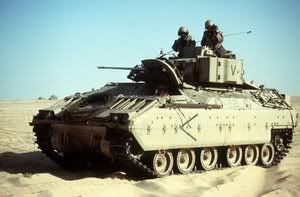
I’m sure you, as did I, looked at a photo of a Bradley Fighting Vehicle while reading Beauchamp’s account of catching the first dog in the Bradley’s tracks. Of course, we both noticed that the Bradley driver sits low in the left front of the Bradley, with a steel hatch cover and a turret completely blocking the view of the right rear area.
We immediately noticed that the only way the driver could "snag its (the dog's leg) under the tracks" would be to have the front of the right track roll precisely over the dog's leg. Why is that? Because a 30-ton Bradley traveling at dog-walk speed cannot make a track bounce into the air to land on a dog's leg.
To further complicate matters, to lurch a slow moving Bradley to its right, you have to almost stop the right track, and let the unbraked left track push you into the right turn.
So now the driver has done something bordering on the impossible. He has caught the leg of a dog he couldn't see in a precise spot of the track where its leg would be wedged and thus caught, and Private Beauchamp adds to the incredulity by observing it all from ...?
From where?
Wasn't Beauchamp inside the Bradley?
What could he see from there?
Further, didn’t we both notice that it is impossible to drag something caught in a Bradley track? Apparently Private Beauchamp is not as observant as you and I, and didn’t perceive that anything caught in a Bradley track could not possibly be dragged, because the portion of the track where the animal was caught would remain on the same spot of ground until it became the rearmost piece of track, and then would suddenly be propelled upwards, then violently forward. Something caught in it might be flung upwards, or if caught firmly be carried upwards and forward, but it could never be dragged.
I’ll bet you also caught that the second dog could not have died in the manner described by Private Beauchamp. Again looking at the photo of the Bradley, we would have noticed its wide track.
“How wide is that track, I wonder?”
A quick Google of “Bradley Fighting Vehicle” got us the answer, didn’t it?
Twenty-one inches wide.
How long is the torso of a dog?
I don’t know about your dog, Mr. Rutten, but my dog Buddy has a very long torso, 28 inches. Even if a dog as large as Buddy were lying squarely across the path of a Bradley, and was struck in its exact center, there would be a 3.5 inch rear portion, a smashed middle, and a front portion with neck and head, with all portions still attached. It is beyond any and all rational belief to think that an animal run over by a 21 inch-wide track on a 30-ton vehicle would have a rear part left that was capable of “twitching wildly,” or a “head (that) was still raised and smiling at the sun as if nothing had happened at all.”
You see, Mr. Rutten, you and I can easily visualize the effect a Bradley track would have on a dog, can’t we? In fact, with our superior logic and experience we know that such a track, hitting the average dog, would in fact smash all of it flat, leaving nothing to twitch wildly or smile at the sun.
Mr. Rutten, I appreciate that your regard for your fellow professionals at The New Republic brought forth your effort to obfuscate this matter and spare them public humiliation and embarrassment at the hands of Bloggers, but the matter is shockingly simple.
If The New Republic editors cannot demonstrate why they did not reject Private Beauchamp’s easily disproven tales, then they were either incompetent or complicit in spreading lies about United States soldiers serving in Iraq.
Isn't it one of the lowest things a journalist could do, engaging in specious reporting and casting aspersions upon the actions of men who are serving their country honorably? Stealing their valor by spreading and sensationalizing false stories?
Clearly there is no room for a third interpretation, and nothing that has happened subsequent to The New Republic publishing the stories can change that.
Trying to drag Drudge in, and posing a series of irrelevant questions about Drudge’s participation, leaves a stink rising from your article like that of a dead red herring lying in the sun.
You see, Mr. Rutten, when the essential elements of a story are false, the story is false. Even when it is reported by someone the Los Angeles Times doesn’t like.
So congratulations, Mr. Rutten.
Now you have brought the Los Angeles Times into solidarity with The New Republic in their public humiliation and embarrassment.
Mr. Rutten does nothing to advance an argument or to make a point, but merely uses the device of listing question after question. The questions have nothing to do with allegations that the 'Baghdad Diarist' articles are untruthful, but are only raised to divert attention from the articles.
It is as if Mr. Rutten thinks that raising questions about the role or motives of Drudge in reporting the allegations that ‘Baghdad Diarist’ stories are false somehow substantiates the stories.
Mr. Rutten, the only thing that would or could substantiate the 'Baghdad Diarist’ stories are the facts contained in the stories, not the pedigree of an aggregator of news stories who selected them for inclusion in his blog.
But as long as we’re asking questions, why not some of you?
Mr. Rutten, why in your Los Angeles Times article did you write that (Army Pvt. Scott Thomas) Beauchamp described "… attempts to run over stray dogs with Bradley fighting vehicles…”?
I assume you actually read the article and noticed that Private Beauchamp described observing another Army private, the driver of a Bradley Fighting Vehicle, killing two dogs with the Bradley, and that Private Beauchamp described both killings in great detail.
Remember?
He (the driver) slowed the Bradley down to lure the first kill in, and, as the diesel engine grew quieter, the dog walked close enough for him to jerk the machine hard to the right and snag its leg under the tracks. The leg caught, and he dragged the dog for a little while, until it disengaged and lay twitching in the road.
You do remember that, right Mr. Rutten?
How about?
A dog that was lying in the street and bathing in the sun didn't have enough time to get up and run away from the speeding Bradley. Its front half was completely severed from its rear, which was twitching wildly, and its head was still raised and smiling at the sun as if nothing had happened at all.
Yet you described that Private Beauchamp wrote of attempts to run over stray dogs, not the killing of the stray dogs that Private Beauchamp described.
Why didn’t you write that Beauchamp described the “killing” of stray dogs rather than “attempts” to run over them?
May I speculate why you chose to mischaracterize what Private Beauchamp wrote?
I believe that you realize, as do I, that only a fool or a someone complicit in Beauchamp’s fanciful reporting would publish his account as fact.
I’m sure you, as did I, looked at a photo of a Bradley Fighting Vehicle while reading Beauchamp’s account of catching the first dog in the Bradley’s tracks. Of course, we both noticed that the Bradley driver sits low in the left front of the Bradley, with a steel hatch cover and a turret completely blocking the view of the right rear area.
We immediately noticed that the only way the driver could "snag its (the dog's leg) under the tracks" would be to have the front of the right track roll precisely over the dog's leg. Why is that? Because a 30-ton Bradley traveling at dog-walk speed cannot make a track bounce into the air to land on a dog's leg.
To further complicate matters, to lurch a slow moving Bradley to its right, you have to almost stop the right track, and let the unbraked left track push you into the right turn.
So now the driver has done something bordering on the impossible. He has caught the leg of a dog he couldn't see in a precise spot of the track where its leg would be wedged and thus caught, and Private Beauchamp adds to the incredulity by observing it all from ...?
From where?
Wasn't Beauchamp inside the Bradley?
What could he see from there?
Further, didn’t we both notice that it is impossible to drag something caught in a Bradley track? Apparently Private Beauchamp is not as observant as you and I, and didn’t perceive that anything caught in a Bradley track could not possibly be dragged, because the portion of the track where the animal was caught would remain on the same spot of ground until it became the rearmost piece of track, and then would suddenly be propelled upwards, then violently forward. Something caught in it might be flung upwards, or if caught firmly be carried upwards and forward, but it could never be dragged.
I’ll bet you also caught that the second dog could not have died in the manner described by Private Beauchamp. Again looking at the photo of the Bradley, we would have noticed its wide track.
“How wide is that track, I wonder?”
A quick Google of “Bradley Fighting Vehicle” got us the answer, didn’t it?
Twenty-one inches wide.
How long is the torso of a dog?
I don’t know about your dog, Mr. Rutten, but my dog Buddy has a very long torso, 28 inches. Even if a dog as large as Buddy were lying squarely across the path of a Bradley, and was struck in its exact center, there would be a 3.5 inch rear portion, a smashed middle, and a front portion with neck and head, with all portions still attached. It is beyond any and all rational belief to think that an animal run over by a 21 inch-wide track on a 30-ton vehicle would have a rear part left that was capable of “twitching wildly,” or a “head (that) was still raised and smiling at the sun as if nothing had happened at all.”
You see, Mr. Rutten, you and I can easily visualize the effect a Bradley track would have on a dog, can’t we? In fact, with our superior logic and experience we know that such a track, hitting the average dog, would in fact smash all of it flat, leaving nothing to twitch wildly or smile at the sun.
Mr. Rutten, I appreciate that your regard for your fellow professionals at The New Republic brought forth your effort to obfuscate this matter and spare them public humiliation and embarrassment at the hands of Bloggers, but the matter is shockingly simple.
If The New Republic editors cannot demonstrate why they did not reject Private Beauchamp’s easily disproven tales, then they were either incompetent or complicit in spreading lies about United States soldiers serving in Iraq.
Isn't it one of the lowest things a journalist could do, engaging in specious reporting and casting aspersions upon the actions of men who are serving their country honorably? Stealing their valor by spreading and sensationalizing false stories?
Clearly there is no room for a third interpretation, and nothing that has happened subsequent to The New Republic publishing the stories can change that.
Trying to drag Drudge in, and posing a series of irrelevant questions about Drudge’s participation, leaves a stink rising from your article like that of a dead red herring lying in the sun.
You see, Mr. Rutten, when the essential elements of a story are false, the story is false. Even when it is reported by someone the Los Angeles Times doesn’t like.
So congratulations, Mr. Rutten.
Now you have brought the Los Angeles Times into solidarity with The New Republic in their public humiliation and embarrassment.
Friday, October 26, 2007
"The New Republic" is Blogger Road Kill
Before I unload, several major bloggers have already nailed down a strong case against the editorial staff of The New Republic.
Here is a very well researched and organized dénouement of The New Republic article by blogger extraordinaire Bob “Confederate Yankee” Owens. (A big hat tip to Captain’s Quarters)
Here is more great stuff Mr. Owens posted on Pajamas Media.
Just as the blogosphere dismembered CBS News and Dan Blather over the Texas Air National Guard forgeries, now The New Republic is paying the price for liberal bias, ignorance of the military, slipshod fact checking, and stone-walling.
Of particular interest to me was the way that expertise on one issue was contributed by readers of the Confederate Yankee blog. The New Republic published an article, Shock Troops, by Army Private Scott Beauchamp, writing from and stationed in Iraq. One of Private Beauchamp’s stories was highly detailed, and in reflection, totally unbelievable.
The story, as told by Private Beauchamp:
The first point that commenters made was that it would be impossible for the Bradley Fighting Vehicle to be used in the way described to kill dogs. Mr. Owens contacted an expert at the manufacturing company and confirmed this. The expert was the same guy The New Republic had interviewed previously to support Private Beauchamp's story. Unfortunately for The New Republic, their fact checker was clueless about military vehicles and didn't ask pertinent questions.
First, the crew of a Bradley includes its commander, a gunner, the driver, and two to six mission soldiers. Beauchamp’s description of the driver, an Army Private, having the capacity to operate the Bradley as his own personal joy ride vehicle to act out his video game fantasies is incredible. Number 1, his commander (riding in the turret) wouldn’t allow it. Number 2, it would make an already very uncomfortable ride totally unbearable for the mission soldiers cramped inside the Bradley, and they wouldn’t let him do it.
Bradley Fighting Vehicle - note driver at left forward, with hatch behind, and turret to right and behind. The driver has a great position to spot something at the right rear, don't you think?
Second, look at the picture of the Bradley, and note that the Bradley driver has a very limited range of view. He would not even be able to see a dog near his tracks, and would not be able to see to the rear at all to appreciate what he supposedly did. Of course, Beauchamp, who wrote that he observed two kills one day, was not the driver, commander, or gunner, and would have absolutely no way to see anything happening outside the Bradley.
Look at the picture of the Bradley. The Bradley driver is on the left front, the soon-to-be-dead dog would be approaching on the right rear.
We have already established that the driver can’t see behind – look at the picture of the Bradley again, and the raised steel hatch lid behind the driver – and the picture also shows that the Bradley turret blocks the driver’s view of the entire right side, all the way to the horizon - and yet Private Beauchamp wrote that the driver would be able to see a dog approaching the Bradley from the right rear, and then be able to swerve the Bradley to the right in such a way as to catch the dog in its tracks.
That’s right. Tracks.
As the Army veterans who commented to Bob Owens noted, in order to swerve a Bradley to the right traveling at low speed – at a speed slower than that of the dog walking up to the Bradley - you have to stop the right track while the left track continues ahead. At low speed the Bradley does not skid suddenly, and it can’t catch anything in its track.
Have you ever watched a track on a rolling tank? You can’t drag anything caught in a moving tank tread. The tread is moving in an endless loop. Look at the picture again and try to visualize where a dog’s leg could be caught in order for it to be dragged. Remember, while the portion of track where the “leg caught” was in contact with the ground, it can't move. Only when that portion becomes the rearmost part of the track does it move, and then it goes up, followed by violently forward.
Not for one moment would anything caught in the track be dragged.
A dog to be caught would have to be very slow, and also deaf.
The Bradley weighs thirty tons, and makes a horrendous noise.
Just the sort of thing to attract every feral dog in the neighborhood to want to run after it and get a piece of it, right?
That brings us to dog kill number 2.
I just measured my dog, Buddy. He has an exceptionally long torso, roughly 28” long, probably placing him in the top five percentile for body length, and much longer than any Iraqi dogs I’ve seen pictured.
The Bradley track is 21” wide.
If a Bradley ran over a normal sized dog, there would no “front half completely severed from its rear.” There would be one dog completely crushed on the road.
Suffice it to say, just looking at one photo of a Bradley gives the lie to Private Beauchamp’s fanciful descriptions of "dogicide."
That still leaves a lot of other details in doubt.
In terms of Private Beauchamp’s description of radio traffic, since radios only allow one set to be transmitting on a frequency at a time, it’s hard for me to visualize how “A roar of laughter broke out over the radio.”
Not only how, but from whence and from whom?
Still, the editors of The New Republic are sticking to their story, but they’re stuck like a deer in the headlamps, and a convoy of bloggers are coming at them at high speed.
The New Republic road kill is on the Blog City Diner menu tonight.
For the many of you fortunate not to have The San Francisco Chronicle as your daily newspaper, the “road kill” and “Blog City Diner menu” are a tribute to the late Chronicle cartoonist Phil Frank, who had a group of black bears running the Fog City Diner, where the critter customers selected from a menu featuring the choicest of the day’s road kill.
"Hey, Bloggers, tonight's special is "The New Republic," grilled and stuffed with crow."
Here is a very well researched and organized dénouement of The New Republic article by blogger extraordinaire Bob “Confederate Yankee” Owens. (A big hat tip to Captain’s Quarters)
Here is more great stuff Mr. Owens posted on Pajamas Media.
Just as the blogosphere dismembered CBS News and Dan Blather over the Texas Air National Guard forgeries, now The New Republic is paying the price for liberal bias, ignorance of the military, slipshod fact checking, and stone-walling.
Of particular interest to me was the way that expertise on one issue was contributed by readers of the Confederate Yankee blog. The New Republic published an article, Shock Troops, by Army Private Scott Beauchamp, writing from and stationed in Iraq. One of Private Beauchamp’s stories was highly detailed, and in reflection, totally unbelievable.
The story, as told by Private Beauchamp:
I know another private who really only enjoyed driving Bradley Fighting Vehicles because it gave him the opportunity to run things over. He took out curbs, concrete barriers, corners of buildings, stands in the market, and his favorite target: dogs. Occasionally, the brave ones would chase the Bradleys, barking at them like they bark at trash trucks in America--providing him with the perfect opportunity to suddenly swerve and catch a leg or a tail in the vehicle's tracks. He kept a tally of his kills in a little green notebook that sat on the dashboard of the driver's hatch. One particular day, he killed three dogs. He slowed the Bradley down to lure the first kill in, and, as the diesel engine grew quieter, the dog walked close enough for him to jerk the machine hard to the right and snag its leg under the tracks. The leg caught, and he dragged the dog for a little while, until it disengaged and lay twitching in the road. A roar of laughter broke out over the radio. Another notch for the book.
The second kill was a straight shot: A dog that was lying in the street and bathing in the sun didn't have enough time to get up and run away from the speeding Bradley. Its front half was completely severed from its rear, which was twitching wildly, and its head was still raised and smiling at the sun as if nothing had happened at all.
I didn't see the third kill, but I heard about it over the radio. Everyone was laughing, nearly rolling with laughter. I approached the private after the mission and asked him about it.
"So, you killed a few dogs today,” I said skeptically.
"Hell yeah, I did. It's like hunting in Iraq!" he said, shaking with laughter.
"Did you run over dogs before the war, back in Indiana?" I asked him."No,"he replied, and looked at me curiously. Almost as if the question itself was in poor taste.
The first point that commenters made was that it would be impossible for the Bradley Fighting Vehicle to be used in the way described to kill dogs. Mr. Owens contacted an expert at the manufacturing company and confirmed this. The expert was the same guy The New Republic had interviewed previously to support Private Beauchamp's story. Unfortunately for The New Republic, their fact checker was clueless about military vehicles and didn't ask pertinent questions.
First, the crew of a Bradley includes its commander, a gunner, the driver, and two to six mission soldiers. Beauchamp’s description of the driver, an Army Private, having the capacity to operate the Bradley as his own personal joy ride vehicle to act out his video game fantasies is incredible. Number 1, his commander (riding in the turret) wouldn’t allow it. Number 2, it would make an already very uncomfortable ride totally unbearable for the mission soldiers cramped inside the Bradley, and they wouldn’t let him do it.
Bradley Fighting Vehicle - note driver at left forward, with hatch behind, and turret to right and behind. The driver has a great position to spot something at the right rear, don't you think?
Second, look at the picture of the Bradley, and note that the Bradley driver has a very limited range of view. He would not even be able to see a dog near his tracks, and would not be able to see to the rear at all to appreciate what he supposedly did. Of course, Beauchamp, who wrote that he observed two kills one day, was not the driver, commander, or gunner, and would have absolutely no way to see anything happening outside the Bradley.
Occasionally, the brave ones would chase the Bradleys, barking at them like they bark at trash trucks in America--providing him with the perfect opportunity to suddenly swerve and catch a leg or a tail in the vehicle's tracks.
Look at the picture of the Bradley. The Bradley driver is on the left front, the soon-to-be-dead dog would be approaching on the right rear.
We have already established that the driver can’t see behind – look at the picture of the Bradley again, and the raised steel hatch lid behind the driver – and the picture also shows that the Bradley turret blocks the driver’s view of the entire right side, all the way to the horizon - and yet Private Beauchamp wrote that the driver would be able to see a dog approaching the Bradley from the right rear, and then be able to swerve the Bradley to the right in such a way as to catch the dog in its tracks.
That’s right. Tracks.
As the Army veterans who commented to Bob Owens noted, in order to swerve a Bradley to the right traveling at low speed – at a speed slower than that of the dog walking up to the Bradley - you have to stop the right track while the left track continues ahead. At low speed the Bradley does not skid suddenly, and it can’t catch anything in its track.
The leg caught, and he dragged the dog for a little while, until it disengaged and lay twitching in the road.
Have you ever watched a track on a rolling tank? You can’t drag anything caught in a moving tank tread. The tread is moving in an endless loop. Look at the picture again and try to visualize where a dog’s leg could be caught in order for it to be dragged. Remember, while the portion of track where the “leg caught” was in contact with the ground, it can't move. Only when that portion becomes the rearmost part of the track does it move, and then it goes up, followed by violently forward.
Not for one moment would anything caught in the track be dragged.
A dog to be caught would have to be very slow, and also deaf.
The Bradley weighs thirty tons, and makes a horrendous noise.
Just the sort of thing to attract every feral dog in the neighborhood to want to run after it and get a piece of it, right?
That brings us to dog kill number 2.
The second kill was a straight shot: A dog that was lying in the street and bathing in the sun didn't have enough time to get up and run away from the speeding Bradley. Its front half was completely severed from its rear, which was twitching wildly, and its head was still raised and smiling at the sun as if nothing had happened at all.
I just measured my dog, Buddy. He has an exceptionally long torso, roughly 28” long, probably placing him in the top five percentile for body length, and much longer than any Iraqi dogs I’ve seen pictured.
The Bradley track is 21” wide.
If a Bradley ran over a normal sized dog, there would no “front half completely severed from its rear.” There would be one dog completely crushed on the road.
Suffice it to say, just looking at one photo of a Bradley gives the lie to Private Beauchamp’s fanciful descriptions of "dogicide."
That still leaves a lot of other details in doubt.
In terms of Private Beauchamp’s description of radio traffic, since radios only allow one set to be transmitting on a frequency at a time, it’s hard for me to visualize how “A roar of laughter broke out over the radio.”
Not only how, but from whence and from whom?
Still, the editors of The New Republic are sticking to their story, but they’re stuck like a deer in the headlamps, and a convoy of bloggers are coming at them at high speed.
The New Republic road kill is on the Blog City Diner menu tonight.
For the many of you fortunate not to have The San Francisco Chronicle as your daily newspaper, the “road kill” and “Blog City Diner menu” are a tribute to the late Chronicle cartoonist Phil Frank, who had a group of black bears running the Fog City Diner, where the critter customers selected from a menu featuring the choicest of the day’s road kill.
"Hey, Bloggers, tonight's special is "The New Republic," grilled and stuffed with crow."
Subscribe to:
Posts (Atom)