Showing posts with label Travel. Show all posts

Tuesday, March 21, 2023

Witnesses to Flight Rage!

         Our relaxing ten-day Barbados vacation ended March 8 when we boarded American Flight 1192 at 4 pm bound for Miami on a three-and-a-half-hour flight in comfortable First Class, row 3, seats A and B. The first two hours passed uneventfully. I read our Gualala Rotary book club selection, Ireland: A Novel, by Frank Delaney, on my iPhone, and Alice read a Barbados newspaper borrowed from a large, genial fellow, seated just in front of me. At sone point Alice remarked that a fellow in the first row, far left seat (seat D), was laughing often and quite loudly. 

Just past the two-hour mark I stood up and stepped into the aisle to let Alice go to the restroom located forward on the left of the cockpit door. Alice asked the two fellows from row one, who were standing in the Flight Attendant galley area, if they were in line for the bathroom and they said they weren’t, so Alice continued to the restroom and entered. 


Then the fellow who had been laughing, now standing in the galley area, started arguing with the male and two female flight attendants who were trying to work there. They told him to go back to his seat and he loudly refused. Then he pushed towards the door to the cockpit and the flight attendants continued to order him to return to his seat.


One of the female flight attendants left the galley area with a roll of duct tape and handed it to a passenger, a large man seated a row behind me. He took the duct tape and came up the aisle towards the front. On his way forward he recruited the big guy seated in front of me and an even bigger Polynesian guy seated across from me to go with him to control to troublemaker. As they passed I got up and stood behind them to see if Alice was in danger.


I saw the bathroom door open and Alice started out. She saw me and later told me that she had never seen me so worried. As she started to leave the bathroom she was afraid that there was a terrorist attack. A female flight attendant saw Alice exiting the bathroom and told her to go back in, which she did without asking the attendant why. 


The three large men confronted the angry man and told him to either get in his seat or be put in it by force and duct taped to it. The trouble maker continued angrily and obscenely to refuse to take his seat and the three men replied – with a few choice obscene words of their own - that they would make him take his seat. 


The impasse ended abruptly when the Polynesian guy suddenly grabbed the fellow and slammed him into his seat. This inspired him to protest very loudly while the three men demanded that he stay in his seat and shut up or be shut up. The shouting abruptly halted when the fellow realized that he was sitting on broken glass. The wine glass he left at his seat when he went to argue with the flight attendants shattered when he was thrown into his seat. He quietly got up and stood at his seat while a flight attendant removed the broken glass and wiped up the spilled wine with a white towel, then went to the restroom and told Alice to come out in order that the cleanup could be completed in the bathroom. 


When Alice saw the towel she thought that it was bloody and was relieved to find that it was just red wine. Alice weaved her way through the “big guys” still standing in the aisle and returned to her seat next to me. 


The remainder of the flight was uneventful until we landed in Miami and taxied to the gate and the ramp was attached. When the aircraft door was opened a uniformed policeman entered the plane and stood in the aisle near the troublemaker. A wheelchair was then brought for an elderly woman in the right seat of the first row, and she and her attendant who was sitting behind her and just in front of Alice left the plane. 


The policeman began asking questions about what happened, who was involved, and if anyone would volunteer to accompany him to an office area in the terminal to make a formal statement. Several passengers volunteered that they had videoed the incident on their smart phones and would transmit their videos to an address the policeman provided. 


The policeman then told the perpetrator to stand up with his hands behind his back and be handcuffed. The Polynesian fellow identified himself as the person who physically acted and arranged to give a statement in time to make his connecting flight. 


The process with the policeman lasted about twenty minutes and finally we were all allowed to exit the plane. When Alice and I left the plane we passed by the handcuffed fellow leaning against a wall in the hallway in the company of six policemen. His plight inspired me to think about his coming day in court. Not too many years ago, in similar circumstances, he could have denied doing what he was accused of and many people would have to be brought from far away at great personal expense and inconvenience to testify against him. Now everything he did and said is recorded in several videos; there is no need to have witnesses try to remember and describe all that they saw and heard in such a confused environment. 


It's plea bargain time!

Thursday, January 29, 2009

Dental Implants in Hungary - Not a good idea

Unfortunately, my implant holiday in Hungary did not work from a dental point of view. The upper left implant fell out a month after our return, and when I contacted The Implant Center, they mailed me a screw to be inserted while they repaired the implant and mailed it back to me. The screw was too big. By the time they mailed me the correct size, the hole in my gum had grown closed.

Then my dentist gave me more bad news. "The two upper right implants are mobile. They've failed, and it's just a matter of time before you lose them too."

I gingerly checked them, and they moved a lot side to side. So did the bottom right impant. "They should be very firm, not mobile like that," my dentist said.

The bottom line is that concerning my teeth, I'm worse off now than before I got the implants. It won't be long before all I have are the anchors embedded in my jaws, with no implants in them. Also, the anchors are not compatible with any fixes or repairs I could get in the United States, and there is no reason to believe I could get the dentists in Hungary to make them work any better than they do now. Now with each bite I expect an implant to pop out.

Sometimes saving money can get mighty expensive.

Tuesday, December 16, 2008

Our 2008 Christmas Letter


Alice and I were walking Buddy to Cook’s Beach, about 15 minutes away, and I realized I hadn’t started our Christmas letter. What to write about? Travel! Of course! Question: “Alice, besides the two weeks in Guatemala, can you remember anything else?”

After about half a minute of silent walking: “We visited Carol on Maui in January, and then we went to Peleliu for a week. Remember when we were leaving and you asked who won the Super Bowl, and a woman said the New England Patriots? Two days later you learned it was the Giants.”

“That’s right. New York. New England. Very confusing. Then what?”

“We went to Istanbul for a week, then over a week in Budapest for your four teeth implants. It’s a shame that one fell out a month later. On the way back we stopped in New York for ‘Wicked,’ ‘Phantom,’ ‘Chicago,’ Sunday services at the Abyssinian Baptist Church of Harlem, and a day in the American Museum.”

“The Baptist church choir, ’Phantom’ and ‘Chicago’ were great. It’s a pity ‘Wicked’ wasn’t. I hope that implant can be fixed without a third trip to Budapest. Anything else?”

“Well, in early July went to Temecula for your oldest son Bruce’s and Lisa’s marriage.”

“Of course I remember,” I said, realizing I’d forgotten until Alice reminded me. I congratulated myself that at least I remembered that we went to Guatemala City, Antigua, and the Mayan ruins at Tikal for two weeks in early September. While in Antigua, we hiked several miles up and down an active volcano, periodically in driving rain, with a group of a dozen Israeli students, all much younger than our children. Guatemalan cowboys followed us for most of the hike up. “Taxi?” they kept asking us, waiting for us to wear out and rent their horses. We didn’t, and we kept up with the youngsters.

“Anything else happen?” I asked.

“Well, you know, the President thing,” Alice replied.

“Of course, how could I forget?” Actually, I hadn’t. With all the hours we put in, there’s no way I would forget that Alice is now her Book Club president, and that I’m the president of Gualala Rotary.

2009 will be a bit quieter. We plan a driving tour to Yellowstone and Mount Rushmore in May. Then in November, when I should be writing our Christmas letter and mailing the cards on time, we’ll be in India for three weeks. Needless to say, I’ll be in the usual last minute panic to get our cards out, the same as always.

It’s a family tradition.


Alice, Michael, and Buddy

Wednesday, September 24, 2008

How 'Ya Gonna Keep 'Em Down on the Farm?


How 'Ya Gonna Keep 'Em Down on the Farm? (After they've seen how the other half lives)


You notice many things while travelling in foreign countries that should be obvious, but just never come to mind while living in the United States. Last month in Guatemala my attention was drawn to farming.

When I was born in 1942, about twenty percent of Americans lived on farms. Now the number is only two percent, and the number of farms has shrunk from six million to two million. Conversely, the average farm size more than doubled, and farmers produced even more food at a cheaper cost to consumers on roughly the same amount of farmland. Scientific advances, mechanization, and specialization all contributed to increased productivity, and have made United States farmers the most productive and efficient in the world.

Much of the third world is going the other direction primarily because of their continuing population explosion. More people living on the same amount of land means less land to support each person. Farming in the United States never faced that dilemma, because the Industrial Revolution provided an outlet for the surplus farm population.

In fact, industrial needs were so great that scientific advances, mechanization, and specialization were driven as much to overcome farm labor shortages as they were to improve productivity. Even with the rapid improvements in farming methods, farm labor continued to be in short supply resulting in the “Wetback Movement” (commemorated by Lalo Guerrero and his masterpiece, "The Ballad of Pancho Lopez") and later what is now referred to as undocumented immigration.

Third world cities, on the other hand, can’t absorb their farming population surpluses effectively because they have neither the capital nor do they produce sufficient energy to meet the employment needs and living standards of their burgeoning urban populations.

However, that doesn’t mean the rural poor are content to stay on their farms just because their cities don’t have much to offer. The World War I song, "How 'Ya Gonna Keep 'Em Down on the Farm? (After They've Seen Paree)” can be applied to the rural poor in undeveloped countries. They don’t have to travel anywhere to “see Paree.” They see Paree, and LA, and New York, and London, and the other exciting world cities on TV every day. If their own county’s major cities can’t satisfy their dreams of a better life, they soon learn that they can join the ranks of the undocumented immigrants.

Hello, Los Angeles! New York! London! Amsterdam! Paris!


How do growing populations increase the number of farms and shrink their size?

I already explained how the Industrial Revolution caused the opposite in the developed world. Unfortunately, the Industrial Revolution bypassed the countries that are home to over half the world’s population.

Suppose a farmer has ten acres, and suppose he and his wife have ten children, five boys and five girls. Because of the small size of the farm, the lack of powered farming equipment and seeds to grow scientifically improved crops, and the great distance and lack of transportation to get crops to markets, the farm is diversified and primarily produces for consumption by the farmer and his family. If the farm was larger, and access to markets was better, the farmer could specialize and grow a cash crop. But that’s not the case.

The farmer has chickens, maybe a cow, probably pigs. He has to devote some of his time, land, and crops to them, because they will provide what little protein he and his family consume. Then there are the beans and corn, nutritious and filling staples that do well in storage if the farmer is careful. During harvest periods, the farmer will have tomatoes and other vegetables in excess that don’t store well. He can sell or trade his excess, although all his neighbors also have excesses of the same crops at the same time he does.

As the farmer’s children grow, their help with the work in the house and field is very useful, since the work requires physical labor because of the lack of powered farming equipment. However, at some point each child grows to be more of a burden on the family food supply than an asset. Fortunately for the farmer, at that point each girl is old enough to get married and leave to live with her husband’s family.

It’s the boys that are a problem. They’re going to stay, and want to get married, and add their wives and children to the growing burden on the land. Further, each new, young family will want to have part of the farm for their own purposes. The ten-acre farm that barely supported one farmer and his family becomes five two-acre farms supporting five young families and the aging farmer and his wife.

After this has repeated over several generations, and the population has far exceeded the carrying capacity of the land, a revolution is necessary for land reform to take it from the rich and redistribute it to the poor, because the rich won't just give it away.
Zimbabwe provides the best current example of this. The rich landlords are killed or driven away, and their land divided amongst the poor. However, the poor still don’t have access to capital and skills to improve their farm productivity, and the former owners and their capital and skills are gone. Also gone are the wages that were paid to the workers and the contracts the former owners had to sell their specialized and abundant produce to multinational corporations.

Soon the poor farmers are back where they were before the revolution, only worse off because the country’s fund of capital, jobs, and skills has shrunk, and the aura of political instability will keep it that way.

Friday, September 12, 2008

Che Lives! (In Our Colleges, Anyway)


Che Lived! Che Lives! Che will never die!


Che lives. But in Guatemala, Che only lives on T-shirts sold in T-shirt shops which are usually located next to a McDonalds, a Burger King, Domino’s Pizza, etc., or a distinctive and very successful Latin-American fast-food chain founded in Guatemala over thirty years ago, Pollo Campero.


The face of Che is ubiquitous, but his beliefs aren't.


“Communism was a great system for making people equally poor. In fact, there was no better system in the world for that than communism.” Extolling Globalization, Thomas L. Friedman wrote this in “The World is Flat,” and added that “Capitalism made people unequally rich.”


Besides totally agreeing with Friedman, I would extend his assessment to communism’s bastard step-child, socialism, and add that capitalism succeeds wherever it is tried.


Of course there are many true believers in Communism, but few of them live in the former citadels of Communism, the Soviet Union and China. Even most North Koreans and Cubans have lost their Marxist zeal; they saw their countries go from the theory of the dictatorship of the proletariat to the deification of dictators. But now the Gods of Communism are either dead, discredited, or disregarded: Marx, Engels, Lenin, Stalin, Kim Jong Il, Mao, Castro, and Kim Il Sung.


I've seen some of their statues already on junk piles, and look forward to see others added to the trash heap of history. How delightful to think of Mao in his mausoleum observing China's mad race down the capitalist road Mao devoted his life and the deaths of a hundred million Chinese to stop.


Now the only place communism and socialism are valued and revered are amongst ignorant and illiterate peoples of undeveloped countries, and in the halls of academia amongst Progressive economists, environmentalists, and anti-Globalizationists.


They and Che are good company.

Thursday, September 11, 2008

A Swinging Time in Guatemala


Alice and I went to Tikal for a few days, and enjoyed our tour of the Mayan ruins. We stayed at a very nice hotel in the National Park. It had a very nice swimming pool, and I still have a small cut on my forehead where I banged my head against the wall when a horrible sound woke me from dead-tired sleep in the middle of the night. When I found our flashlight, and stopped the bleeding, I went out to investigate.

In and around the swimming pool were several small frogs; their bodies were only about two inches long. I could not believe the crashing, ear-drum smashing sounds they were producing. I kicked a couple into the water, thinking it might scare the rest to shut up. It didn't.

I put ear plugs in, to little avail. Then suddenly, they stopped. Deafening silence.

For awhile I couldn't go back to sleep. I couldn't stop listening for them to start again.

Our second day we took a short trip to the edge of the park to slide suspended from cables through the rainforest canopy for a total of over two kilometers. The adventure sounds very ecologically and environmentally proper: communing with the rainforest canopy, and its canopy dwelling creatures.

Actually, it is primarily an adolescent thrill ride, but this realization didn't put Alice and I off this adventure for even a moment. We were rigged into our harnesses, clambered up stairs and ladders to a platform high in a tree, and soon found ourselves gliding rapidly under the forest canopy, suspended from a wheel running on a cable. Our gloved right hand rested on the cable behind us to keep us from spinning, and when we got near our destination platform, we used it to press down on the cable to slow us down.

On our first slide, Alice pressed a bit too much a bit too soon, and stopped short of the platform, but one of our young guides quickly pulled her in. On the other hand, I had to press down very hard and slow myself quickly because I came in very fast. Alice was certain that my much greater weight gave me much higher speed.


At any rate, we continued through the rainforest in hundreds of meters increments, climbing from each destination platform to the next lauching platform high above.


We tried to squeeze some ecological and educational tidbits from our experience, but the only time we noticed Nature above and around us was during the periods on the platforms. Once we launched, we focused on getting to the next destination platform smoothly and safely.

One of our guides, Felix, borrowed our camera and took photos of us sliding along, plus a couple shots of some howler monkeys that were probably amused watching us.

Wednesday, September 10, 2008

Hot Time in Guatemala


Alice admires the flowing lava


This is one way to dry clothes fast!


What do two 66-year old Americans have in common with a dozen Young Israelis?

Actually quite a lot. One they got over the fact that Alice and I were two to three times older than anyone else in our group, we walked three kilometers together up the side of an active volcano (Mount Pacaya, Guatemala), were pelted by torrential rains, stood on cooling lava next to a steadily flowing stream of red-hot lava (it put off enough heat to almost dry some of our soaking wet clothes), and then we hiked the three kilometers back to our bus in the dark, and for part of the way, through more rain.

Alice and I came out rather well, considering how heavy the rain was, since we both had thick ponchos that Alice insisted we take. I no longer thought taking them was silly, and I used mine in combination with an umbrella. The young Israelis had neither ponchos nor umbrellas, and soon were totally soaked. However, when our guide asked us if we wanted to take a break under a shelter and wait for the rain to stop, we all voted to press on.

The rain finally did abate just before we got to the lava fields, and never became heavy again on our way back through the dark.


It was almost 8PM, when we got back to the trail head. As we waited in a small cafe to get back on our bus, we exchanged many stories. Mine were about the heavily pro-Israeli slant of Strong Ox etc., particularly during the Israeli-Hezbollah (Lebanon) War. Alice handled the personal and religious issues: the young people were secular, but believe in God; they had just visited the US - San Francisco, Tahoe, Yosemite, the redwoods, San Diego, and the Grand Canyon; they ate all kinds of food, including pork, and noted that an Orthodox Jew could not do their travels, because they would starve.

After an hour traveling back on the bus, it was almost 9PM when a police roadblock stopped us and informed us: "Pasa no." As the driver turned around, the significance of the earlier heavy rainfall struck us; the rain hadn't fallen only on the high slopes of Mount Pacaya. We realized we would be on the bus at least another hour before getting back to Antigua and our hotel rooms, showers, and warm, dry clothes.

And food!

Just as despair became deeply entrenched in our wet, cold, starved group, we got to share another experience. Our bus driver pulled into a Burger King on the outskirts of Guatemala City, and we all hurried in to order Whoppers with cheese, french fries, and Pepsis (Supersized). More lively chatter soon returned, and when we reboarded the bus all were remarkably revived.

Soon we were back in Antigua, and our bus driver distributed us among our hotels. I grabbed a quick shower and fell asleep, and Alice took one of her liesurely hour-long baths.

We woke up refreshed, with no pains except regret that our shoes were still soaked, and that the volcanic ash had blackened our pants legs and socks. We hope the hotel laundry can work miracles on the pants, although I doubt my white socks will ever be white again.

On to the next adventure!
(I hope our shoes dry fast)

Wednesday, May 21, 2008

There Will Always be an England, Always Muddling Through

We showed up for our bus from the Heathrow Holiday Inn at 4:15 AM, and it showed up at 4:45 to take us to Heathrow for a 7:05 departure. Not to worry.

I had double-checked at the Holiday Inn desk that our flight on British Airways to Istanbul at 7:05 would leave from Terminal 1. When we got to Terminal 1, we found a long line of passengers waiting at the locked gate to the British Airways check-in area. At one side was another line, this one of British Airways employees waiting to go to work. No one had the key. Not to worry.

Finally the door was unlocked and we streamed inside, British Airways employees to one side of the check-in counters, passengers to the other. I asked an British Airways agent who appeared to be directing traffic where Alice and I should start. She informed us that we should start in Terminal 5, because British Airways flights to Istanbul no longer leave from Terminal 1 - and hadn’t for a long time. Not to worry.

If we passed back through Terminal 1 we would find a lift - elevator - to take us to the Express Train to Terminal 5. As we and several other distraught passengers wandered down a long corridor to the Express Train to Terminal 5, a Heathrow transportation specialist informed us that the trains were not running at the moment. He suggested we walk back partially through Terminal 1 and take the Underground to Terminal 5. Not to worry.

Fortunately a “wisdom of the crowd” enabled our group of confused and distraught passengers to make the correct turns and reach the Underground - Subway - to take us from Terminal 1 to Terminal 5. It is amazing how a group of people, not one of which knows the way through new territories, finds its way unerringly. Unerringly may not be a good word to use in context of going to the latest airport wonder of wonders, the infamous Heathrow Terminal 5, which commanded banner headlines for weeks after its opening two months ago because of the monumental foul-ups passengers and their baggage suffered in and through it. Not to worry.

We were in Terminal 5, human guinea pigs in the development of a new world being, World Traveler. Among many things, World Traveler will know how to do much travel processing itself. For example, it will know to go to small kiosks, scan in a passport page, and punch in flight information that will cause the production of boarding passes and other apparently necessary and perhaps even useful pieces of paper. From there you take it all to a Fast Bags station, where an attendant examines the papers and places a baggage tag on each piece of checked luggage.

Then we were directed to Security South, apparently because it was much farther away than Security North, where we tried to enter only to be chased away to the South. At this point I became alarmed about not having a gate assigned for our flight, and was told we would get it after Security. Not to worry.

The Security posts were all manned by Indians, Pakistanis, and South Africans, which meant they were all better and clearer speakers of English than our English speaking citizens working in Airport Security stateside, and far more polite.

We quickly exited Security, still without a gate assignment. Our flight number 678, British Airways to Istanbul, was on the board, but with no indicated gate. So with less than an hour to go to takeoff, we went to a snack shop for a light breakfast with a good view of the departure board. Not to worry.

As we finished breakfast, our gate assignment appeared, A20, only a short block equivalent away. I began to not worry.

All went well. Our hotel sent a driver who met us at the Istanbul Airport and whisked us to the Sumengen Hotel, three blocks from the Blue Mosque and only a couple more blocks to Aya Sophia. Suddenly all is easy and relaxed, and that worries me.

Monday, February 18, 2008

Crosses to Bear

Alice and I just returned from a wonderfully relaxing and educational vacation on Peleliu, in the Palau archipelago. The snorkeling, hiking, and biking, the reading and relaxing, the fresh fish, cocoanut crab, and chicken adobe were all a part of the relaxing.

The education came from looking at the evidence that peaceful and idyllic Peleliu was the site of the bloodiest battle of World War II. In a two-month period beginning September 1944, tiny Peleliu (six to twenty-four square miles, depending on how you measure the mangrove swamps) hosted the deaths of 1,800 Americans (1,500 Marines and 300 Army), and almost every last one of its 11,000 Japanese soldier occupying force.

To put these numbers in perspective, more Americans were killed in less than two full months on Peleliu than were killed in the first two full years of fighting in Iraq, and the 1,800 dead are more than half the total killed in combat in Iraq since the war began five years ago.

With all the killed, I went to look for the crosses marking or commemorating their deaths.

Photobucket

We found this one on the Peleliu Evangelical Church, just across from our bungalow in Storyboard Beach Resort.

About a half mile south we found a cemetery with many crosses, but none seemed to have anything to do with the epic battle to wrest Peleliu from the Japanese in 1944.

Medal of Honor memorial, Peleliu,Alice

Near Bloody Nose Ridge, the scene of the bloodiest fighting, we found this modest memorial to American combat dead. On this face of the memorial are listed Medal of Honor recipients; five of the eight were awarded posthumously.

Alice,US tribute to Japanese soldeirs killed

Nearby was a less modest Shinto shrine, a memorial to Japanese dead. You can get a good idea of size when you compare Alice standing in the middle of this Japanese shrine to her standing by the Marine memorial.

At the rear right center is a plaque shown in the following picture that reads: “Tourists from every country who visit this island should be told how courageous and patriotic were the Japanese soldiers who all died defending this island.
Pacific Fleet Commander in Chief (USA) C. W. Nimitz (Built Nov. 24, 1994)”


Photobucket

Where are the crosses?

Alice and I had walked and biked all over Peleliu and hadn't found any crosses marking the final resting places of almost 2,000 brave Marines and GIs.

Photobucket

These are the crosses in the Marine cemetery on Iwo Jima, with Mount Suribachi in the distance. American casualties on Iwo Jima were greater than the total Allied casualties at the Battle of Normandy on D-Day. This photo was taken in 1945. Those killed in the battle for Peleliu in 1944 wouldn’t be buried here.

Photobucket

They were probably buried in Punchbowl Military Cemetery on Oahu, with a cross or Star of David on the grave marker. Punchbowl was one of the most popular stops for Japanese tour groups when I was stationed at Hickam Air Force Base 1978-1982.

Photobucket

Anti-war activists have placed crosses (and Stars of David, but apparently no Islamic crescents) for US soldiers killed in Iraq on a hillside across from the BART (Bay Area Rapid Transit) station in Lafayette, California, which is about 20 miles east of San Francisco.

I’m grateful that there are so few.

During the last year of LBJ’s presidency, more Americans were killed in each two-month period in Vietnam than in five years of combat in Iraq.

Photobucket

A Cuban-American walks next to crosses in a symbolic cemetery at the Tamiami Park in Coral Gables, Miami February 16, 2008. Cuban exiles placed more than 10,000 crosses in the park to honor loved ones who died fighting Castro's government or trying to cross the ocean to the United States.
REUTERS/Carlos Barria


I wonder who is putting up crosses for the hundreds of thousands killed in Sudan by Muslim terrorists, Stars of David for the thousands of innocent Israeli civilians slaughtered by Palestinian suicide bombers, or crescents for the hundreds of thousands of Muslims killed by other Muslims all over the world?

The attention of the American press given to symbols of grief and commemoration seem very selective and only involve anti-Bush activists. The greater suffering in the rest of the world is ignored.

Photobucket

Christians and Muslims join together to repair a cross on a church in Baghdad.

Some crosses are easier to bear.

Friday, October 12, 2007

Instant China Expert

Photo Sharing and Video Hosting at Photobucket
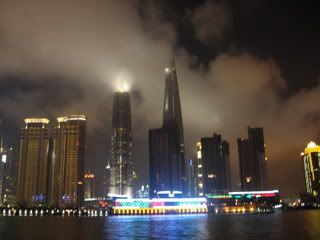
Shanghai by Night

Alice and I just returned from three weeks in China, and as you might expect, I am now an expert in matters Chinese (at least as how China will impact the future).

The first point is that China is not going to risk or provoke war with the United States, for the simple reason that China has nothing to gain, and everything to lose. To paraphrase Kris Kristofferson, “Freedom (to take risks) is just another word for nothing left to lose.”

Where is my proof?

One word. Shanghai.

Our incredibly competent, hard working, and industrious (entertaining, too) tour director, Comrade David (a Party member), informed us that the city bird of Shanghai was the crane – the construction crane. In twenty years Shanghai went from a city with its tallest building 26 stories high, to a city with over a thousand buildings over 26 stories. Most of the building boom, which continues, occurred between 1995 and 2000, causing a world-wide shortage of construction cranes.

More proof needed? Beijing, Chongqing, Xi’an, Guilin, Hong Kong, Macao, and hundreds of places in between and around. Places I’ve heard of, more that I hadn’t, and a huge number that I still know nothing about, and all of them putting a “Chinese face on socialism.”

As Alice gently chided David, the Chinese socialist face looks decidedly capitalist.

David, his modest salary augmented by generous tips (which he richly deserves), smiled inscrutably.

The old state-owned businesses, many owned and operated by the People’s Liberation Army, have failed or are failing. Many Communist Party bosses are known more for ineptness and corruption than enlightened management. So who or what is responsible for China’s spectacular growth?

Quite simply, the Chinese people.

They have a remarkable capacity to work hard at difficult jobs. China’s rapidly growing per capita GDP of about $2,000 is still very low (in the bottom half) among world economies, but the private sector already produces 70% of the total and its share is steadily increasing.

Of course, Chinese growth is not occurring in an economic vacuum. Those high rises on the Shanghai waterfront house banks and businesses with familiar international names. The Chinese economic miracle is built on foreign investment, and exports to fill the West’s demands to consume prodigiously, but inexpensively.

The Chinese themselves are reluctant consumers, just as the Japanese were during their brief period of seeming economic invincibility. Chinese reluctance to spend is understandable. David grudgingly agreed with Alice that the United States fits the model of socialist welfare state much better than China. Chinese government pensions are and will continue to be nasty jokes on China’s elders that thought Communism would reward their sacrifices and provide for them in their Golden Years.

(Most of the old State-Owned Enterprises are operating at a loss, and can barely meet their obligations to pay current retirees. When inflation is added to the picture, the payments to current retirees are rendered meaningless.)

“From each according to his abilities, to each according to his needs.”

Right?

Old people have diminishing abilities coupled with increasing needs. So how does Communist China take care of them in their Golden Years? By passing a law that children must support their parents (and parents can sue if they don’t). Of course, prior to passage of this law, Communist leaders also passed a law that basically limits each couple to one child (with some exceptions, so don’t nit pick me). So now you have two elderly parents depending on one child (who, with a spouse, is also supporting themselves, a child, and the spouse’s elderly parents).

The typical Chinese young working couple is also paying into a pension fund, which is being eaten by inflation while being squandered though corruption and mismanagement.

No wonder all but the wealthiest Chinese save all they can, and why Chinese consumption alone can’t power economic growth until the Chinese can see that their savings and investments will secure their futures.

The Chinese will have Privatized Social Security long before we do, and for the right reasons – principally, economic necessity. And while they’re doing the thing right, our bankrupt Medicare system will be joined in a decade by our already actuarially bankrupt Social Security system, and ruinous tax increases, benefit cuts, financial means testing, and rationing of medical care will be required in a vain attempt to avert total government-funded retirement system failure.

However, the tax increases and benefit cuts necessary to attempt to salvage Social Security and Medicare will only kill our economy and make matters worse.

To bring it all down then, in three short weeks I learned that China is not a military threat, but thanks to the West is an economic juggernaut. I learned that China will not sacrifice the economic progress of its predominantly impoverished citizens on the altar of environmentalism – every place we went in China had air pollution worse than Los Angeles at its smoggiest.

Things I knew before the trip – China has Pandas, the United States has pandering politicians.

The Chinese are doing all they can to save their endangered Pandas.

Our industrious citizenry are continuing to create and grow our incredibly strong economy, but our politicians are not doing anything to prevent it inevitably drowning under a sea of unsustainable social welfare expenditures.

Long before natural global warming floods our coastal cities, we’ll drown under a sea of red ink.

When Al Gore was VP, he didn’t do anything to forestall future disasters, and he still isn’t.

The fact that he was an inept leader uniquely qualifies him, in the eyes of the Nobel Prize committee, for its Peace Prize.

Just as the Nobel previously saw fit to award the corruption of Yasser Arafat, and the ineptitude of Jimmy Carter.

In China, Chairman Mao is turning over in his mausoleum.

Chairman Mao: “If inept leadership is all it takes, I deserve one for the Cultural Revolution. One decade of Cultural Revolution set back Chinese industrialization two decades. Not even Jimmy Carter could screw things up that bad.

Kim Jong-Il deserves one.

Fidel deserves one too.

Jimmy Carter has the credibility in the inept leadership realm to write the nominating letters.”

Note to the Nobel Prize Committee. You should award Chairman Mao posthumously. He would graciously share it with Fidel and Kim Jong-Il.

Dead totalitarians are very accommodating.

Friday, September 07, 2007

Dental Implants in Hungary

UPDATE: Unfortunately, my implant holiday in Hungary did not work from a dental point of view. The upper left implant fell out a month after our return, and when I contacted The Implant Center, they mailed me a screw to be inserted while they repaired the implant and mailed it back to me. The screw was too big. By the time they mailed me the correct size, the hole in my gum had grown closed.

Then my dentist gave me more bad news. "The two upper right implants are mobile. They've failed, and it's just a matter of time before you lose them too."

I gingerly checked them, and they moved a lot side to side. So did the bottom right impant. "They should be very firm, not mobile like that," my dentist said.

The bottom line is that concerning my teeth, I'm worse off now than before I got the implants. It won't be long before all I have are the anchors embedded in my jaws, with no implants in them. Also, the anchors are not compatible with any fixes or repairs I could get in the United States, and there is no reason to believe I could get the dentists in Hungary to make them work any better than they do now.

Now with each bite I expect an implant to pop out.

Sometimes saving money can get mighty expensive.

“There’s no place like home, there’s no place like home. (Click, click)”

Alice and I love travel, and we love being home. The part of travel that makes it so easy to love our home in Gualala so much is the beginning and end of each trip. We usually stay a night or two, going and coming, with Alice’s two lovely daughters and their delightful families in Walnut Creek.

However, we can’t magically teleport from one place to the next, so we take our only practical option, and drive. So do millions of San Francisco Bay Area residents and commuters. We all congregate on the freeways, and see how successful we can be at not getting anyplace in a reasonable period of time.

When we got back from our Hungary trip on Friday, August 31, and checked into our hotel in South San Francisco, we heard an announcement that the Bay Bridge was closing for three or four days to complete repairs to a section. The next day our thirty minute trip to Walnut Creek took three hours.

The Hungary trip was a dental holiday. About a year ago I saw an item on the Internet about the high quality and low cost of Hungarian dentistry. The article caught my attention because I had just lost another two teeth as a late payment for the sins of growing up poor far from dental practitioners. By the time Point Arena got a dentist in the late 1950s, I was sixteen years old and needed many fillings and one molar extracted that was too decayed to save. As the years passed, I lost another seven teeth for a total of eight missing, five upper rear and three lower rear.

As luck, and dental neglect would have it, the teeth I lost did not lend themselves to logical or easy replacement via bridges or dentures. When that realization sunk in, then the thought of implants arose. I went to a specialist in Santa Rosa and found him eager to put in three implants for about $15,000, and then let a regular dentist add the crowns for another $2,800.

It would cost me $17,800 to get one implant upper right, one upper left, and one lower right. That would still leave a significant gap upper right. A fourth implant would close the gap, but add about $5,000 to the cost for a total of almost $23,000.

That’s when the article about high quality, inexpensive Hungarian dentistry grabbed my attention.

Why is there high quality dentistry in Hungary? One reason is that good dentistry is a Hungarian tradition, and their dentists train longer, and more comprehensively, than in neighboring European countries like Austria. Then they charge about 20 to 25 percent of what Austrian, German, British, etc., dentists cost. As a result, their volume of business, and the competition for business, produces excellent, low cost dentistry.

Of course, it also helps that the European Union makes its dentists in developed countries charge very high prices, which drives most of their customers to Hungarian dentists. The European Union (EU) defends this practice by saying it protects dentists from ruinous competition.

Right. It protects EU dentists so well, that many Austrian and German dentists go to Hungary for their own dental treatment. And can barely attract enough customers to continue in dental practice in their homelands.

We arrived in Budapest on the evening of Thursday, August 23, after spending two nights in Brussels.

Photo Sharing and Video Hosting at Photobucket
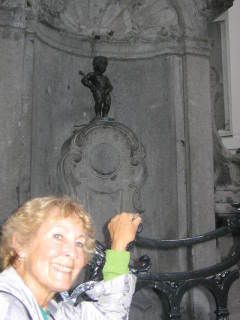
Alice viewing Brussel's famous Monsieur Pis, an activity apparently indulged by all Brussels visitors.
Photo Sharing and Video Hosting at Photobucket
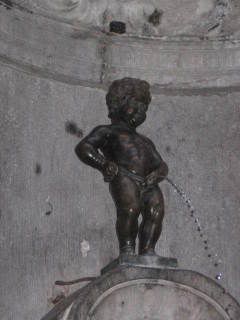
Monsieur Pis entertains us - apparently we're not a demanding audience

My suitcase, obviously not happy to be in the Capitol of the (socialist) European Union, skipped Brussels but rejoined me in Budapest. Our two-night stay in Brussels without my suitcase motivated me to rethink all the things I have been putting in my checked luggage because of restrictions on what can be in my carry-on bag. I had gotten into the habit of putting my entire shaving kit in my checked bag because of its liquids and razor. Henceforth I will take it with me filled with small bottles of essentials, and larger bottles for longer trips in my checked luggage. Plus I’ll put a more generous allocation of underwear and socks in my carry on.

And my umbrella.

The Implant Center (also referred to as Smile Savers of Hungary) had a car and driver, Thomazh, meet us at the Budapest airport and drove us to our excellent hotel, the Hotel Gellert in Buda on the shore of the Danube near the (now under repair - the photo shows it before repairs started) Freedom Bridge.

Photo Sharing and Video Hosting at Photobucket
The Freedom Bridge over the Danube, with Hotel Gellert

Photo Sharing and Video Hosting at Photobucket
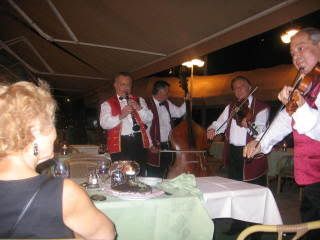
The Hungarian Gypsy band at Hotel Gellert serenaded Alice almost every night

Photo Sharing and Video Hosting at Photobucket
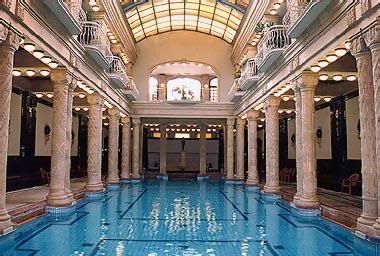
The Hotel Gellert spa had several large pools, including three natural thermal ones in addition to this covered swimming pool at room temperature

Photo Sharing and Video Hosting at Photobucket
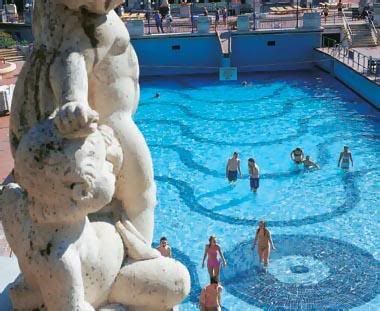
Hotel Gellert outdoor wave pool

The next morning, promptly at 8, Thomazh’s older brother Lazlo picked me up at the hotel and drove me to the clinic. Both brothers spoke excellent English, since they both had attended high school in Bethesda, Maryland, while their father was working in the Hungarian Embassy in Washington, DC.

After a short wait, just long enough for me to admire the pretty ladies who manned (decorated?) the reception lounge, one of them took me to the X-ray room and made a panoramic scan of my teeth. Then back to the reception lounge to resume admiring, but not for long for soon it was time to begin serious dentistry.

Dr. Attila Kaman MD, DDS, greeted me and escorted me into a nice, modern clinic office and into a dentist chair. Dr Kaman is the head of the clinic, and would do my implant surgery. According to his web site, Dr. Kaman is “One of the most experienced specialists in implantology in Europe if not the world having placed 9,000 successful implants in the last 6 years.” For the next two hours every thing he did convinced me that his reputation was well deserved.

My procedure was painless, and each step of the process flowed smoothly and precisely. Dr. Kaman began with the left upper rear implant. After numbing, he opened the gum and drilled the first hole using successively thicker drill bits. Then he inserted processed cow bone material into my sinus cavity (the “sinus lift”) to build up the bone thickness, after which the implant anchor was screwed into my jaw, and the incision closed with stitches.

Photo Sharing and Video Hosting at Photobucket
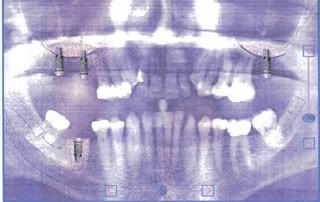
My X-ray showing how the implant (CamLogs) would be placed. The shaded areas above the upper implants show the sinus lifts

Dr. Kaman repeated the procedure and implanted two anchors in my right upper rear jaw.

The last implant, in my right lower rear jaw, went very quickly because the bone there is thick and no procedure similar to a sinus lift to build up the bone was needed.

Total cost for the sinus lifts and four CamLog anchors, $6,304.

Remaining expenses when I go back next year to get four crowns fitted to complete the implants, $1,408, for a total cost of $7,712 and a savings of over $15,000. I could reduce the savings by about $3,000 to account for the cost of the trip, but we enjoyed the trip so much that it doesn’t seem fair to add it to the cost of the dentistry.

Photo Sharing and Video Hosting at Photobucket
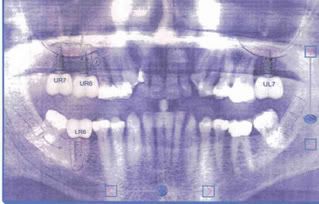
This X-ray shows how my teeth will look when the four caps are fitted next year

We love to travel, we loved the trip, it was time for a vacation, and we’re already looking forward to returning next year.

Photo Sharing and Video Hosting at Photobucket
Alice was impressed by the statues with buff buns

Photo Sharing and Video Hosting at Photobucket
We had a long climb ahead of us, but I didn't know it yet, so I'm smiling (the cheek with the most swelling from the implants is in shadow, so I look almost normal)

And looking forward to spending almost a week in Turkey then.

I’m already reviving my almost forgotten Turkish phrases in my mind (phonetically):

Mir haba, akadash (Hello, friend).

Nasil sen? (How are you?)

Kash para? (How much does it cost?)

Chok para! (Too much!)

As long as I remember that no matter what price I’m given, it’s too much, I should be OK.

Chok te she kara darum. (Thank you)

Sunday, March 05, 2006

Europe Bicycle Trip Of A Lifetime - We Begin

In May 1998 Alice and I completed preparations for a four-month bicycle trip through parts of Europe. I had resigned from the Internal Audit Department of Kaiser-Permanente in Oakland in early May, and Alice was wrapping up some pet projects at her company, Vulcan Incorporated in Hayward.

We had our bicycles and our gear ready to go, but had only ridden the bikes a few miles and had never tested them carrying the packs or being packed for a trip in an airplane. As a matter of fact, Alice and I had done very little bicycle riding since we got married in 1989.

In our favor, Alice planned the trip very carefully, and I was happy with my choice of bicycles and packs. Alice devoured travel guides, such as Fodor’s and Rick Steves, which proved valuable during the trip. Not only the advice was valuable, but just the sight of her Rick Steves or Fodor’s travel books got us better service from our B&B hosts. Alice also studied books specifically about biking in Germany, England, and Ireland, and made copies of the pages that covered the bike paths on our route.

The bicycles I chose were foldable Dahons with full-size 26” wheels and a 7-speed Shimano internal hub instead of a derailleur shifting system. The bicycles were easy to assemble and disassemble, pack in a carry bag, and take along with us as part of our airline luggage. We were very lucky to buy the bikes we did. Nothing comparable is on the market now. The closest I could find on the Internet now is this.

The night before departure, Alice worked at Vulcan until past 2 in the morning. We barely had our heads on the pillows before it was 5:30, time to be up and off to Dover Air Force Base, Delaware, via San Francisco Airport and Baltimore.

We had high hopes of getting a free military stand-by flight, called a hop, from Dover AFB to Ramstein Air Base, Germany, but we had delayed our departure too much. It was now mid-June, all the kids were out of school, and the regular military and their families were traveling with higher travel priority ratings than we military retirees. After ten days waiting, and little hope for a change, we bought commercial tickets and flew from Newark to Paris.

Our time in Dover was far from wasted. While there, we finally had time to ride the bikes and get used to them and carrying the packs. Also, I got to disassemble and reassemble them, and pack them for transport, almost on a daily basis. Learning these skills, which should have happened before we started, came in very handy throughout our four-month bike tour.

Klein Gumpen, Here We Come!


On the 23rd of June, 1998, we loaded our packs, mounted our bikes, and struck out through Heidelberg, and then east along the Neckar River. In our typical fashion, it was already afternoon when we finally got going, and we left Bruce and Leaha to care for and eventually bring back stateside 24 generic German garden gnomes.

Alice just had to have the cute things; I couldn’t see any use for them, thought they were butt ugly, and tried to discourage their purchase. The more against it I was, the more for it Alice was. Alice was determined; they would make perfect gifts for many friends and relatives. She already had made a list of who would get which. Bruce eventually brought them in his household goods to Las Vegas, stored them in his closet a year or two, and we finally picked them up and sent them via UPS to our Gualala, California home. Most of them are still packed away in our barn.

When Alice reads this, the now eight-year old plan will be revived. So, dear friends and relatives, please prepare a place in your lawn or garden for a gruesome gift generic German garden gnome to be received sometime this year. Hopefully you have a place where you won’t have to look at it often. They are homely; only Alice and Germans think they're cute.

Our first day took us to Neckarsteinach, and we stayed two nights at the Vierburgeneck Hotel. When we made our plans to bike in Germany, we had decided that if we followed the rivers, we would avoid the hills. The plan worked to a point. When we were traveling from place to place along the rivers, we didn’t have to climb any hills. But when we stopped at a town like Neckarsteinach, and wanted to see the sights in its vicinity, we found that almost all of the things we wanted to see, such as castles, were on the tops of the surrounding hills. So we ended up doing a lot of hill climbing on our bikes, but at least we could leave our big packs in our room while sightseeing.

After two days, and a total of less than 20 miles traveled from Heidelberg, we loaded our packs and pedaled on. We left the Neckar, and went due north to Erbach. Along the way, we faced several challenging hills. Fortunately for me, even though I hadn’t put in much time riding the bike to prepare for the trip, I had been running three to five miles a day. On the other hand, Alice had been working hard at Vulcan almost to the moment we got on the plane, and was not in shape for strenuous biking. As we were pedaling up one long hill, with Alice straining very hard, a truck came up the hill from behind and passed us. The driver gave me a withering look – “Why are you abusing your poor wife like that?” his stare seemed to say. I wanted to explain, “It’s all her idea, this is what she wants to do,” but of course I never got the chance.

We stopped in a little park next to the road, ate our sandwiches and refilled our water bottles, and pressed on for Erbach. Just as we reached our hotel and checked in, it started to rain hard. We were tired, but thankfully dry.

During our short stay in Erbach, I learned a valuable lesson about modern travel that has served Alice and I very well in our many travels since. I had decided it would be a good idea to cash a travelers’ check and get some Deutsch marks. I soon found out that cashing travelers’ checks is a time consuming and expensive process in Germany, and probably elsewhere. When I found a bank that would cash one, the fees were numerous and prohibitive. This was very bad news, since I had brought $3,000 of travelers’ checks with me to use in the many instances, such as when we stayed in Bed & Breakfast hotels, where I knew I wouldn’t be able to use my credit card. Just as I was mentally beating up on myself, I noticed the bank’s Automated Teller Machine (ATM). “I wonder,” thought I, “if my credit union ATM will work here?” So I tried it, and out came Deutsch Marks, and I wasn’t even charged an ATM fee. Further, I noticed that there were ATM’s all over, accessible at any hour of the day or night, seven days a week, with no bank lines to stand in, and no bank managers or tellers to annoy or confuse me, and I them. I tucked the travelers’ checks away for future emergencies that never occurred, and deposited them back into my account after we returned to California four months later.

The following day we pressed on, still headed north, destination Reichelsheim. We never made it that day, or any day since. Alice was worn out, and as we passed a village named Klein Gumpen, Alice said, “I can’t go any farther, I’ve got to stop.” As luck would have it, just as she said that we were passing a hotel, so we turned back and checked in. This unplanned stop became one of the highlights of the entire trip.

Tuesday, February 14, 2006

Finding Real Beauty In The Galapagos Islands


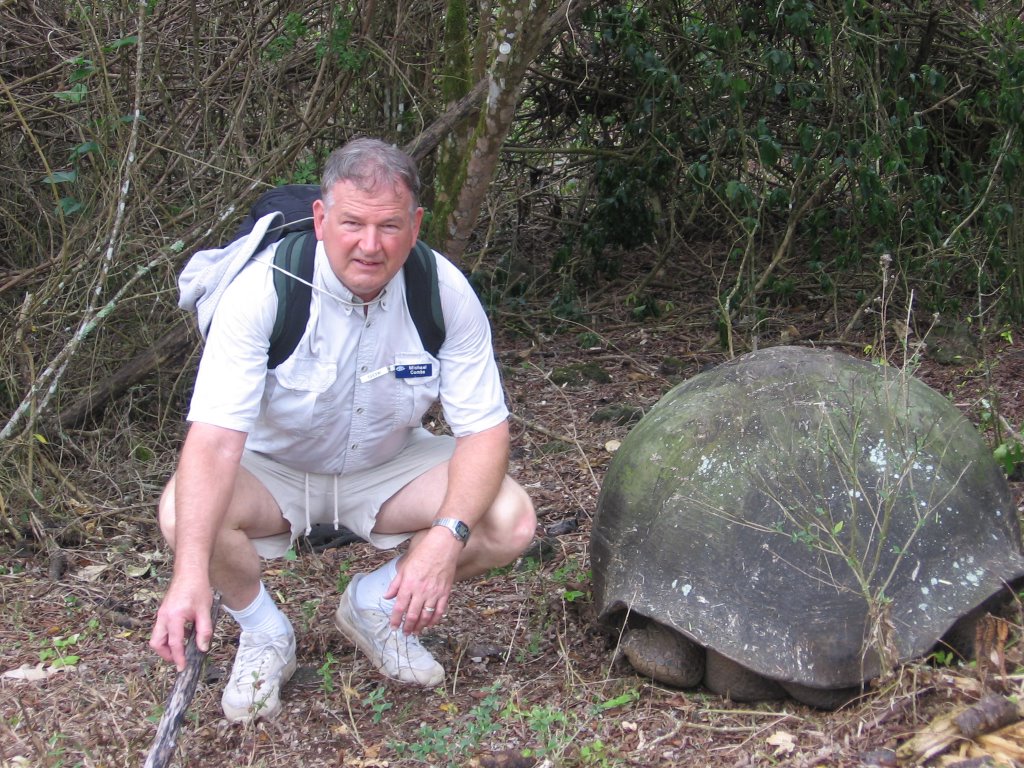
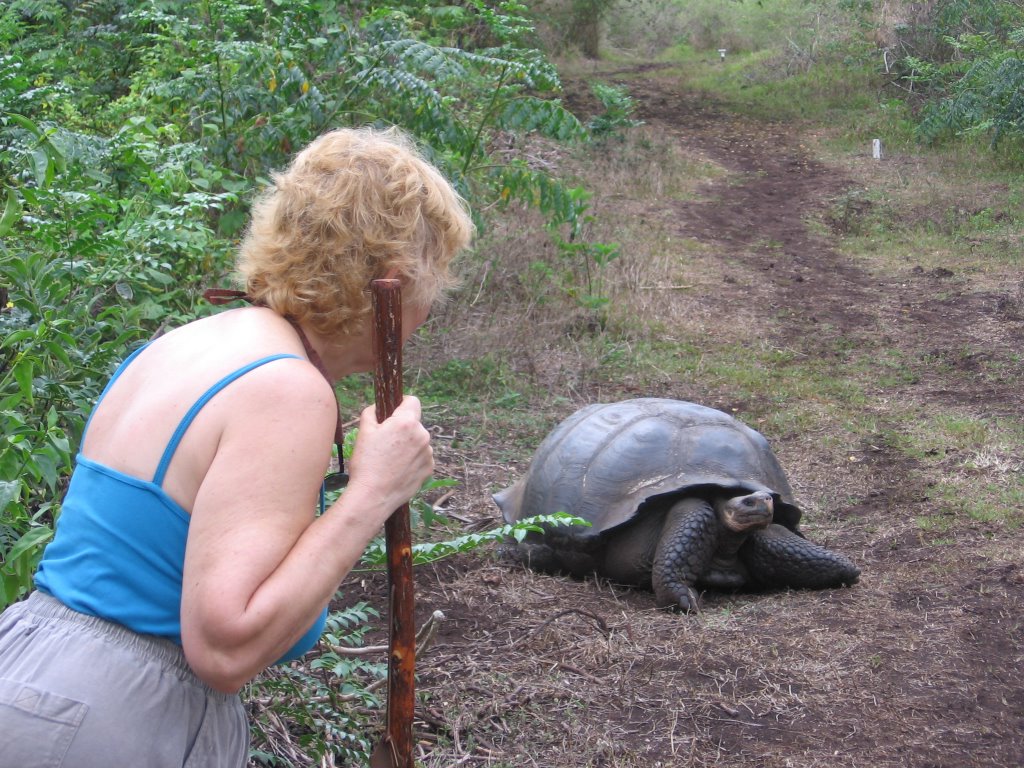
On our last evening on the MS Islander, we all met in the lounge and the microphone was passed around to give each of us a chance to tell our most lasting memory of our week cruising The Galapagos Islands. My turn came early, but the pattern had already been set -- animals, birds, fish – no surprises here. But I recalled our visit to the Tortoise Center, and the tortoise egg incubator.

When it had been decided that endangered tortoises would get human help to hatch eggs in the Center, the goals were to increase the percentage of hatching success and infant tortoise survival, and by incubating the eggs at a higher temperature, to increase the ratio of female to male tortoise hatchlings. More females, a few viral males to service them, a recipe for a tortoise population explosion.

To further help nature, an expensive incubator was designed and built at a stateside university, shipped to the center and installed, and immediately started failing for a variety of reasons, mostly associated with the incubator being unsuited for the primitive Center environment – frequent power outages and fluctuations, salty air, wind driven sand and dust, the long lead time to get and install spare parts – in other words, the incubator worked perfectly in an environment that did not exist within thousands of miles of the Center.

What did the Center researchers do? They took a hair dryer, a simple thermostat, and a pan of water, put it in the egg boxes, and their locally designed system worked perfectly. Making repairs and getting spare parts was easy. A triumph of the human mind!

So while my fellow passengers were impressed by the beauty of this bird, that sea lion, those fish, I was profoundly impressed once more by this display of the beauty of the human mind at work. It is still the greatest of all creations, by whatever creator you wish to credit. The human mind can both comprehend evolution, create God in its own image, and carefully hatch and raise baby tortoises. It is the most beautiful and remarkable thing on Earth, and for all I know, in the Heavens too.

Monday, December 25, 1995

Feliz Ano Nuevo!


Ajijic street art

        Alice and I started thinking and planning retirement not long after our marriage in 1989. In the early 1990’s it looked like we probably would need to find an economical place to retire, because Alice’s business, Vulcan Incorporated, was struggling against tough competition, and I was struggling to stay employed during the period of defense cutbacks following the collapse of the Soviet Union. As we say in defense contracting, “Peace is Hell.”

        That’s a joke, you hyper-sensitive Leftists.

        Our motto in the Air Force was, "Peace is our Profession."

        It wasn't a joke.

        Like Teddy Roosevelt said, "Walk softly. But carry a big stick!".

        Anyway, we started developing our retirement criteria. Besides inexpensive, we wanted a great climate, and all the comforts of home. We also were looking for an area where we could lead an active lifestyle, and enjoy an interesting culture. Many parts of the world were attractive, but we quickly ruled out many places too.

        Europe was variously too expensive, and in Eastern Europe where it was less expensive, the winters were too cold. On the basis of the five years I lived in England (1970-1975), I would have voted for the United Kingdom or Ireland as my number one choice regardless of weather or cost of living, but Alice would never be happy with the cold, damp winters. Or the occassional cold, damp summers.

        Africa was interesting, but the political instability and threats of intense sporadic violence scared us off.

        We felt the same about Asia, plus Alice vetoed any Muslim nation because of their treatment of women. That eliminated one of my favorites, Turkey, where I had lived a year across the Sea of Marmara from Istanbul in 1964-65.

        Australia and New Zealand scored high marks with us, but cost of living wasn’t much lower than in the United States, and the vast distances to travel to visit family and friends were daunting.

        South America was a great unknown to both of us, but the political instability and social problems in South America were constantly in the news, and left us with a vague feeling of uneasiness about living there.

        The Caribbean interested us, but seemed too expensive, plus the politically stable parts were too touristy, and the less expensive, less touristy parts were too unstable.

        Canada was out. Climate.

        That left us with Mexico and Central America, and the warm but less expensive parts of the United States. We eliminated the United States because “We’ll save that for when we’re old.”

        Central America? We don’t know much about it, it’s probably a lot like Mexico, except it’s further away.

        “Mexico, here we come!”

         A friend told us of a marvelous bed & breakfast, Los Artistas (now under new owners), operated then by two gay fellows, the “two Steves,” in Ajijic, on the shores of Lake Chapala, near Guadalajara. As confessed in an earlier post, Mixed Company, Alice and I have a stereotypical prejudice about gays. We believe they are the best Bed & Breakfast proprietors, although we have stayed at many “straight” B&B’s we thought were great too. It’s just that we have never had a bad experience at a B&B operated by gays.

        I hope someone will read this and be offended and let me know, thereby validating another of my stereotypical prejudices that there is nothing complimentary I can say about gays that won’t offend someone, usually a straight Liberal.

        The Guadalajara area had already been brought to our attention because of its year around mild climate and its large colony of American and Canadian expatriates and retirees.

        Right after Christmas 1995 we left for a week in Mexico. We were picked up by taxi from the Guadalajara airport and whisked to Los Artistas in Ajijic. Our hosts were warm and congenial, the room “The Studio” was very nice, and the grounds were well kept and inviting. We soon found the meals were excellent also. Everything lived up to our stereotypical expectations.

        Ajijic was a marvelous combination of small Mexican village life with a community of Americans and Canadians on the shore of Lake Chapala. The lake itself was a bit of a dissappointment. It was in a lovely setting, with mountains on the other side, but from the shoreline to a point a half mile or more out in the lake it was covered thickly with water hyacinth.

        I'm sure that someone someday will find a use for water hyacinth (has a limited use as cattle feed), or a way to control it, but as far as I know, no one has. As it was, all boats could do was plow through it, and small outboard motor boats could barely move in it at all. Sometimes the wind shifted and blew from the land, and the water hyacinth was blown out into the middle of Lake Chapala, but the periods of clear water didn't last long.

        We rented horses and rode through Ajijic and along the lake shore, and through a park. As usual, my horse was a bit of a head case, and I never was confident that he would stay on good behavior. He did, but he kept me worried.

        Alice got a smile or wave from everyone we met by unfailingly greeting them with a cheery "buenos dias."

        We spent a day with a real estate agent looking at houses in Ajijic and were impressed by what we saw. The houses were relatively inexpensive, and were large and comfortable. From what we saw in the furnished homes, life would be as comfortable as in California, with the very welcome added benefit of an affordable cook and house keeper.

        We made reservations for New Years Eve at a very nice restaurant at an Ajijic hotel, and dressed up very formally for the occassion. After the Maitre'De met us at the door and seated us, our waiter appeared and Alice wished him a cheery "Feliz Ano Nuevo." He almost hurt himself trying to hold back laughter, but he couldn't hold it, so he burst out laughing.

        We looked at him with puzzled expressions, and when he finally regained his composure, with words and a pat on his rear end he indicated Alice had just wished him a "Happy New Asshole." The Spanish word "ano" (pronounced "ah'-no") in English is "anus," and the Spanish word for "year" is "año" (pronounced "ah'-nyo").

        What she should have said in greeting was "Feliz Año Nuevo," but if she had we wouldn't have shared such a great laugh.

        On New Years Day the two Steves kept trays of delicious hors 'devoures available for their friends and guests all day as we participated in the All-American tradition of Bowl Game watching. Los Artistas had a large satellite dish for television reception, so we started with the Rose Parade, and then I think we glanced at the easily forgetable Cotton Bowl, with Colorado stomping Oregon 38-6.

        The highlight for me, and seemingly for most of the guests, was the Rose Bowl, USC against Northwestern. It was a very exciting game, and when Northwestern went ahead 32-31 in the fourth quarter, it was obvious that Northwestern was the favorite of most of us watching. In fact, as a Californian, I may have been the only USC rooter there. However, their joy was short lived as USC scored the next ten points and won 41-32.

        The bowl games ended with the Orange Bowl where Florida State beat Notre Dame 31-26, with an incredible fourth quarter comeback. Again the large midwestern contingent watching at Los Artistas was disappointed.

        Alice had no interest in the bowl games, as usual, but she was having a great time in the company of several other "football widows," which included a lesbian couple she particularly enjoyed chatting with.

        We returned to our home on our five-acre ranch in Livermore, and developments at work for both of us soon had our full attention. Later in 1996 I was laid off at Power Spectra and scrambled to find work as a temporary employee, including several months at Nummi in Fremont before getting on as an Internal Auditor at Kaiser Permanente in Oakland.

        Alice's company, Vulcan Incorporated, continued to struggle against its fierce competitor until early in 1997. Happily for Alice, the competitor went bankrupt and she was able to sign their top salesman to a sweat equity deal that has since made Vulcan very successful.

        We had forgotten totally about retiring in Mexico, and when we finally retired in 1998, Alice's first grandchild was almost a year old and we chose to retire in Gualala to stay close to family and friends.

        Now many years later, Mexico is a fond memory as we start each new year wishing each other a "Happy New Anus!"

Please click on the label below to see all my articles on this topic.