I remember Arthur in war
Now that Arthur’s gone
His memories are mine
I remember a man just eighteen
On the quiet North Africa morning
Standing by his shining gun
Its master and its servant
Their war began and ended
Before they fought in it
Destroyed by bigger and more powerful German guns
Death arrived before announced by sound
Of gun and friends only Arthur survived
I remember Arthur in a Yankee hospital
Blessed with luck and youth
And skills and labors of doctors and nurses
Gifted him sixty more years of precious life
Months later returned to England
In a Suffolk hospital cheerfully met
Then married Nurse Molly
And went again among the friendly Yanks
Working in Supply at RAF Bentwaters
I remember RAF Bentwaters and Woodbridge
Were birthed by war in 1944
Spitfires and Mustangs fluttered like butterflies
Rising from wheat stalk-paved runways
Then circling in droning swarms
Until a sputtering flare arcing high
Signaled formations in great V’s
Eastward across the English Channel
I remember Suffolk, an immobile aircraft carrier
Sending fighters and bombers over German factories
And farms, and cathedrals, and villages
Aircrews never seeing the frightened German faces
Scanning leaden skies for raining death
Or the faces of the prayerful Jews
In abandonment of hope for life
Wishing death equally on captive and captor
I remember Arthur
Serving in the Home Guard
Old men and boys and the wounded
Patrolling the Suffolk beaches
Scanning the North Sea horizon
Searching the leaden skies
Waiting and watching
For the ones that never came
I remember borne in war in 1942
With all the world’s mad pain and suffering
I was softly pulled from Mom’s belly
A triumph over her crippled hip and leg
My most precious gift from Mom and Pop
Brother Ron arrived less than a year later
Against long odds our little family grew
As other families perished all together
I remember when I arrived at Bentwaters
And met Arthur my first day on the job
The Cold War raged, and our 72 Phantom jets
Were in England to fly a deadly mission
A one-way trip to the Fulda Gap
Ending in a high-speed dive
A sudden pull up and release
A nuclear bomb powered by inertia and gravity
Flashing above the Eastern Army tanks and trains
Bringing death before sound announces its arrival
I remember fighting a thermo-nuclear war
Every month for over five years
Strangely war always arrived quietly
Dilly and I would be in the field
Dilly chasing a hare as I approved
Then on the dirt farm road
Our old Ford Anglia bouncing
Marilynn waving, shouting “Alert”
I changed to my uniform and raced to the Command Post
I remember plotting nuclear detonations
Of differing megatonage and how the winds
Distributed the nuclear fallout pattern downwind
Soon the first nukes would fall
London would be gone
The millions of people and the thousands of years
Living and building gone in a flash
Next Manchester, deadly for us
Prevailing winds would soon bring fallout
And we rushed to launch our flights of death
Before its silent and invisible shroud
Covered us
I remember, I remember
Another exercise is over
Released into the cold English night
From the bustling Command Post
The quiet, the silence, the peace
I remember telling Arthur
“Mate, I can’t imagine war,
What was it like?”
“Mike, I don’t know
My war was over before I knew it”
Showing posts with label Bentwaters. Show all posts
Showing posts with label Bentwaters. Show all posts
Sunday, August 08, 2010

Saturday, October 04, 2008
Looking Back at Over 21 Air Force Years
Would I do it again?
Looking back now, the only thing I would change is my age. Make me twenty again, with a stripe on my sleeve, my duffle bag on my shoulder, and permanent change of station orders in my hand.
Heaven to me is doing it all over again, going back to the bases, seeing my friends, having the bull sessions, and then seeing all the places I missed the first time around. It was a very rich life, and we will never see the like of it again.
Most of the bases are closed now, the aircraft retired and salvaged, and the people the same. When I went back to Bentwaters in England, my favorite base and assignment, it had been closed several years. I felt an enormous loss and sadness, because a closed base quickly loses its aura of the people once stationed there, and of what they did and how they did it.
That base was once a true city, but now is a ghost town, one whose ghostly inhabitants were dispersed to far off places, taking their memories with them. When I stood there on the lonely base, no one was around to say "remember when?"
Only me.
And then I was gone.
Looking back now, the only thing I would change is my age. Make me twenty again, with a stripe on my sleeve, my duffle bag on my shoulder, and permanent change of station orders in my hand.
Heaven to me is doing it all over again, going back to the bases, seeing my friends, having the bull sessions, and then seeing all the places I missed the first time around. It was a very rich life, and we will never see the like of it again.
Most of the bases are closed now, the aircraft retired and salvaged, and the people the same. When I went back to Bentwaters in England, my favorite base and assignment, it had been closed several years. I felt an enormous loss and sadness, because a closed base quickly loses its aura of the people once stationed there, and of what they did and how they did it.
That base was once a true city, but now is a ghost town, one whose ghostly inhabitants were dispersed to far off places, taking their memories with them. When I stood there on the lonely base, no one was around to say "remember when?"
Only me.
And then I was gone.
Thursday, January 17, 2008
The New Budget Officer, RAF Bentwaters, 1970
In my previous post we arrived at my new base in the UK and we spent the first six weeks living in the Coach and Horses, Melton, while I worked constantly, then searched long and despairingly for a house for us.
I arrived at RAF Bentwaters, Suffolk, UK, in early January, 1970, a 27-year old 2nd Lieutenant with wife, Marilynn, and three sons ages 6, 3, and 1. I had just completed an MBA at Michigan State, and the Budget Officer job at Bentwaters would be my first Air Force duty as an officer. Since I had spent my six enlisted years as a Russian linguist radio intercept analyst, clerk typist, and/or college student, I knew absolutely nothing about Air Force accounting or budgeting.
Apparently the Air Force wasn’t concerned, because no mention was ever made of sending me to any school to train me for my new job.
When I reported for duty as the Budget Officer, 81st Combat Support Group, 81st Tactical Fighter Wing, I found that my predecessor, Mr. Byce Pierce, had transferred from RAF Bentwaters to an accounting and finance job on RAF Lakenheath nine months before my arrival. During that long vacant period, the Budget Office had operated with only two people, TSgt Phillip Ashcraft and UK civilian clerk Art Sharman. Their happiness at my arrival was tempered with the immediate recognition that I didn’t know the slightest thing about the Air Force’s accounting and budgeting system.
Another thing that happened the week I arrived that tempered their joy was the simultaneous arrival of the “call” to begin preparation of the Fiscal Year 1971 Wing Operations Operating Budget and Family Housing Budget. The preparation of each of these hundreds of pages documents is a harrowing and challenging activity at the best of times. With a new untrained and inexperienced leader, and a just installed new tape and hard drive computer (Burroughs 3500) to replace the old punched card one, a Burroughs B-263, the budget preparation tasks looked impossibly difficult.
Looks weren’t deceiving.
For the next six weeks each of the three of us worked forty or more hours of overtime each week, but even though each of us worked the same long hours, this arduous workload was not evenly distributed.
At 27, I was the youngest, but my position as Budget Officer and my total lack of accounting knowledge gave me few duties I was either required or capable of performing. Fortunately, writing the budget narrative (borrowing heavily from the previous years’ budgets) and proofreading the typed printing masters were important jobs that I could do well without grasping the underlying details and concepts.
TSgt Ashcraft was the Noncommissioned Officer in Charge (NCOIC) of Budget, and was ten years older than me, and very calm and affable. He was able to get a lot of information from a wide variety of activities and individuals, and incorporate it into the Byzantine budget formats. I didn’t realize until much later that Air Force budgeting was in a period of transition and upheaval when I arrived. My ignorance of what preceded the new system led me to believe that I was entering an established one, when actually it was in complete disarray and groping its way in the dark from being a tightly centrally managed one to responsibilities being distributed throughout all levels of Air Force management. TSgt Ashcraft was struggling to make the transition, and for the most part I was unaware of it.
Arthur Sharman, the UK civilian budget clerk, was twenty years older than me, and I owe him a lot for my eventually successful career in budgeting. Art handled the most precisely demanding elements of our budget, the pay of civilian employees and the contracts and services provided through the British Ministry of Defense and Department of Environment (DOE), which performed the functions performed at stateside bases by Air Force Civil Engineering. He also ably liaised with the financial officer of the DOE, Mrs. Iris Fletcher, a very able and slightly built but imposing woman in her fifties who Art nicknamed the Dragon Lady. Between the two of them they wielded a surprising amount of power over most of the physical plant of the two air bases which were operated by the 81st Tactical Fighter Wing, Royal Air Force Bases Bentwaters and Woodbridge.
The problem we all faced was that the newly responsible financial managers had no training or experience in their duties under the new program. Being an overseas base compounded the problems, because both military and civilian managers and personnel were normally rotated back to a stateside base after three years, and there were very few with any knowledge or experience in financial management.
I thought I was stepping into an existing system and that I had to find out what everyone was doing so I could learn and get up to speed, and they thought I was there to lead them.
It could have been a classic example of the blind leading the blind, except I didn’t know they were blind and waiting for me to show them the way.
Somehow we got the budgets finished on time, although Phil Ashcraft was visibly exhausted, and Art Sharman suffered a minor stroke and was off work for about six weeks to recover. Although the budgets were in, we continued working many hours of overtime each week, even after Arthur came back to work.
Not long after Arthur came back, Phil Ashcraft finished his tour of duty and went back stateside. Arthur and I anxiously awaited his replacement, another TSgt named Robert Clough, coming to us from a Defense Contracting Agency job in Paramus, New Jersey, and prior to that, a year at Tan Son Nhut Air Base, Vietnam.
As we awaited TSgt Clough’s arrival, we continued to burn many overtime hours on tasks such as loading budget targets in the Base Accounting system on the B-3500 computer, and corresponding supply and equipment targets in the Base Supply system on the Univac 1050-II computer system.
Working with Base Supply was particularly difficult, since they operated in accordance with their own sacrosanct regulations and procedures which seemed to be in competition or opposition to the overall budget process. We were in a constant fear that Base Supply would not issue a critical maintenance part because of a shortage of funds in a unit account, thereby resulting in delayed repairs to an aircraft delaying mission accomplishment, and the blame placed on us.
The Supply system seemed to be run by its cranky computer. When there were problems, and there were endless problems, the usual explanation for not fixing them immediately was that “the computer won’t let us.”
We had very little information about TSgt Clough, but information in some of his records we received before his arrival showed he had experience working with Base Supply.
The fateful day finally arrived, and I made the short walk from Accounting across the highway to the parking lot in front of the Base Reception Center to meet the bus carrying Sergeant Clough and his family from the UK arrival base, RAF Mildenhall. The bus pulled in, and Sergeant Clough and his wife Lorna, plus two sons and a daughter, got off. As I gave Sergeant Clough a warm welcome I noticed he was overweight and his uniform more unkempt looking than expected even considering the long flight and bus ride.
He introduced me to his family, then announced that he was “on the Road program.”
“What’s the ‘Road’ program?” I asked.
“Retired On Active Duty,” he replied.
I arrived at RAF Bentwaters, Suffolk, UK, in early January, 1970, a 27-year old 2nd Lieutenant with wife, Marilynn, and three sons ages 6, 3, and 1. I had just completed an MBA at Michigan State, and the Budget Officer job at Bentwaters would be my first Air Force duty as an officer. Since I had spent my six enlisted years as a Russian linguist radio intercept analyst, clerk typist, and/or college student, I knew absolutely nothing about Air Force accounting or budgeting.
Apparently the Air Force wasn’t concerned, because no mention was ever made of sending me to any school to train me for my new job.
When I reported for duty as the Budget Officer, 81st Combat Support Group, 81st Tactical Fighter Wing, I found that my predecessor, Mr. Byce Pierce, had transferred from RAF Bentwaters to an accounting and finance job on RAF Lakenheath nine months before my arrival. During that long vacant period, the Budget Office had operated with only two people, TSgt Phillip Ashcraft and UK civilian clerk Art Sharman. Their happiness at my arrival was tempered with the immediate recognition that I didn’t know the slightest thing about the Air Force’s accounting and budgeting system.
Another thing that happened the week I arrived that tempered their joy was the simultaneous arrival of the “call” to begin preparation of the Fiscal Year 1971 Wing Operations Operating Budget and Family Housing Budget. The preparation of each of these hundreds of pages documents is a harrowing and challenging activity at the best of times. With a new untrained and inexperienced leader, and a just installed new tape and hard drive computer (Burroughs 3500) to replace the old punched card one, a Burroughs B-263, the budget preparation tasks looked impossibly difficult.
Looks weren’t deceiving.
For the next six weeks each of the three of us worked forty or more hours of overtime each week, but even though each of us worked the same long hours, this arduous workload was not evenly distributed.
At 27, I was the youngest, but my position as Budget Officer and my total lack of accounting knowledge gave me few duties I was either required or capable of performing. Fortunately, writing the budget narrative (borrowing heavily from the previous years’ budgets) and proofreading the typed printing masters were important jobs that I could do well without grasping the underlying details and concepts.
TSgt Ashcraft was the Noncommissioned Officer in Charge (NCOIC) of Budget, and was ten years older than me, and very calm and affable. He was able to get a lot of information from a wide variety of activities and individuals, and incorporate it into the Byzantine budget formats. I didn’t realize until much later that Air Force budgeting was in a period of transition and upheaval when I arrived. My ignorance of what preceded the new system led me to believe that I was entering an established one, when actually it was in complete disarray and groping its way in the dark from being a tightly centrally managed one to responsibilities being distributed throughout all levels of Air Force management. TSgt Ashcraft was struggling to make the transition, and for the most part I was unaware of it.
Arthur Sharman, the UK civilian budget clerk, was twenty years older than me, and I owe him a lot for my eventually successful career in budgeting. Art handled the most precisely demanding elements of our budget, the pay of civilian employees and the contracts and services provided through the British Ministry of Defense and Department of Environment (DOE), which performed the functions performed at stateside bases by Air Force Civil Engineering. He also ably liaised with the financial officer of the DOE, Mrs. Iris Fletcher, a very able and slightly built but imposing woman in her fifties who Art nicknamed the Dragon Lady. Between the two of them they wielded a surprising amount of power over most of the physical plant of the two air bases which were operated by the 81st Tactical Fighter Wing, Royal Air Force Bases Bentwaters and Woodbridge.
The problem we all faced was that the newly responsible financial managers had no training or experience in their duties under the new program. Being an overseas base compounded the problems, because both military and civilian managers and personnel were normally rotated back to a stateside base after three years, and there were very few with any knowledge or experience in financial management.
I thought I was stepping into an existing system and that I had to find out what everyone was doing so I could learn and get up to speed, and they thought I was there to lead them.
It could have been a classic example of the blind leading the blind, except I didn’t know they were blind and waiting for me to show them the way.
Somehow we got the budgets finished on time, although Phil Ashcraft was visibly exhausted, and Art Sharman suffered a minor stroke and was off work for about six weeks to recover. Although the budgets were in, we continued working many hours of overtime each week, even after Arthur came back to work.
Not long after Arthur came back, Phil Ashcraft finished his tour of duty and went back stateside. Arthur and I anxiously awaited his replacement, another TSgt named Robert Clough, coming to us from a Defense Contracting Agency job in Paramus, New Jersey, and prior to that, a year at Tan Son Nhut Air Base, Vietnam.
As we awaited TSgt Clough’s arrival, we continued to burn many overtime hours on tasks such as loading budget targets in the Base Accounting system on the B-3500 computer, and corresponding supply and equipment targets in the Base Supply system on the Univac 1050-II computer system.
Working with Base Supply was particularly difficult, since they operated in accordance with their own sacrosanct regulations and procedures which seemed to be in competition or opposition to the overall budget process. We were in a constant fear that Base Supply would not issue a critical maintenance part because of a shortage of funds in a unit account, thereby resulting in delayed repairs to an aircraft delaying mission accomplishment, and the blame placed on us.
The Supply system seemed to be run by its cranky computer. When there were problems, and there were endless problems, the usual explanation for not fixing them immediately was that “the computer won’t let us.”
We had very little information about TSgt Clough, but information in some of his records we received before his arrival showed he had experience working with Base Supply.
The fateful day finally arrived, and I made the short walk from Accounting across the highway to the parking lot in front of the Base Reception Center to meet the bus carrying Sergeant Clough and his family from the UK arrival base, RAF Mildenhall. The bus pulled in, and Sergeant Clough and his wife Lorna, plus two sons and a daughter, got off. As I gave Sergeant Clough a warm welcome I noticed he was overweight and his uniform more unkempt looking than expected even considering the long flight and bus ride.
He introduced me to his family, then announced that he was “on the Road program.”
“What’s the ‘Road’ program?” I asked.
“Retired On Active Duty,” he replied.
Wednesday, September 05, 2007
The Coach and Horses
When we arrived in England in January, 1970, I reported for duty as Budget Officer at the 81st Tactical Fighter Wing, RAF Bentwaters, Suffolk, UK, and my sponsor, Captain Troxel, had reserved temporary lodging for us in The Coach and Horses Inn, Melton. Our two rooms were upstairs above the Pub, one in the front of the Inn, the other in the back. Bruce, 7, and Scott, 4, got the front room, and Marilynn and I, and one-year old Jeffrey, took the back.
Both rooms were small, and since the Earth had experienced a quarter-century of global cooling, the rooms also were cold. That winter, all of England seemed cold and dreary. The UK was just then beginning to exploit its North Sea gas fields, and almost all of England was still using coal-fired fireplaces and furnaces for warmth.
Our rooms had small electric heaters, fueled by the shilling coins we fed into them.
We had breakfasts in our room. We set a box outside the window, and it stayed cold enough to keep the milk, cheese, bread, condiments, and a few other perishable items fresh. I had lunches on the base, and Marilynn and the boys would join me or have sandwiches in the room. Marilynn and I had almost all our dinners in the restaurant of the Coach and Horses. Before having our dinners, we would order dinner for the boys and feed them in their room, then go to the restaurant for a quiet, relaxing meal. I worked my way through the menu top to bottom (several times), but Marilynn had halibut every night.
I rode the bus to the base and back for several days, then bought a used 1962 Morris 1100 automobile.
On most winter days a noon walk was like an evening walk. The Sun, never seen, provided a feeble glow through the thick overcast, and brought little warmth. In the far northern latitudes of the UK, the Sun apparently rose after 9 am, and presumably set about 3 pm. The black of night briefly was interrupted by the dull grey of day.
The air was redolent of coal smoke, and the exteriors of buildings were grimy with soot.
I loved it.
My wandering soul was home. I had found where I belonged.
In retrospect, my reactions to England were probably what you would expect from someone who loved reading the adventure classics of English literature, and watching movies like “Twelve O’clock High,” “Mrs. Miniver,” and “Ivanhoe.” Even “The Quiet Man,” set in Ireland, made my heart yearn for an English home I had never known. Just a picture of a John Constable painting of the English countryside made my chest ache in longing to return to a place I had never been.
Marilynn, although not as smitten as I was with England, adapted quickly and enjoyed our new adventure, just as she had in Turkey six years earlier.
Our temporary stay in the Coach and Horses began to have the feel of permanence. Our arrival in January, 1970, followed the arrival of the 67th Aerospace Rescue and Recovery Squadron, which had just been kicked out of Wheelus Air Force Base, Libya, by “Colonel” Muammar Gaddafi “Duck” in late 1969. Every house I hoped to rent had already been found and rented by someone from the 67th. While I was tied down working twelve-hour days, seven days a week, preparing the Fiscal Year 1971 budget – I arrived the same week its preparation began – the 67th AARS personnel and their families had plenty of spare time and resources to be very formidable house-hunting opposition.
One day I skipped lunch to drop in to the Base Housing Office to see if, by some miracle, something had popped up and gotten past the 67th bird dogs. Just as I reached the office door, I heard profanity muttered by an Air Force Chief Master Sergeant who was getting out of his car in the parking lot. Among the expletives (deleted) I heard him say something about how !@#%&*! it was that the Air Force would make a senior NCO and his family move again after they had just found a home and moved in a few months before.
“Excuse me, Chief,” I said, “could I beg a few moments of your time?”
I guess he noticed my 27-year-old face didn’t go with my 2nd Lieutenant bars, so he cordially explained he had just received reassignment to RAF Upper Heyford, near Oxford, to be the aircraft maintenance nanny for the F-111, a versatile swing wing tactical bomber due to arrive at Upper Heyford in September, 1970.
He had found a big, four-bedroom farmhouse in Saxmundham a few months before, was all settled in, and now he was going to Base Housing to let them know it would soon be available to rent.
“That won’t be necessary,” I assured him. “I’ll rent it.”
“Don’t you want to look at it?” he asked.
“No, it’s perfect,” I replied, and arranged to contact the owner.
The owners, the Underwoods of Bury St. Edmonds, seemed happy with the arrangement. I was happy to find the Underwoods would charge us the same rent as the Chief’s family, 52 pounds ($125) a month. The Underwoods assured me they would be delighted to continue driving to Saxmundham once each month to pick up the rent in pound notes, no checks please.
The Chief and his family were packed quickly by the Air Force and moved to Upper Heyford, and our household goods, which were sitting in storage at the Felixstowe docks, were delivered immediately.
We moved into The Street Farm, Saxmundham, the 16th of February, in the middle of the strongest (and only) snowstorm we experienced the five years we were in England.
The Street Farm was at the top of Street Farm Road, just a block off the A-12 highway (at that time; the A-12 has since been rerouted), behind the telephone building operated by the General Post Office, and past the office of the Suffolk Constabulary.
The Street Farm itself was a large, two-story farm house with four bedrooms and a bathroom upstairs, two living rooms, a kitchen, dining room, pantry, bathroom, bonus room, and utility room downstairs. It had a large fenced yard with a garden in back, overlooked a pasture, and beyond it was barns, stables, and an old dairy no longer in use. On the other side of Street Farm Road was a smaller house for the farm’s caretaker and his family.
We lived there for four wonderful years.
(Please click on the highlighted text to bounce to the next installment about my baptism into Base Budgeting at RAF Bentwaters)
Both rooms were small, and since the Earth had experienced a quarter-century of global cooling, the rooms also were cold. That winter, all of England seemed cold and dreary. The UK was just then beginning to exploit its North Sea gas fields, and almost all of England was still using coal-fired fireplaces and furnaces for warmth.
Our rooms had small electric heaters, fueled by the shilling coins we fed into them.
We had breakfasts in our room. We set a box outside the window, and it stayed cold enough to keep the milk, cheese, bread, condiments, and a few other perishable items fresh. I had lunches on the base, and Marilynn and the boys would join me or have sandwiches in the room. Marilynn and I had almost all our dinners in the restaurant of the Coach and Horses. Before having our dinners, we would order dinner for the boys and feed them in their room, then go to the restaurant for a quiet, relaxing meal. I worked my way through the menu top to bottom (several times), but Marilynn had halibut every night.
I rode the bus to the base and back for several days, then bought a used 1962 Morris 1100 automobile.
On most winter days a noon walk was like an evening walk. The Sun, never seen, provided a feeble glow through the thick overcast, and brought little warmth. In the far northern latitudes of the UK, the Sun apparently rose after 9 am, and presumably set about 3 pm. The black of night briefly was interrupted by the dull grey of day.
The air was redolent of coal smoke, and the exteriors of buildings were grimy with soot.
I loved it.
My wandering soul was home. I had found where I belonged.
In retrospect, my reactions to England were probably what you would expect from someone who loved reading the adventure classics of English literature, and watching movies like “Twelve O’clock High,” “Mrs. Miniver,” and “Ivanhoe.” Even “The Quiet Man,” set in Ireland, made my heart yearn for an English home I had never known. Just a picture of a John Constable painting of the English countryside made my chest ache in longing to return to a place I had never been.
Marilynn, although not as smitten as I was with England, adapted quickly and enjoyed our new adventure, just as she had in Turkey six years earlier.
Our temporary stay in the Coach and Horses began to have the feel of permanence. Our arrival in January, 1970, followed the arrival of the 67th Aerospace Rescue and Recovery Squadron, which had just been kicked out of Wheelus Air Force Base, Libya, by “Colonel” Muammar Gaddafi “Duck” in late 1969. Every house I hoped to rent had already been found and rented by someone from the 67th. While I was tied down working twelve-hour days, seven days a week, preparing the Fiscal Year 1971 budget – I arrived the same week its preparation began – the 67th AARS personnel and their families had plenty of spare time and resources to be very formidable house-hunting opposition.
One day I skipped lunch to drop in to the Base Housing Office to see if, by some miracle, something had popped up and gotten past the 67th bird dogs. Just as I reached the office door, I heard profanity muttered by an Air Force Chief Master Sergeant who was getting out of his car in the parking lot. Among the expletives (deleted) I heard him say something about how !@#%&*! it was that the Air Force would make a senior NCO and his family move again after they had just found a home and moved in a few months before.
“Excuse me, Chief,” I said, “could I beg a few moments of your time?”
I guess he noticed my 27-year-old face didn’t go with my 2nd Lieutenant bars, so he cordially explained he had just received reassignment to RAF Upper Heyford, near Oxford, to be the aircraft maintenance nanny for the F-111, a versatile swing wing tactical bomber due to arrive at Upper Heyford in September, 1970.
He had found a big, four-bedroom farmhouse in Saxmundham a few months before, was all settled in, and now he was going to Base Housing to let them know it would soon be available to rent.
“That won’t be necessary,” I assured him. “I’ll rent it.”
“Don’t you want to look at it?” he asked.
“No, it’s perfect,” I replied, and arranged to contact the owner.
The owners, the Underwoods of Bury St. Edmonds, seemed happy with the arrangement. I was happy to find the Underwoods would charge us the same rent as the Chief’s family, 52 pounds ($125) a month. The Underwoods assured me they would be delighted to continue driving to Saxmundham once each month to pick up the rent in pound notes, no checks please.
The Chief and his family were packed quickly by the Air Force and moved to Upper Heyford, and our household goods, which were sitting in storage at the Felixstowe docks, were delivered immediately.
We moved into The Street Farm, Saxmundham, the 16th of February, in the middle of the strongest (and only) snowstorm we experienced the five years we were in England.
The Street Farm was at the top of Street Farm Road, just a block off the A-12 highway (at that time; the A-12 has since been rerouted), behind the telephone building operated by the General Post Office, and past the office of the Suffolk Constabulary.
The Street Farm itself was a large, two-story farm house with four bedrooms and a bathroom upstairs, two living rooms, a kitchen, dining room, pantry, bathroom, bonus room, and utility room downstairs. It had a large fenced yard with a garden in back, overlooked a pasture, and beyond it was barns, stables, and an old dairy no longer in use. On the other side of Street Farm Road was a smaller house for the farm’s caretaker and his family.
We lived there for four wonderful years.
(Please click on the highlighted text to bounce to the next installment about my baptism into Base Budgeting at RAF Bentwaters)
Saturday, March 10, 2007
Walkie Poos
While stationed at RAF Bentwaters, U.K. 1970 to 1975, we lived on The Street Farm, Saxmundham, Suffolk. Marilynn was very active in the Officer Wife’s Club, and one of her friends was Ida, the wife of LtCol Bill Juhrs, our Base’s elderly Safety Officer. In the early spring of 1972, the Vice Wing Commander and his wife gave them a puppy. They loved the puppy, and Bill took it with him all day in his pickup as he made his safety rounds, but the puppy was too active for them to care for and exercise in their small house and yard on base, so they sadly gave it to Marilynn.

Dilly on The Street Farm, Saxmundham, U.K. 1972
When we got Dilly, she had already left most of her puppy days behind. She was still playful, but also well trained, and never gave us any puppy problems such as messing in the house, or chewing on things.
Dilly was a wonderful dog for our family. She was medium size, short black hair with white patches and tummy, long legs and body, deep chest, small waist, about 35 pounds, loved to play with me and our three sons, was a fast, tireless runner, and was never heard to bark. She whined softly once, when I accidentally stepped on her paw, so I knew she wasn’t mute, but besides that she was silent.
She had been named for the couple that originally gave her as a present, Richard and Phyllis = Dick and Philly = Dilly.

Jeffrey and Dilly after a busy day on The Street Farm
Dilly was a perfect dog for farm life. The Street Farm was surrounded by fields for running, and the wheat and barley fields, which the British called “corn,” contained many hare for her to chase.
One rainy afternoon I took Dilly for a walk in the fields, and just after we passed the last farm building, a hare dashed across the recently plowed field. Dilly was off after the hare in an instant, and was gaining on it rapidly when the hare made a sharp left turn back towards the farm buildings. In my mind’s eye I can still see Dilly suddenly turning left as hard as she could. She had been running much faster than the hare, and it was difficult to change direction at high speed on the wet, plowed earth. Her body was almost parallel to the ground, her legs churning, her tail lashing like a whip to steady her balance as she turned and slid, and was suddenly running at full speed again and gaining on the hare as her body coiled and uncoiled with each bounding stride.
I still get tears in my eyes thinking about it. Dilly running at full speed across that field was one of the most beautiful sights I have ever seen.
The hare darted into another sharp turn, and Dilly slid – turned - clawed her way after it again. And again. And again, and just when I thought the hare “was a goner,” it reached the safety of the thick brush beside a small farm pond.
If Dilly was disappointed, it never showed. She sniffed a bit, then pranced happily back to me with what I was sure was a doggy smile.

Dilly knew how to relax
One of the many characters on British television was a woman who had a show on dog training, and one of her catch phrases was “walkies,” to signal a dog it was time for its walk. Marilynn and the boys quickly taught Dilly that that was the eagerly awaited signal for me to take her on her evening walk. Since one of the purposes of the evening walk was also to give Dilly an opportunity to “poo,” the signal quickly became, “Dilly! Walkie poos!”
That was all Dilly needed to hear to race to the door and start a hopping, tail wagging dance while waiting for me to get the leash and let her out.

Safe sunning and dignity go together
Our wonderful five years in England ended all too soon, and we set off in February of 1975 for Scott AFB near Belleville, Illinois. One of the last things I did before we left England was to deliver Dilly to a kennel that would care for her for a month, and then ship her via air cargo to Lambert Field in Saint Louis.

Bruce and Jeff love Dilly
We soon found and bought a nice house on the south side of Belleville, and Dilly made herself at home. As with most homes in Illinois, ours was only a block from a cornfield. Dilly may have been disappointed there weren’t as many hare, but probably she felt the number of feral cats abounding more than made up for the lack of hare.
The thing Dilly liked most about Illinois was the snow, and what she liked most about snow was snowstorms. During the winter it was already dark when I got home from work at Scott AFB. We usually had dinner at about six, then I would settle back to read the newspaper. However, this bucolic, relaxing scene never was destined to last long if a storm was blowing through. If the wind was howling, the snow blowing, the boys knew it was time to announce: “Dilly! Walkie poos!”
Dilly would run to the door, both body and tail wagging vigorously, looking at the door, looking at me, looking back at the door, almost beside herself in eager anticipation. I put on my sweater, thick parka, thick socks, felt insulated snowmobile boots, snowmobile mittens (very handy, even if, like me, you have never ridden on a snowmobile), and wrapped a scarf around my neck. Finally I got a flashlight, and Dilly’s leash, and opened the door.
Dilly would dash out the door, leap over the bushes by the porch, race across the snow-covered lawn, cross the street, and into the cornfield. I would plod along behind, the Incredible Bulk, hardly recognizable as human under thirty pounds of cold-weather gear and wishing I had more.
In the meantime, Dilly would be gloriously running, bounding, sliding through the snow covered cornfield. The stronger the wind, the heavier the snowfall, the entire better to Dilly. We never had a blizzard in our four Illinois winters, according to my Illini neighbors, although I thought they must draw the dividing line between a snow storm and a blizzard awfully high.
We left Scott AFB and Illinois for Hickam AFB and Hawaii in the summer of 1978. Marilynn had just had a mastectomy for breast cancer, leaving her with an eight-inch open incision where a breast had been. With our two youngest sons, Scott and Jeffrey, she went back to California by plane to stay at her parent’s home in Vallejo. I loaded a rental truck with all the things we didn’t ship to Hawaii, attached our red VW station wagon with a bumper hitch, and set off with Dilly as my companion. My mother-in-law, Priscilla, drove our 1974 Jaguar XJ6 (a memento of England) with our oldest son, Bruce, for companionship.
Along the way we stopped briefly in Bellevue, Nebraska, to load some household items that Marilynn’s recently divorced sister Deanna wanted from the house where her ex-husband, an Air Force officer, still lived while working at Offut AFB.
When we arrived in California I immediately put Dilly on a flight for Honolulu, where she was transported to the Animal Quarantine Station in Halawa Valley to be held for 120 days to prevent rabies from being introduced in Hawaii.
Dilly had already been in quarantine for 30 days when we arrived in Hawaii, with 90 days to go. This started one of the most heart-warming, heart aching periods I have ever experienced with a pet.
We would visit Dilly at Halawa about once a week, and Marilynn and the boys insisted I go in her cage first. The reason was than she was so overjoyed at seeing us, she would jump all over almost uncontrollably for several minutes, wagging her whole body, paws on my chest, licking me, finally settling down to let me pet her quietly and rub her tummy.
When she had calmed enough, Marilynn and the boys came in to join us, and Dilly made the rounds of greeting each and letting each know how much she loved and missed them.
Then it would be time to leave, and she would watch us intently, tail still wagging constantly, and then we would be out of sight. I would imagine her sitting there, silently watching, waiting for us to come back.
September 1978 finally arrived, and Dilly was finally free to come home with us to our townhouse on Fox Boulevard, Hickam AFB. It was small, three bedrooms on two floors, about 900 square feet, but it was comfortable and airy. One of the good features was a fenced back yard, small, but a nice area for Dilly to relax and stretch.
Her big event each day was still the evening “walkie poos.” After sundown, Dilly and I would walk about a block, past the tennis courts and baseball diamonds, past the base library, to the big lawn lined with cocoanut palms surrounding the Base Headquarters building. I would let Dilly off the leash, and she would trot over towards the bushes next to Headquarters.
The big attraction for Dilly was the feral cats that the ladies working at Headquarters put out food for every day. The cats would prowl around the building each evening, and Dilly would search for one to chase. As soon as she spotted one, the chase was on!
Since Dilly never gave a warning bark, the first sign of danger the cat would notice was a flash of white fur on the chest of a hard-charging black dog.
The cat would bolt towards the safety of the bushes around the building, with Dilly in hot pursuit. Not only did the bushes give the cats sanctuary, but there were also holes in the vents that the small cats could dive through to get away under the building, that were much to small for Dilly to follow behind.
On our usual half-hour “walk,” Dilly would usually get to chase three or four cats. She would bowl over a cat now and then, but I never saw her bite one (or be bitten). It seemed harmless - fun and exercise for Dilly, and a break in boredom for the cats.
When the Air Force gave me a humanitarian reassignment to Travis AFB in 1982, to be near Marilynn’s family in Vallejo for help and support during her cancer treatment, we picked up a new addition to our family just before we left Hawaii.
Our eldest son Bruce was given a little black kitten he named Ash for a “graduation” present from one of his classmates at Radford High School. We sent Dilly on a cargo flight back to California, and I carried Ash on the plane back in a little basket I held on my lap or set on the aircraft floor between my feet.
It didn’t take Ash and Dilly long to become good friends and play together. Dilly would jab her nose at Ash (now usually called by her nickname “Ashley”), and Ashley would sit up and jab with her forepaws like a boxer. Then they would curl up and sleep together.
The family considered Dilly to be my dog because she seemed to be next to me most of the time. Ashley was Bruce’s, and Marilynn said she would like a pet of her own. We found an ad for kittens in San Francisco, and Marilynn fell in love with a lively little white one she named “Dusty.”
Dusty and Ashley both got along wonderfully with Dilly, although they didn’t seem to care for each other at all.
When Ashley wanted some excitement, she would pounce on Dilly in our living room, and then race away down the hall towards the rear bedroom with Dilly in pursuit. As often as not, Dilly would soon race back into the living room with little Ashley in pursuit. They would fly over and across the couch, jab at each other a few times in the middle of the living room, then the pursuer would again become the pursued, and switch, then switch again.
Surprisingly, with all the mad running and rough play fighting, I never saw or heard any anger or injury, and nothing was damaged or broken.
Besides not barking, we had never seen Dilly swim, so one day the boys gently carried her into the swimming pool and released her. Without kicking, splashing, or any other motion, she sank slowly in about four feet of water and stood on the pool bottom looking up at me. I jumped in and pulled her up to the surface, then set her back on the pool deck. At no point did she show any sign of distress, nor any sign that she would ever try to swim.
About a year later, about the time of her fourteenth birthday, it seemed she became weak and feeble almost overnight. I took her to the veterinarian, and he said she wasn’t sick, just old, would probably die soon, and that there was nothing that could be done to make her get better.
I took her back home, but she was so weak she couldn’t go out for “walkie poos” anymore, and she looked very distressed as she had an accident on the floor for the first time in her life.
Marilynn and the boys said goodbye to her, and I took her to the vet to be euthanized. I wanted to be with her when she was put down, to have her head on my lap and be petting her, but the vet didn’t allow it, so I gave her some last pats and rubs and left quietly.
I don’t remember driving home.
Please click on the label below to see all my articles on this topic.

Dilly on The Street Farm, Saxmundham, U.K. 1972
When we got Dilly, she had already left most of her puppy days behind. She was still playful, but also well trained, and never gave us any puppy problems such as messing in the house, or chewing on things.
Dilly was a wonderful dog for our family. She was medium size, short black hair with white patches and tummy, long legs and body, deep chest, small waist, about 35 pounds, loved to play with me and our three sons, was a fast, tireless runner, and was never heard to bark. She whined softly once, when I accidentally stepped on her paw, so I knew she wasn’t mute, but besides that she was silent.
She had been named for the couple that originally gave her as a present, Richard and Phyllis = Dick and Philly = Dilly.

Jeffrey and Dilly after a busy day on The Street Farm
Dilly was a perfect dog for farm life. The Street Farm was surrounded by fields for running, and the wheat and barley fields, which the British called “corn,” contained many hare for her to chase.
One rainy afternoon I took Dilly for a walk in the fields, and just after we passed the last farm building, a hare dashed across the recently plowed field. Dilly was off after the hare in an instant, and was gaining on it rapidly when the hare made a sharp left turn back towards the farm buildings. In my mind’s eye I can still see Dilly suddenly turning left as hard as she could. She had been running much faster than the hare, and it was difficult to change direction at high speed on the wet, plowed earth. Her body was almost parallel to the ground, her legs churning, her tail lashing like a whip to steady her balance as she turned and slid, and was suddenly running at full speed again and gaining on the hare as her body coiled and uncoiled with each bounding stride.
I still get tears in my eyes thinking about it. Dilly running at full speed across that field was one of the most beautiful sights I have ever seen.
The hare darted into another sharp turn, and Dilly slid – turned - clawed her way after it again. And again. And again, and just when I thought the hare “was a goner,” it reached the safety of the thick brush beside a small farm pond.
If Dilly was disappointed, it never showed. She sniffed a bit, then pranced happily back to me with what I was sure was a doggy smile.

Dilly knew how to relax
That was all Dilly needed to hear to race to the door and start a hopping, tail wagging dance while waiting for me to get the leash and let her out.

Safe sunning and dignity go together
Our wonderful five years in England ended all too soon, and we set off in February of 1975 for Scott AFB near Belleville, Illinois. One of the last things I did before we left England was to deliver Dilly to a kennel that would care for her for a month, and then ship her via air cargo to Lambert Field in Saint Louis.

Bruce and Jeff love Dilly
We soon found and bought a nice house on the south side of Belleville, and Dilly made herself at home. As with most homes in Illinois, ours was only a block from a cornfield. Dilly may have been disappointed there weren’t as many hare, but probably she felt the number of feral cats abounding more than made up for the lack of hare.
The thing Dilly liked most about Illinois was the snow, and what she liked most about snow was snowstorms. During the winter it was already dark when I got home from work at Scott AFB. We usually had dinner at about six, then I would settle back to read the newspaper. However, this bucolic, relaxing scene never was destined to last long if a storm was blowing through. If the wind was howling, the snow blowing, the boys knew it was time to announce: “Dilly! Walkie poos!”
Dilly would run to the door, both body and tail wagging vigorously, looking at the door, looking at me, looking back at the door, almost beside herself in eager anticipation. I put on my sweater, thick parka, thick socks, felt insulated snowmobile boots, snowmobile mittens (very handy, even if, like me, you have never ridden on a snowmobile), and wrapped a scarf around my neck. Finally I got a flashlight, and Dilly’s leash, and opened the door.
Dilly would dash out the door, leap over the bushes by the porch, race across the snow-covered lawn, cross the street, and into the cornfield. I would plod along behind, the Incredible Bulk, hardly recognizable as human under thirty pounds of cold-weather gear and wishing I had more.
In the meantime, Dilly would be gloriously running, bounding, sliding through the snow covered cornfield. The stronger the wind, the heavier the snowfall, the entire better to Dilly. We never had a blizzard in our four Illinois winters, according to my Illini neighbors, although I thought they must draw the dividing line between a snow storm and a blizzard awfully high.
We left Scott AFB and Illinois for Hickam AFB and Hawaii in the summer of 1978. Marilynn had just had a mastectomy for breast cancer, leaving her with an eight-inch open incision where a breast had been. With our two youngest sons, Scott and Jeffrey, she went back to California by plane to stay at her parent’s home in Vallejo. I loaded a rental truck with all the things we didn’t ship to Hawaii, attached our red VW station wagon with a bumper hitch, and set off with Dilly as my companion. My mother-in-law, Priscilla, drove our 1974 Jaguar XJ6 (a memento of England) with our oldest son, Bruce, for companionship.
Along the way we stopped briefly in Bellevue, Nebraska, to load some household items that Marilynn’s recently divorced sister Deanna wanted from the house where her ex-husband, an Air Force officer, still lived while working at Offut AFB.
When we arrived in California I immediately put Dilly on a flight for Honolulu, where she was transported to the Animal Quarantine Station in Halawa Valley to be held for 120 days to prevent rabies from being introduced in Hawaii.
Dilly had already been in quarantine for 30 days when we arrived in Hawaii, with 90 days to go. This started one of the most heart-warming, heart aching periods I have ever experienced with a pet.
We would visit Dilly at Halawa about once a week, and Marilynn and the boys insisted I go in her cage first. The reason was than she was so overjoyed at seeing us, she would jump all over almost uncontrollably for several minutes, wagging her whole body, paws on my chest, licking me, finally settling down to let me pet her quietly and rub her tummy.
When she had calmed enough, Marilynn and the boys came in to join us, and Dilly made the rounds of greeting each and letting each know how much she loved and missed them.
Then it would be time to leave, and she would watch us intently, tail still wagging constantly, and then we would be out of sight. I would imagine her sitting there, silently watching, waiting for us to come back.
September 1978 finally arrived, and Dilly was finally free to come home with us to our townhouse on Fox Boulevard, Hickam AFB. It was small, three bedrooms on two floors, about 900 square feet, but it was comfortable and airy. One of the good features was a fenced back yard, small, but a nice area for Dilly to relax and stretch.
Her big event each day was still the evening “walkie poos.” After sundown, Dilly and I would walk about a block, past the tennis courts and baseball diamonds, past the base library, to the big lawn lined with cocoanut palms surrounding the Base Headquarters building. I would let Dilly off the leash, and she would trot over towards the bushes next to Headquarters.
The big attraction for Dilly was the feral cats that the ladies working at Headquarters put out food for every day. The cats would prowl around the building each evening, and Dilly would search for one to chase. As soon as she spotted one, the chase was on!
Since Dilly never gave a warning bark, the first sign of danger the cat would notice was a flash of white fur on the chest of a hard-charging black dog.
The cat would bolt towards the safety of the bushes around the building, with Dilly in hot pursuit. Not only did the bushes give the cats sanctuary, but there were also holes in the vents that the small cats could dive through to get away under the building, that were much to small for Dilly to follow behind.
On our usual half-hour “walk,” Dilly would usually get to chase three or four cats. She would bowl over a cat now and then, but I never saw her bite one (or be bitten). It seemed harmless - fun and exercise for Dilly, and a break in boredom for the cats.
When the Air Force gave me a humanitarian reassignment to Travis AFB in 1982, to be near Marilynn’s family in Vallejo for help and support during her cancer treatment, we picked up a new addition to our family just before we left Hawaii.
Our eldest son Bruce was given a little black kitten he named Ash for a “graduation” present from one of his classmates at Radford High School. We sent Dilly on a cargo flight back to California, and I carried Ash on the plane back in a little basket I held on my lap or set on the aircraft floor between my feet.
It didn’t take Ash and Dilly long to become good friends and play together. Dilly would jab her nose at Ash (now usually called by her nickname “Ashley”), and Ashley would sit up and jab with her forepaws like a boxer. Then they would curl up and sleep together.
The family considered Dilly to be my dog because she seemed to be next to me most of the time. Ashley was Bruce’s, and Marilynn said she would like a pet of her own. We found an ad for kittens in San Francisco, and Marilynn fell in love with a lively little white one she named “Dusty.”
Dusty and Ashley both got along wonderfully with Dilly, although they didn’t seem to care for each other at all.
When Ashley wanted some excitement, she would pounce on Dilly in our living room, and then race away down the hall towards the rear bedroom with Dilly in pursuit. As often as not, Dilly would soon race back into the living room with little Ashley in pursuit. They would fly over and across the couch, jab at each other a few times in the middle of the living room, then the pursuer would again become the pursued, and switch, then switch again.
Surprisingly, with all the mad running and rough play fighting, I never saw or heard any anger or injury, and nothing was damaged or broken.
Besides not barking, we had never seen Dilly swim, so one day the boys gently carried her into the swimming pool and released her. Without kicking, splashing, or any other motion, she sank slowly in about four feet of water and stood on the pool bottom looking up at me. I jumped in and pulled her up to the surface, then set her back on the pool deck. At no point did she show any sign of distress, nor any sign that she would ever try to swim.
About a year later, about the time of her fourteenth birthday, it seemed she became weak and feeble almost overnight. I took her to the veterinarian, and he said she wasn’t sick, just old, would probably die soon, and that there was nothing that could be done to make her get better.
I took her back home, but she was so weak she couldn’t go out for “walkie poos” anymore, and she looked very distressed as she had an accident on the floor for the first time in her life.
Marilynn and the boys said goodbye to her, and I took her to the vet to be euthanized. I wanted to be with her when she was put down, to have her head on my lap and be petting her, but the vet didn’t allow it, so I gave her some last pats and rubs and left quietly.
I don’t remember driving home.
Please click on the label below to see all my articles on this topic.
Friday, October 27, 2006
Running

Buddy loves a run on the beach!
I had been stationed at RAF Bentwaters, Suffolk, UK, for about a year when I was selected to attend Squadron Officer School (SOS) at Maxwell AFB, Montgomery, Alabama in early 1971. I was pleased and excited to be selected. I was a 29-year old First Lieutenant, commissioned after six years enlisted service, with a wife and three sons. Being among the first group selected competitively from overseas to go to SOS was a good indicator that I had done well my first year as the Base Budget Officer. The other four selected from my base were all captains: a fighter pilot, two navigators, and a very senior captain Accounting and Finance Officer.
While at SOS I would be at away from Marilynn and the boys for 14 weeks, which was not unusual. In nine years of Air Force service, we already had four long separations lasting from four to six months. However, as the early January 1971 departure date got closer, I started to worry about how Marilynn and the boys would get by while I was gone. In November Scott, four years old, spent a week in the RAF Lakenheath hospital hooked to an IV because of dehydration from the flu.
I was the only one not sick during the Christmas season. Our 1970 Christmas dinner was potato soup. However, by New Years everyone seemed to be recovered to the point that Marilynn said she would be OK without me. Bruce was seven, and rode the bus to school at the base. Scott seemed to be getting steadily stronger. Three days before Jeffrey’s second birthday I anxiously hugged and kissed everyone goodbye, and left on what I hoped would be another great adventure.
The first day at SOS I found that my sedentary life, which I attributed to spending over a year studying in the MBA program at Michigan State, working long hours in budget, and helping Marilynn with the boys, that very sedentary life was going to have to change. SOS had team sports – volleyball, soccer, and flickerball – but each day we were expected to run twelve minutes, and keep a record of how far we ran in each twelve-minute period.
Besides living a sedentary life, I was a cigarette smoker, at least a pack a day of unfiltered king-size cigarettes (Pall Mall usually) since I graduated from high school in 1960. However, after a couple of weeks of running almost every day I was able to cover approximately 1.5 miles in each twelve-minute run, not bad for a smoker. It just didn’t look like I was going to improve much.
About this time we devoted one entire day to an exercise invasion of a made up island nation that reminded me a lot of Cuba. It was an exercise in logistics, and at one point I had to take a large stack of papers from our classroom down the hall to another classroom. I lit a cigarette and dangled it from my lips, then filled my arms with the papers and delivered them. When I walked into the other classroom, a senior officer instructor saw me with the dangling cigarette and remarked, “That’s the grossest thing I’ve seen in a long time.”
I pulled the cigarette from my mouth and smashed it out, and as I left the room I pulled my pack from my socks, crushed it, and threw it in the trash. I had smoked my last cigarette.
Each day after I quit smoking I could run a little further in the twelve minutes. Soon I was doing 1.75 miles, and before SOS ended I did a little over two miles per run a couple of times. Only two persons in my section accumulated more than 100 miles at SOS, and I was one of them.
When I returned to my base in England, I continued running four days a week. I didn’t run on weekends, and I never ran on Fridays, because that was fish and chips day at the Officers’ Club.
When I was reassigned to Scott AFB, Illinois, I ran five days a week because the Friday lunches were nothing special. By then my running routine was so ingrained that I didn’t let the deep winter snows stop me. When the snow got too deep, I ran in the gymnasium just as hard and fast as I did outdoors. Unfortunately, running that fast on the hard gym floor put too much of a strain on my back, and I ruptured a disk in my lower back.
I didn’t know I had a ruptured disk. The pain was in my left leg, not in my back. I went in to see the base medical center doctors several times, and I think they started to think the pain was in my mind. I think I was starting to agree with them, because it would stop hurting while I was running, then come back while I was sitting or lying down, taking it easy.
One morning a couple of young doctors were examining me, and an older doctor who seemed to be just taking a break overheard the discussion. He came over and asked me to keep my big toes rigid while he tried to bend them. After pulling on my big toes for just a moment, he announced I had a ruptured disk. He had been able to determine that my left big toe was much weaker than the right, signaling that the muscles in my left leg had already atrophied because the ruptured disk in my back was pressing on the nerve and radiating pain down my left leg.
I went into the hospital and into a bed where I lied flat without leaving the bed for eighteen days. When that didn’t fix the problem, I had an operation and have been fine ever since. While I was in the bed in the hospital I read a Playboy Magazine article, “Jogging can kill you.”
My next Air Force assignment was Hickam Air Force Base, Hawaii, where I started running seven days a week, three to six miles each day. I usually ran in the afternoon after work, in the heat and humidity, at an average pace of six and a half to seven minutes per mile. We lived across the street from the largest base swimming pool, so at the end of each run I would put on my swim suit and do a quarter mile in the pool.
I ran every day I was on inspection duty in Japan, The Philippines, and Korea, too. In Korea I created a small international incident. Korean soldiers guarded the Air Force bases we inspected, and at one base at least one of the soldiers filed a complaint that I was running without a shirt, and he or they were offended by my bare chest. Reluctantly I started wearing a shirt whenever I ran in Korea.
The final base in my twenty-one year Air Force career was Travis AFB, California, where I ran three miles each day on a sixth of a mile track near the gym. After a couple of months on the track, I noticed that I was doing each lap in just a few seconds over a minute. I realized that if I could run every lap in a minute, in eighteen laps I would cover the three miles in eighteen minutes. After that, my goal was to run each lap in one minute for as long as I could hold the pace.
The summer of that year, 1983, I turned 41 and ran in the Gualala Ridge Run. It was a mostly level five-mile run from the intersection of Iversen Road and Ten-Mile Cutoff to Bower Park on Old Stage Road. I hoped to run well, because Pop, who was slowly recovering from a horrific operation for throat cancer, would be at the Finish line. I was first in my age group and fourth overall in just over thirty-two minutes, and I was very happy to see how proud Pop was.
Pop died suddenly three months later.
That summer I also had to do the annual 1.5 mile run required by Air Force physical fitness standards. As I waited on the quarter-mile track to begin the timed run, I looked at the guys I would be running against and felt extremely intimidated. In particular, there was a large group of young, black, very athletic looking Airmen. They were half my age, and looked like they spent most of their spare time on the basketball court and in the weight room. When the whistle blew to start us, they raced off ahead, even though I started at my fastest pace. However, I didn’t feel despondent too long, because I soon started to pass each of them, and by the time I started the sixth and last lap, I had passed them all again. I finished first in my group for the mile and a half, in eight minutes and 25 seconds, and didn’t see any of them cross the finish line for another two minutes.
I hope they had some words and thoughts about the “old guy” who passed them twice.
Just before I retired from the Air Force and started working at Lockheed in early 1984, I was finally able to sustain one-minute laps for eighteen laps, and did a couple of three-mile runs in just under 18 minutes.
That marked the high point of my running. In the twenty-two years since I have let work, minor illness, slow but steady weight increase, travel and family activities, and sometimes just plain laziness erode my running discipline. Now I run with Buddy, and our ten-year old puppy and I average about an eleven-minute mile pace.
We do finish by running up a very steep hill for the last 200 yards. It is really steep. I have fallen off cliffs that were not as steep. (OK, this is country boy humor by exaggeration, but it is not far from the truth.)
When we get to the house, Alice always asks, "Did you have a not-too-horrible run?"
With sweat dripping, chest heaving, I answer, "It was horrible, but not too horrible," sounding all the while like it was beyond horrible. But "it was not too horrible" means that while all runs are horrible, the fact that I apparently survived this one, it couldn't have been too horrible. Just horrible enough.
A year ago I ran a 10K (6.2 miles) in the Gualala River Run, tying for second in my age group in just under an hour and seven minutes. This year I ran the 5K, and finished fourth in the 60-69 age group in 33 minutes 25 seconds, which would have been good for second place in the 30-39, 40-49, and 50-59 age groups. The 60-69 age group is very competitive.
However, I was thankful to just run the 5K instead of the 10K, because I had been on my feet for eight hours the day before working at the Gualala Rotary Dinner/Dance, and my legs were dead. But I also realized that I had slipped a lot in the past twenty two years. The times I ran when I was 41 would have been good for second place for all runners in the 10K River Run this year, regardless of age, but now I can’t even place in the top three in my own age group.
The 235 pounds I’m packing on my 6’ 2” body probably has something to do with it, or maybe the way I have eased off on my running over the years has resulted in the 30 pounds I have added to get to 235. Regardless, I can stand to lose some weight, so I’m going to put pressure on myself to lose it.
Today, October 27, 2006, I weighed 232.8 pounds.
After Thanksgiving I weighed 228.6 pounds. So far so good.
After Christmas I weighed 228.0 pounds, which is fantastic. I think I have always gained weight over the holidays, and this time I actually lost a little.
Just before the Super Bowl I will weigh - it's a complicated story, but suffice to say, about a week after the Super Bowl I weighed 226.0.
Next weigh point, March 19 for Alice's birthday.
Here it is, the 8th of August, and not long ago I weighed in at 221.2. I would be congratulating the heck out of myself, except during the same period Alice quite effortlessly lost 26 pounds, and is now down to her weight at our wedding 18 years ago.
I won't say what her weight is now (or then), but this is a picture from then.
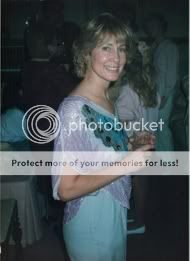
If I can continue to lose weight, then the next project will be to keep it off.
Wish me luck, or discipline, or whatever it takes. I’m sure I’ll need it.
Hopefully you are not now an ounce heavier than when you started reading this long tale.
Saturday, April 08, 2006
Pardo's Push
The Officers' Club: Piggyback Hero reminds me of my post that was inspired through my efforts to contact buddies from RAF Bentwaters in England, "Pardo's Push - Bravery, Ingenuity, Loyalty." Many years passed before this extraordinary story was given the attention it deserved and its participants received recognition for service above and beyond the call of duty.
Monday, March 27, 2006
England, 1970 To 1975
January 1970, Jeffrey was just a year old, and we were off to England. This was another example of the Air Force working in mysterious ways its wonders to perform. During the previous fifteen months I was in the MBA program at Michigan State, and at first I was certain that the Air Force would send me to Viet Nam upon completion. For the past three years the Air Force had told me my next assignment would be Viet Nam. But first I was sent for almost two years to the University of Arizona for a BS in Accounting, then Officer Training School at Medina Annex, Lackland Air Force Base, San Antonio, Texas for a commission as a 2nd Lieutenant, and then immediately to Michigan State for the MBA program. Somehow the Viet Nam assignment I was “frozen” for never came up.
What did come up surprised me. Ent Air Force Base Colorado. I received a notification from the Air Force Personnel Center in the mail during summer, 1969, that I would be the Budget Officer at Ent AFB, downtown Colorado Springs, Colorado. Marilynn and I were very happy at the prospect of a Colorado assignment. Marilynn was born in Colorado at La Junta, which is in the southeastern corner and is a lot more like Kansas than Colorado. If Dorothy and Toto would have landed there, Dorothy would have told Toto: “Toto, I think we’re still in Kansas.”
Colorado Springs would be totally different. Outside of the San Antonio area – which at that time included Lackland, Kelly, Randolph, and Brooks Air Force Bases – Colorado Springs was the spiritual center of the Air Force. The Air Force Academy is just outside of town, and Ent and Peterson Air Force Bases were in town.
We started planning our move to Colorado, and one of the first things we did was buy a new car. That part was spurred by the massive engine failure of my old car, an American Motors Rambler, which excelled at giving me examples of why American Motors is no longer with us. Michigan State University is in East Lansing, which is as you would expect just east of Lansing. Lansing was the home of Oldsmobile for over 100 years until production stopped in 2004. When I was there in 1968-1969, Oldsmobile was still going strong. In the American car market, Japanese cars were laughed at, and Volkswagen just had the most humorous ads. The big three US auto manufacturers were no laughing matter. They were the unchallenged masters of all that was holy to the American male, and the gas they guzzled only cost two-bits a gallon.
I bought a 1969 Oldsmobile Vista-Cruiser station wagon, with enormous V-8 and optional third row of seats, perfect for cruising across the United States between California and Colorado with Marilynn and sons Bruce, Scott, and Jeffrey. Very soon after taking delivery, another letter from the Air Force arrived in my mailbox. Without any warning or explanation, my assignment had been changed to be the Budget Officer serving in the 81st Combat Support Group, 81st Tactical Fighter Wing, Royal Air Force Base Bentwaters, Suffolk, England, United Kingdom. Notification was soon followed by orders and information about my new assignment. Life got complicated quickly.
My support base while attending Michigan State was Selfridge Air Force Base. As I was preparing for the shipment to England, Selfridge was preparing to be inactivated as an Air Force Base and to be reconstituted as a Michigan Air National Guard Base. My initial paperwork to arrange the transportation of our family and our household goods was boxed up and sent off to I still don’t know where. After a nervous month passed with no progress apparently being made, I started the paperwork shuffle again. We drove to Selfridge on the northern shore of Lake St. Clair, north of Detroit, for passports for Marilynn and the boys, and to start the paperwork to ship our household goods and car to England. That was when I received the unwelcome good advice that I shouldn’t take my “Yank Tank” to England. It was too big for the roads, had left-hand steering in a country that required left-hand driving, and it would be extremely difficult to get spare parts and competent repairs and maintenance. In other words, it would be best to get rid of my brand new car, and buy something more suitable when we got to England. I reluctantly agreed, used the car a final time to drive us back to California on leave after graduating in early December, and luckily found a buyer for it just days before we got on the plane.
The first leg of our journey was flown from San Francisco to Philadelphia, then by bus to McGuire Air Force Base. As luck would have it, we were expected at McGuire. In fact, the guys in the Passenger Terminal almost fell over each other to gawk at the “2nd Lieutenant with a wife and three kids.” And they were also eager to tell me that, since my transportation had been arranged and I had gone off for thirty days of leave in California, the flight schedule had been changed and the plane I expected to leave on tomorrow had left yesterday. But no problem. I was booked on the next flight out leaving in three days. I guess it’s easy for a guy with a car and a house nearby to tell a guy with a wife and three little sons, no car, and no hotel room reserved, that there is no problem with spending an unexpected extra three days at a base in New Jersey in the dead of winter. Fortunately, we were able to get a room on base close enough to a snack bar that we didn’t freeze too badly while walking around in our California “winter clothes.”
We boarded the Boeing 707 and took off for RAF Mildenhall, England, late in the evening on January 13. I was impressed by the décor of the chartered plane; it was decorated in a Caribbean Islands motif, since its usual use when not chartered by the Air Force was to be chartered by tour companies to fly tourists to the Caribbean. The stewardesses were also appropriately attired for a tropical excursion, wearing high heels, light-weight flowery blouses, and mini-skirts. Little did we know as we climbed above cloudy and snow-covered New Jersey that we were embarking on one of the longest days of our lives.
The first sign that our trip to England was not going to be as simple and uncomplicated as we thought was when the pilot announced that bad weather over England and Germany was going to force us to divert to Cologne, Germany, to unload passengers going to bases in Germany to be taken by buses to their destination base, Rhein-Main AFB near Frankfurt. Those of us going to England would be delivered to RAF Mildenhall on the return flight to McGuire, after picking up passengers leaving Germany who would be bused to Cologne from Rhein-Main.
When we landed at Cologne, we were told we would have to leave the plane briefly so the ground crew could clean and refuel it, and restock passenger drinks and meals. Since all of this would be done quickly, we were advised that we could leave all our stuff on board. Fortunately, we took almost all of Jeffrey’s things with us – diaper bag, plenty of diapers (cloth ones in those days), baby bottles and baby food. We wouldn’t get back on the plane again for six hours.
(The next installment is about The Coach and Horses, Melton, where we lived for many weeks as I learned and intensively performed my Budget Officer duties. Click on the highlighted title, or here, to continue this tale.)
(Or click on the Air Force label below to go to all my stories about Air Force life)
What did come up surprised me. Ent Air Force Base Colorado. I received a notification from the Air Force Personnel Center in the mail during summer, 1969, that I would be the Budget Officer at Ent AFB, downtown Colorado Springs, Colorado. Marilynn and I were very happy at the prospect of a Colorado assignment. Marilynn was born in Colorado at La Junta, which is in the southeastern corner and is a lot more like Kansas than Colorado. If Dorothy and Toto would have landed there, Dorothy would have told Toto: “Toto, I think we’re still in Kansas.”
Colorado Springs would be totally different. Outside of the San Antonio area – which at that time included Lackland, Kelly, Randolph, and Brooks Air Force Bases – Colorado Springs was the spiritual center of the Air Force. The Air Force Academy is just outside of town, and Ent and Peterson Air Force Bases were in town.
We started planning our move to Colorado, and one of the first things we did was buy a new car. That part was spurred by the massive engine failure of my old car, an American Motors Rambler, which excelled at giving me examples of why American Motors is no longer with us. Michigan State University is in East Lansing, which is as you would expect just east of Lansing. Lansing was the home of Oldsmobile for over 100 years until production stopped in 2004. When I was there in 1968-1969, Oldsmobile was still going strong. In the American car market, Japanese cars were laughed at, and Volkswagen just had the most humorous ads. The big three US auto manufacturers were no laughing matter. They were the unchallenged masters of all that was holy to the American male, and the gas they guzzled only cost two-bits a gallon.
I bought a 1969 Oldsmobile Vista-Cruiser station wagon, with enormous V-8 and optional third row of seats, perfect for cruising across the United States between California and Colorado with Marilynn and sons Bruce, Scott, and Jeffrey. Very soon after taking delivery, another letter from the Air Force arrived in my mailbox. Without any warning or explanation, my assignment had been changed to be the Budget Officer serving in the 81st Combat Support Group, 81st Tactical Fighter Wing, Royal Air Force Base Bentwaters, Suffolk, England, United Kingdom. Notification was soon followed by orders and information about my new assignment. Life got complicated quickly.
My support base while attending Michigan State was Selfridge Air Force Base. As I was preparing for the shipment to England, Selfridge was preparing to be inactivated as an Air Force Base and to be reconstituted as a Michigan Air National Guard Base. My initial paperwork to arrange the transportation of our family and our household goods was boxed up and sent off to I still don’t know where. After a nervous month passed with no progress apparently being made, I started the paperwork shuffle again. We drove to Selfridge on the northern shore of Lake St. Clair, north of Detroit, for passports for Marilynn and the boys, and to start the paperwork to ship our household goods and car to England. That was when I received the unwelcome good advice that I shouldn’t take my “Yank Tank” to England. It was too big for the roads, had left-hand steering in a country that required left-hand driving, and it would be extremely difficult to get spare parts and competent repairs and maintenance. In other words, it would be best to get rid of my brand new car, and buy something more suitable when we got to England. I reluctantly agreed, used the car a final time to drive us back to California on leave after graduating in early December, and luckily found a buyer for it just days before we got on the plane.
The first leg of our journey was flown from San Francisco to Philadelphia, then by bus to McGuire Air Force Base. As luck would have it, we were expected at McGuire. In fact, the guys in the Passenger Terminal almost fell over each other to gawk at the “2nd Lieutenant with a wife and three kids.” And they were also eager to tell me that, since my transportation had been arranged and I had gone off for thirty days of leave in California, the flight schedule had been changed and the plane I expected to leave on tomorrow had left yesterday. But no problem. I was booked on the next flight out leaving in three days. I guess it’s easy for a guy with a car and a house nearby to tell a guy with a wife and three little sons, no car, and no hotel room reserved, that there is no problem with spending an unexpected extra three days at a base in New Jersey in the dead of winter. Fortunately, we were able to get a room on base close enough to a snack bar that we didn’t freeze too badly while walking around in our California “winter clothes.”
We boarded the Boeing 707 and took off for RAF Mildenhall, England, late in the evening on January 13. I was impressed by the décor of the chartered plane; it was decorated in a Caribbean Islands motif, since its usual use when not chartered by the Air Force was to be chartered by tour companies to fly tourists to the Caribbean. The stewardesses were also appropriately attired for a tropical excursion, wearing high heels, light-weight flowery blouses, and mini-skirts. Little did we know as we climbed above cloudy and snow-covered New Jersey that we were embarking on one of the longest days of our lives.
The first sign that our trip to England was not going to be as simple and uncomplicated as we thought was when the pilot announced that bad weather over England and Germany was going to force us to divert to Cologne, Germany, to unload passengers going to bases in Germany to be taken by buses to their destination base, Rhein-Main AFB near Frankfurt. Those of us going to England would be delivered to RAF Mildenhall on the return flight to McGuire, after picking up passengers leaving Germany who would be bused to Cologne from Rhein-Main.
When we landed at Cologne, we were told we would have to leave the plane briefly so the ground crew could clean and refuel it, and restock passenger drinks and meals. Since all of this would be done quickly, we were advised that we could leave all our stuff on board. Fortunately, we took almost all of Jeffrey’s things with us – diaper bag, plenty of diapers (cloth ones in those days), baby bottles and baby food. We wouldn’t get back on the plane again for six hours.
(The next installment is about The Coach and Horses, Melton, where we lived for many weeks as I learned and intensively performed my Budget Officer duties. Click on the highlighted title, or here, to continue this tale.)
(Or click on the Air Force label below to go to all my stories about Air Force life)
Friday, March 03, 2006
Travelling With A Water Bed
At the end of my fourth year stationed in England, we moved from the big farmhouse in Saxmundham, Suffolk, into Air Force military family housing on Royal Air Force (RAF) Woodbridge, near Ipswich. Not long after we moved into our new house, Marilynn’s parents, Dean and Priscilla Miller, traveled from Vallejo, California, to visit us. We drove to Heathrow Airport, near London, to pick them up. When I remarked that one suitcase was very heavy, Dean explained that it was a water bed.
Among other things we talked about as we drove home, I mentioned that I thought it was really odd to travel with a water bed. Dean and Priscilla couldn’t agree with me in the least. They told me how much they now loved water beds, and how they just couldn’t bring themselves to sleep in a regular bed more than a day, or two days at the most. They were visiting us for almost three weeks. Much too long to sleep in anything but a water bed.
When we got home and unpacked the water bed suitcase, I was not surprised to discover that it was not a complete water bed. They had brought a plastic liner, a heating pad and thermostat, and a water bed mattress. The rest of the bed we would have to buy locally and build ourselves. Since as far as I knew we were about to have the first water bed in England, we would not be able to just get what we needed from a British water bed shop.
“How soon do you plan to be sleeping on this water bed?” I asked Dean.
“Tomorrow night.”
Then we got really busy. Our first stop was a building supply store, where we bought about 30 feet of 2”X8” boards, two 4’X8’ sheets of ¾” plywood, and 12 concrete blocks. Next we visited the Woodbridge Air Base scrap yard, and found some sheet metal which we bent and drilled for corner braces.
Armed with the necessary materials, the actual assembly went very quickly and smoothly. We measured and cut the boards to form the frame for the mattress, then joined the boards with the corner braces. Next we cut the plywood to the dimensions of the bottom of the mattress frame, and fastened the plywood to the frame. We stacked the concrete blocks to form four pedestals, and then put the frame on top. The heating pad went into the frame first, then the plastic liner, then the mattress.
The last part, filling the mattress with water, seemed to take a long time, probably because we didn’t have much to do except keep checking that the mattress filled evenly and didn’t bind in the frame. The step that took the longest by far was also the easiest – heating the water to the proper temperature. Dean assured me that, as wonderful as water beds were for sleeping, you would have a most miserable night in them if the water wasn’t warm enough.
The water bed was ready for use their second night with us, as planned, and Dean and Priscilla slept in it with no problems for the rest of their stay with us – except for the two nights we slept in our fourteen foot trailer when we took them to London. There was no way that water bed could have gone in that trailer, although I’m sure Dean thought about it.
When they went back to Vallejo, they left the water bed with us. Soon some of our friends, other young Air Force couples, heard that we had a water bed, and hinted they would like to sleep over and “check it out.” I think their interest in trying out the water bed had less to do with getting a good night’s sleep, and more with rumors that water beds would add new dimensions to their sex lives.
I must confess, I thought the water bed was a complete waste for all purposes, but I’ll be the first to admit that I didn’t feel motivated to change. Since expectations can determine outcomes, those who expected significant improvements in their sleep or whatever in a water bed have a much better chance of finding it than those who don’t.
It didn’t take long before my boys started arguing over who got to sleep in the water bed, so we brought it with us when I was transferred to Scott Air Force Base, Illinois. By then my middle son Scott claimed it as his, and having it soon came in handy when Dean and Priscilla visited us.
Among other things we talked about as we drove home, I mentioned that I thought it was really odd to travel with a water bed. Dean and Priscilla couldn’t agree with me in the least. They told me how much they now loved water beds, and how they just couldn’t bring themselves to sleep in a regular bed more than a day, or two days at the most. They were visiting us for almost three weeks. Much too long to sleep in anything but a water bed.
When we got home and unpacked the water bed suitcase, I was not surprised to discover that it was not a complete water bed. They had brought a plastic liner, a heating pad and thermostat, and a water bed mattress. The rest of the bed we would have to buy locally and build ourselves. Since as far as I knew we were about to have the first water bed in England, we would not be able to just get what we needed from a British water bed shop.
“How soon do you plan to be sleeping on this water bed?” I asked Dean.
“Tomorrow night.”
Then we got really busy. Our first stop was a building supply store, where we bought about 30 feet of 2”X8” boards, two 4’X8’ sheets of ¾” plywood, and 12 concrete blocks. Next we visited the Woodbridge Air Base scrap yard, and found some sheet metal which we bent and drilled for corner braces.
Armed with the necessary materials, the actual assembly went very quickly and smoothly. We measured and cut the boards to form the frame for the mattress, then joined the boards with the corner braces. Next we cut the plywood to the dimensions of the bottom of the mattress frame, and fastened the plywood to the frame. We stacked the concrete blocks to form four pedestals, and then put the frame on top. The heating pad went into the frame first, then the plastic liner, then the mattress.
The last part, filling the mattress with water, seemed to take a long time, probably because we didn’t have much to do except keep checking that the mattress filled evenly and didn’t bind in the frame. The step that took the longest by far was also the easiest – heating the water to the proper temperature. Dean assured me that, as wonderful as water beds were for sleeping, you would have a most miserable night in them if the water wasn’t warm enough.
The water bed was ready for use their second night with us, as planned, and Dean and Priscilla slept in it with no problems for the rest of their stay with us – except for the two nights we slept in our fourteen foot trailer when we took them to London. There was no way that water bed could have gone in that trailer, although I’m sure Dean thought about it.
When they went back to Vallejo, they left the water bed with us. Soon some of our friends, other young Air Force couples, heard that we had a water bed, and hinted they would like to sleep over and “check it out.” I think their interest in trying out the water bed had less to do with getting a good night’s sleep, and more with rumors that water beds would add new dimensions to their sex lives.
I must confess, I thought the water bed was a complete waste for all purposes, but I’ll be the first to admit that I didn’t feel motivated to change. Since expectations can determine outcomes, those who expected significant improvements in their sleep or whatever in a water bed have a much better chance of finding it than those who don’t.
It didn’t take long before my boys started arguing over who got to sleep in the water bed, so we brought it with us when I was transferred to Scott Air Force Base, Illinois. By then my middle son Scott claimed it as his, and having it soon came in handy when Dean and Priscilla visited us.
Friday, February 24, 2006
Capsule Summary Of My Life
My family came to the Mendocino Coast from Southern California in early September, 1949. Pop had been an oilfield “roughneck” in Southern California. One of his six older brothers, Walter, (he also had seven sisters) ran a small store and bar just south of the Vue Restaurant in Gualala, and he wrote us in early 1949 that “the saw mills are hiring.” Mom was tired of the constant moving every few months to the next oil rig in another Southern California town. Lawndale, Filmore, Newhall, Redondo Beach, Carpenteria, Foster's Park – I went to the first grade in each of these towns except Newhall and Foster's Park(summertime) for short periods. We towed our trailer to Point Arena with our old Buick, and parked it next to the abandoned high school building (since demolished) and my brother Ron and I entered the combined first and second grade class taught by Mrs. Mae Phillips. Our other combined classes and teachers: third and fourth grades, Mrs. O’Neal; fifth and sixth grades, Ms. Branstrom; seventh and eighth grades (and principal), Mr. Russell.
Pop quickly got a job setting chokers for the Empire Lumber Company in the Wheatfield Forks area of the Gualala River. Soon we moved into one large room of the abandoned high school across from the Catholic Church, then in 1952 we moved into the old McMillen house (also now demolished) across from the Methodist Church. In 1955 we started building our own home behind the grammar school on the corner of Lake and Main, and moved into it in 1956. I graduated from Point Arena High in 1960, went a year each to Humboldt State and Santa Rosa Junior College, then enlisted in the Air Force in August, 1962, when I was too broke to continue in college.
My over twenty-one years in the Air Force were very enjoyable and rewarding and I would not hesitate to recommend a military career to all young men and women looking for challenges, adventure, and the camaraderie which is so rare in this world and in our busy lives. After Basic Training I went to Indiana University for nine months of intensive Russian language training. Early in the training, I returned to California on leave just long enough to marry my high school sweetheart, Marilynn Miller, Point Arena High Class of 1962. We had three sons, and celebrated our Silver Anniversary in 1988, two months before she died of breast cancer.
Following Russian language school at Indiana University, I went to radio intercept schools in San Angelo, Texas and The National Security Agency in Maryland. After all the training, I was finally sent in 1964 to my first real job in the Air Force, as a Russian language radio intercept operator at Karamursel Air Station, Turkey, on the south shore of the Sea of Marmara near Istanbul. After a year in Turkey, we had a short stay at Mather Air Force Base near Sacramento before the Air Force sent me to the University of Arizona for a degree in accounting. The first I had ever heard of accounting was when the Air Force told me that I would be studying it, and I had to look it up in the dictionary. Two years later I had my degree, then went to Officer Training School (my second hot summer in military training in San Antonio) and was commissioned a Second Lieutenant in September, 1968. The day I was commissioned I was already late for my next assignment, attending Michigan State University for the next fifteen months to earn a Master in Business Administration.
Finally in January of 1970 I started working at a real job again. I was the Budget Officer at RAF Bentwaters and Woodbridge bases, near Ipswich, Suffolk County, England for over five years, the best job of my life. Following England, in 1975 I worked as a command-level Budget Officer, then as an Accounting and Finance Officer, at Scott AFB, Illinois, near St. Louis, Missouri. My next assignment was as Controller for a Military Airlift Unit stationed at Hickam AFB, next to Pearl Harbor, Hawaii. My final Air Force assignment was as an Internal Auditor at Travis AFB, where I retired in 1984.
On the day I retired from the Air Force, I had just completed my first month working as an Internal Auditor at Lockheed in Sunnyvale. After ten years at Lockheed, where I got to work on projects involving the Space Shuttle, Hubble Space Telescope, and the Trident II submarine launched ballistic missile, I was caught in a massive lay-off in 1994. I then worked for two years for Power Spectra in Sunnyvale, a ground-penetrating radar startup that didn’t make it, then spent a year with Kaiser Permanente in Oakland before retiring in 1998.
Alice and I married in 1989, and when I retired we finally had the opportunity to indulge our travel bugs in a big way. The first thing we did was our trip of a lifetime, a four-month bike trip through Germany, England, Isle of Mann, Ireland, and Wales. This was not a tour. We stayed in bed and breakfast inns and homes, and carried all of our things with us on the bikes. We had done very little bike riding, and nothing like this before in our lives. We had the time of our lives.
Alice and I agree, retirement is hard work, but we both are up to any task we can do together.
Pop quickly got a job setting chokers for the Empire Lumber Company in the Wheatfield Forks area of the Gualala River. Soon we moved into one large room of the abandoned high school across from the Catholic Church, then in 1952 we moved into the old McMillen house (also now demolished) across from the Methodist Church. In 1955 we started building our own home behind the grammar school on the corner of Lake and Main, and moved into it in 1956. I graduated from Point Arena High in 1960, went a year each to Humboldt State and Santa Rosa Junior College, then enlisted in the Air Force in August, 1962, when I was too broke to continue in college.
My over twenty-one years in the Air Force were very enjoyable and rewarding and I would not hesitate to recommend a military career to all young men and women looking for challenges, adventure, and the camaraderie which is so rare in this world and in our busy lives. After Basic Training I went to Indiana University for nine months of intensive Russian language training. Early in the training, I returned to California on leave just long enough to marry my high school sweetheart, Marilynn Miller, Point Arena High Class of 1962. We had three sons, and celebrated our Silver Anniversary in 1988, two months before she died of breast cancer.
Following Russian language school at Indiana University, I went to radio intercept schools in San Angelo, Texas and The National Security Agency in Maryland. After all the training, I was finally sent in 1964 to my first real job in the Air Force, as a Russian language radio intercept operator at Karamursel Air Station, Turkey, on the south shore of the Sea of Marmara near Istanbul. After a year in Turkey, we had a short stay at Mather Air Force Base near Sacramento before the Air Force sent me to the University of Arizona for a degree in accounting. The first I had ever heard of accounting was when the Air Force told me that I would be studying it, and I had to look it up in the dictionary. Two years later I had my degree, then went to Officer Training School (my second hot summer in military training in San Antonio) and was commissioned a Second Lieutenant in September, 1968. The day I was commissioned I was already late for my next assignment, attending Michigan State University for the next fifteen months to earn a Master in Business Administration.
Finally in January of 1970 I started working at a real job again. I was the Budget Officer at RAF Bentwaters and Woodbridge bases, near Ipswich, Suffolk County, England for over five years, the best job of my life. Following England, in 1975 I worked as a command-level Budget Officer, then as an Accounting and Finance Officer, at Scott AFB, Illinois, near St. Louis, Missouri. My next assignment was as Controller for a Military Airlift Unit stationed at Hickam AFB, next to Pearl Harbor, Hawaii. My final Air Force assignment was as an Internal Auditor at Travis AFB, where I retired in 1984.
On the day I retired from the Air Force, I had just completed my first month working as an Internal Auditor at Lockheed in Sunnyvale. After ten years at Lockheed, where I got to work on projects involving the Space Shuttle, Hubble Space Telescope, and the Trident II submarine launched ballistic missile, I was caught in a massive lay-off in 1994. I then worked for two years for Power Spectra in Sunnyvale, a ground-penetrating radar startup that didn’t make it, then spent a year with Kaiser Permanente in Oakland before retiring in 1998.
Alice and I married in 1989, and when I retired we finally had the opportunity to indulge our travel bugs in a big way. The first thing we did was our trip of a lifetime, a four-month bike trip through Germany, England, Isle of Mann, Ireland, and Wales. This was not a tour. We stayed in bed and breakfast inns and homes, and carried all of our things with us on the bikes. We had done very little bike riding, and nothing like this before in our lives. We had the time of our lives.
Alice and I agree, retirement is hard work, but we both are up to any task we can do together.
Subscribe to:
Posts (Atom)