(Often letters to The Editor of the Independent Coast Observer (ICO), our Gualala, California weekly newspaper, are very personal, and I am pleased to be able to share some of the letters and my responses. The Wise but wrong letter below was in the 17 February 2006 ICO, and was in response to a letter Alice wrote in response to an earlier letter to me. I also responded to that earlier letter, but my response did not run in the ICO. Pity. My attempt at poetry wasted.)
Wise but wrong
Editor:
While suffering through the winter here on the Big Island of Hawaii, I was amused, when catching up on the home news in the ICO, to read Alice Combs' letter complaining of the ignorance of some readers to her husbands' mental capacities. Now, I don't know Mr. Combs personally, but from reading his contributions to the letters department in the ICO over these past years I am highly impressed that such a wise and learned man could produce such wrong thinking.
That someone with such vast learning experience, not to mention a Lions Club volunteer, and a lover of children, could be incorrect in his vision of the world is, of course, not unusual. One could find countless examples on both sides of the fence (post).
Conversely, the inverse also applies. Many of the world's best thinkers and leaders had little formal education, not to mention the fact that they never read Time magazine or picked up papers along Highway 1.
As soon as I get home in March, just in case, I plan to go out to the Stornetta Park, pick up some trash, and then get some serious reading done. Then maybe I'll have some credibility around here (there).
Editor
Steve, thank you for your courageous stand for press freedom, and thanks to Steve Finz for inviting me to make a joint statement for freedom.
I lived on Oahu through four winters myself, so I can just imagine Rickey Wasserman’s suffering through this winter on the Big Island. From Mr. Wasserman’s observation about how impressed he is about how a person of my abilities could produce so much wrong thinking and incorrect world vision, I must assume that Mr. Wasserman does not agree with most or all of my beliefs. Since Mr. Wasserman did not mention any specific issues, I am left to speculate about areas of disagreement. From what he has gleaned from my letters, Mr. Wasserman must object to a strong national defense, and must favor higher taxes and larger government. He must also applaud hypocritical Democratic leaders, because I frequently write about how Democrats oppose President Bush when he does things for which they applauded Bill Clinton. For examples, attacks on nations like Iraq and Bosnia that didn’t attack us first, and doing it without forming a United Nations coalition. Or warrantless wiretaps.
Of course Mr. Wasserman would oppose winning the war on terrorism. Or reauthorizing the Patriot Act, just cleared by a 96-3 vote for Senate approval. Since I am for them, he must also be against the Free Trade agreements. I believe in personal freedom and responsibility – I wonder if Mr. Wasserman thinks that is mistaken too?
He probably does, since the positions I attribute to him mark Mr. Wasserman as a liberal Democrat. Perhaps I have been unfair to Mr. Wasserman. I certainly know very little about him, obviously less than he knows of me. But logically, if he thinks me a “wrong thinker,” then he must disagree with my beliefs. Or maybe he just thinks I’m wrong, and takes no position himself. That approach could go a long way towards explaining the incoherence of Democrats.
Saturday, February 18, 2006

Friday, February 17, 2006
Stand up for Freedom

Editor
Though it may come as a surprise to many, we are in complete agreement with each other regarding the controversy raging around the satirical cartoons depicting Muhammad. Politicians all the way up to the Secretary General of the United Nations have been using the phrase “freedom with responsibility” in their attempt to be all things to all people. We do not believe freedom of expression includes a responsibility to avoid insulting or offending anyone. We jointly urge the ICO to express solidarity with media all over the world in support of free expression by reprinting the cartoons that originally appeared in Danish publications and that protestors found so offensive.
Michael B. Combs, Gualala
Steven Finz, Sea Ranch
(Published in the ICO on 17 February 2006, accompanied by a "Press Freedom" editorial by Editor Steve McLuaghlin and this Danish cartoon)
Thursday, February 16, 2006
The House We Built

The house we built at 425 Main Street, Point Arena - still standing over sixty-five years later.
(It looked bigger then - it does have a full-size basement)
Our family bought three acres at the corner of Main and Lake Streets, Point Arena, California, that went down over the sidehill behind to border Windy Hollow Road. I think we bought it in 1954, and the whole family pitched in to buy it. Ronald and I chipped in money from our savings accounts we had built up delivering the Santa Rosa Press Democrat for several years.
The first thing we did was help Pop dig a well by hand. He started digging with a pick and shovel at the base of the hill near the most northerly part of our property near Windy Hollow Road. Ron and I pulled the buckets of dirt out of the hole and dumped them. Pop struck water at about four feet (the well was very close to a wet, marshy area). Pop knew before he started digging that we weren’t going to have any trouble finding water.As Pop kept digging, the water poured in faster. He had to keep a pump running constantly, or stop digging. The well was five feet wide, and when Pop dug down about sixteen feet, he said it was time to quit.
Pop built a wooden form, and we used a cement mixer to pour a concrete casing with holes in the sides near the bottom to let the water flow in.
Next, we drew up plans for the house. Pop roughed out the dimensions on a piece of typewriter paper, then gave me (12 years old then) a piece of poster paper about two by three feet. Pop’s instructions to me were simple. Measure everything carefully to scale, draw sharp right angles, and be very neat. I took the poster paper, my No. 2 pencil and sharpener, gum eraser, protractor and compass, and steel edged fifteen-inch ruler, and in a couple of days completed the drawing. Anyway, I thought the drawing was complete. Unfortunately, Pop found I made a side dimension wrong, so I flipped the poster paper over and did a corrected drawing on the other side. The second time it passed review, so Pop tacked it onto a piece of plywood, and we started building.
We began by digging a full-sized basement. No other house built on flat land in Point Arena had a basement, but we were going to have one. Pop borrowed a plow horse, harness, and clam-shell scraper (it looks like a wheel barrow without a wheel, is pulled by the horse, and also is known as a Fresno Scraper) from a local rancher and saw mill worker, Johnny Remstedt. Johnny lived with his wife, son, and some very lovely daughters about a mile north of us on Windy Hollow Road. I think Donna, the youngest of the pretty Remstedt daughters, had named the horse Prince.
By the by, Windy Hollow is well named. The hollow runs due north from our old property to the Pacific Ocean, and the wind comes unimpeded all the way from the Arctic across the Pacific, and it builds up speed as it funnels down the ever narrowing hollow until it reaches full force as it hits the exterior wall of the bedroom Ron and I shared.
Ron and I spent quite a bit of the summer of 1954 digging the basement, with the horse doing most of the work. Ron and I would alternate, one working the horse and clam-shell scraper, while the other used a mattock to loosen the dirt. Working the horse was fun. We looped the reins behind our neck, grasped a handle with each hand, and tilted the handles up enough to get the scraper to bite into the dirt. When the scraper was full of dirt, we dropped the handles and used the reins to guide the horse to the dirt pile. To dump the dirt, we just lifted the handles up high and flipped them forward to turn the scraper upside down. We then stopped the horse, righted the scraper, guided the horse back down the ramp into the basement, and repeated the process.
After a couple of weeks of good digging, Pop started checking the depth each day when he got home from the saw mill. One day he spent quite a bit of time checking all around the hole, then told Ron and I that it was deep enough, we could stop digging.
That was a very happy, sad moment. It had been fun working Prince, and it was kind of sad to realize that the part of the project we had been so useful on was done. The next phase would be done mostly by Pop and a skilled carpenter named Henry Eddy. Ron and I would be working as unskilled helpers. But the house, our home, was becoming more real each day.
Ron and I were still valuable workers. We were good at mixing concrete in the cement mixer, and we poured a lot of concrete – the floor of the basement, the basement walls, the foundation – all concrete, all mixed by us in the cement mixer. It wasn’t until many years later that premixed concrete trucks replaced portable cement mixers in the Point Arena/Gualala area.
When the foundation was poured, the next really important project we helped on was putting down the wooden floor. As soon as the floor was finished, we moved into the basement and lived there, because the floor also served as a roof for the basement. Now we could live in the basement while completing the house above.
Wednesday, February 15, 2006
The Old High School

We left southern California for northern California in the summer of 1949. But what we really left behind was moving our trailer to the next town and entering the next school every three months, as Pop chased oil field work from one drilling rig to the next. On September 10, 1949 we parked our trailer on a concrete slab, once a tennis court, next to a big old abandoned two-story building that had been the Point Arena High School from the early 1900’s until about 1936, and temporarily the elementary school until the early 1940’s. After a few months in the trailer, Pop arranged for us to rent one big room in the old high school building and we moved in.
The room was about forty feet by fifty feet, with an area about ten feet wide at the rear separated from the rest by a partition that ran about three quarters across. Mom and Pop had their bed in the southwest quadrant, the stove, sink, and dining table were in the southeast quadrant, and a couch and easy chairs formed our “living room” on the south side of the partition. Younger brother Ronald and I had our bunk beds in the partitioned area in the northwest quadrant. A door to the central hall and staircase was in the northeast quarter, giving us access to two very large bathrooms, and another door led into what had been the science and shop room. The center of the room had a laboratory table with sinks and Bunsen burner hose connections, and the walls had pegs and painted silhouettes of the tools that were to be hung there.
Our little family of four were the only inhabitants of this building, which to me at age seven was enormous and exciting. There was a large room, similar to our room, at the southeast corner that I never entered, and never saw anyone enter. It was fascinating to look at it through the dirty windows, full of old furniture. Up the staircase, with its beautiful wooden banister perfect for sliding, were two large and two smaller classrooms. One of the large classrooms had an upright piano, and Mom would use it sometimes to pick out notes for the songs she wrote and was hoping to one day sell and become famous. There was a balcony centered on the north side over the main entrance. We didn’t go on the balcony very often. It was probably the only part of the old building that was a bit dangerous.
California State Highway One passed on the north side about one hundred feet from the building, and there was a concrete walkway from the sidewalk which went through a hedge, past a flagpole, ending at the front entrance. A finely box-trimmed cypress hedge ran along the north and west sides of the grounds, next to the sidewalk and highway on the north side, and provided good shelter from the constant north winds. Across Highway 1 was St. Aloysius Catholic Church, and going east from the church was an open field, then a small house, the rectory and St. Paul’s Methodist Church, and then the Point Arena Elementary School. We only lived in the old abandoned high school for about three years, but in memories it seems like we lived there much longer.
I remember we got our hot water from our wood burning cook stove, which also heated the room. On bath days we would put a large galvanized wash tub on the floor near the stove, and run a hose from the sink to fill it. Mom and Pop would have their baths, removing some water from the tub with a bucket and adding hot water as needed, then Ronald and I would have ours. When finished, we would scoop water from the tub with a bucket until it was lightened enough for us to pick it up and dump the remainder into the sink.
The building was torn down while I was away in the Air Force, I guess about twenty five or thirty years ago. I know it’s gone, but not really. A part of me will always live there.
The room was about forty feet by fifty feet, with an area about ten feet wide at the rear separated from the rest by a partition that ran about three quarters across. Mom and Pop had their bed in the southwest quadrant, the stove, sink, and dining table were in the southeast quadrant, and a couch and easy chairs formed our “living room” on the south side of the partition. Younger brother Ronald and I had our bunk beds in the partitioned area in the northwest quadrant. A door to the central hall and staircase was in the northeast quarter, giving us access to two very large bathrooms, and another door led into what had been the science and shop room. The center of the room had a laboratory table with sinks and Bunsen burner hose connections, and the walls had pegs and painted silhouettes of the tools that were to be hung there.
Our little family of four were the only inhabitants of this building, which to me at age seven was enormous and exciting. There was a large room, similar to our room, at the southeast corner that I never entered, and never saw anyone enter. It was fascinating to look at it through the dirty windows, full of old furniture. Up the staircase, with its beautiful wooden banister perfect for sliding, were two large and two smaller classrooms. One of the large classrooms had an upright piano, and Mom would use it sometimes to pick out notes for the songs she wrote and was hoping to one day sell and become famous. There was a balcony centered on the north side over the main entrance. We didn’t go on the balcony very often. It was probably the only part of the old building that was a bit dangerous.
California State Highway One passed on the north side about one hundred feet from the building, and there was a concrete walkway from the sidewalk which went through a hedge, past a flagpole, ending at the front entrance. A finely box-trimmed cypress hedge ran along the north and west sides of the grounds, next to the sidewalk and highway on the north side, and provided good shelter from the constant north winds. Across Highway 1 was St. Aloysius Catholic Church, and going east from the church was an open field, then a small house, the rectory and St. Paul’s Methodist Church, and then the Point Arena Elementary School. We only lived in the old abandoned high school for about three years, but in memories it seems like we lived there much longer.
I remember we got our hot water from our wood burning cook stove, which also heated the room. On bath days we would put a large galvanized wash tub on the floor near the stove, and run a hose from the sink to fill it. Mom and Pop would have their baths, removing some water from the tub with a bucket and adding hot water as needed, then Ronald and I would have ours. When finished, we would scoop water from the tub with a bucket until it was lightened enough for us to pick it up and dump the remainder into the sink.
The building was torn down while I was away in the Air Force, I guess about twenty five or thirty years ago. I know it’s gone, but not really. A part of me will always live there.
Tuesday, February 14, 2006
Finding Real Beauty In The Galapagos Islands
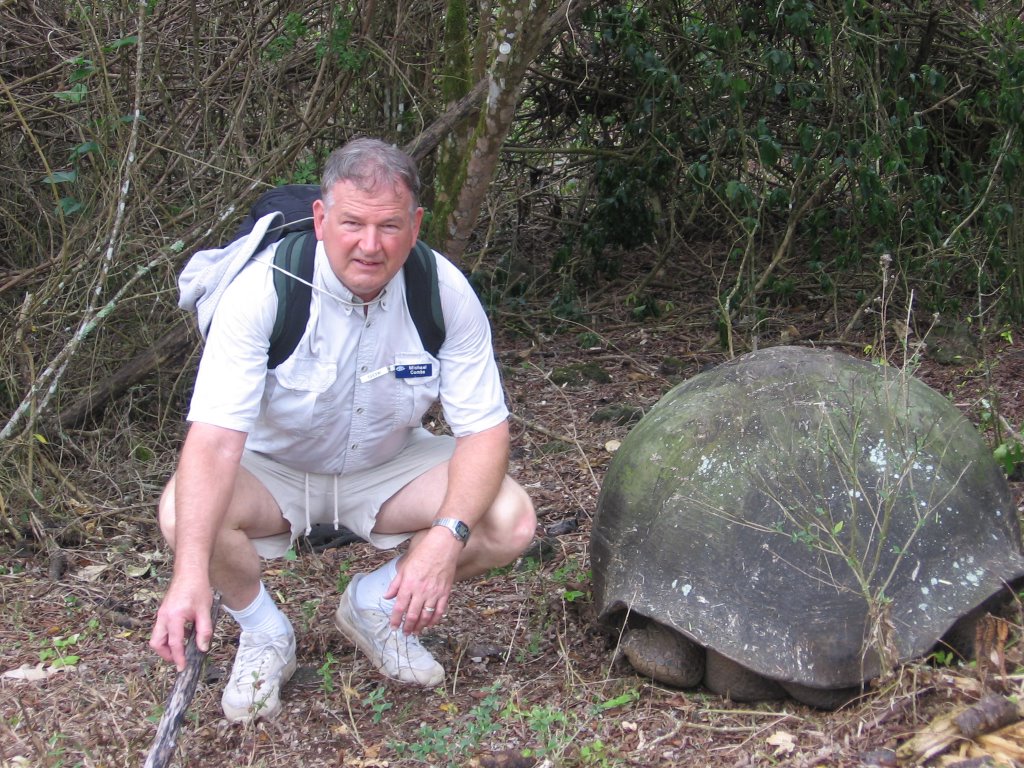
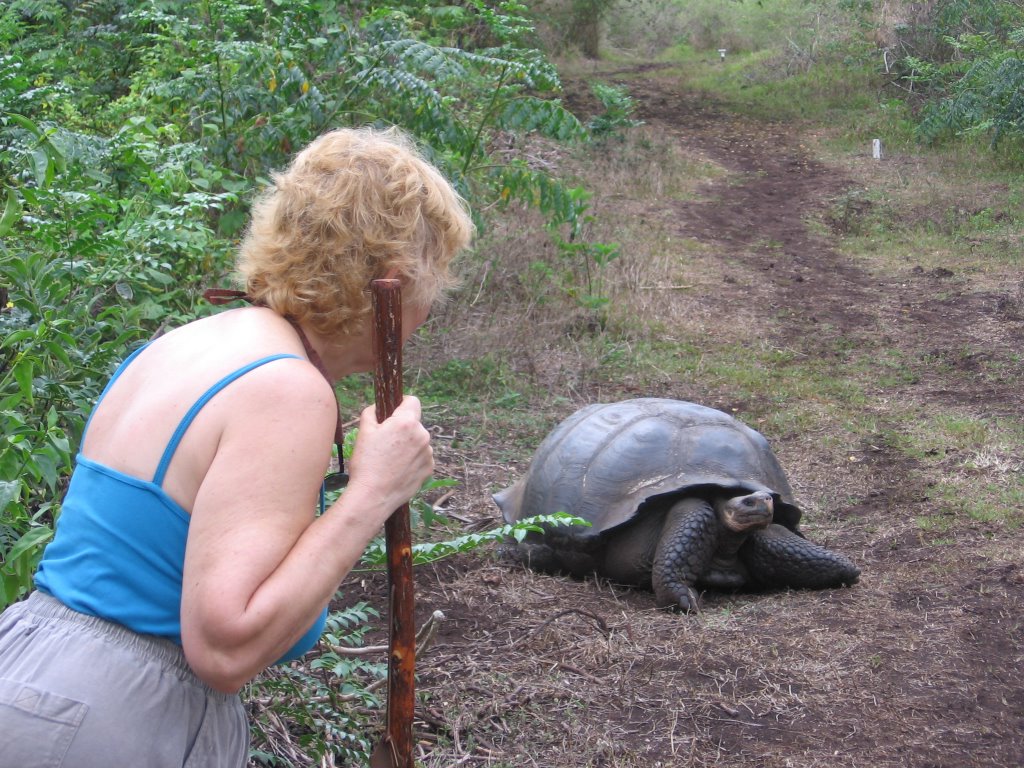
On our last evening on the MS Islander, we all met in the lounge and the microphone was passed around to give each of us a chance to tell our most lasting memory of our week cruising The Galapagos Islands. My turn came early, but the pattern had already been set -- animals, birds, fish – no surprises here. But I recalled our visit to the Tortoise Center, and the tortoise egg incubator.
When it had been decided that endangered tortoises would get human help to hatch eggs in the Center, the goals were to increase the percentage of hatching success and infant tortoise survival, and by incubating the eggs at a higher temperature, to increase the ratio of female to male tortoise hatchlings. More females, a few viral males to service them, a recipe for a tortoise population explosion.
To further help nature, an expensive incubator was designed and built at a stateside university, shipped to the center and installed, and immediately started failing for a variety of reasons, mostly associated with the incubator being unsuited for the primitive Center environment – frequent power outages and fluctuations, salty air, wind driven sand and dust, the long lead time to get and install spare parts – in other words, the incubator worked perfectly in an environment that did not exist within thousands of miles of the Center.
What did the Center researchers do? They took a hair dryer, a simple thermostat, and a pan of water, put it in the egg boxes, and their locally designed system worked perfectly. Making repairs and getting spare parts was easy. A triumph of the human mind!
So while my fellow passengers were impressed by the beauty of this bird, that sea lion, those fish, I was profoundly impressed once more by this display of the beauty of the human mind at work. It is still the greatest of all creations, by whatever creator you wish to credit. The human mind can both comprehend evolution, create God in its own image, and carefully hatch and raise baby tortoises. It is the most beautiful and remarkable thing on Earth, and for all I know, in the Heavens too.
It's The Family After All

We just returned from The Galapagos Islands, where I stumbled upon insights about religion that had eluded me for a lifetime, even though they were always in plain sight. The first occurred in places I had not intended to visit, Catholic churches in Guayaquil and Quito, Ecuador. Our friends, neighbors, and traveling companions Chris and Jan Jewell invited me to attend a Mozart evening in the cathedral near our Guayaquil hotel while Alice got a massage. We made a mistake on the time, and arrived an hour early. The bottom line was we sat through Mass, which we hadn’t intended since none of us are Catholic (I'm a weak-kneed agnostic), but it did get us good seats, because before Mass was over, the cathedral was packed.
Attending Mass, besides getting us good seats for the concert, also gave me plenty of time to observe the cathedral and the worshipers. It soon dawned on me that there were major differences between Catholic and Protestant churches and services, and those differences seemed to be in the attitudes of the worshipers. What were the differences, and why were there differences?
Over a week later, after cruising, snorkeling, kayaking, and hiking The Galapagos Islands almost to exhaustion, we visited Quito for a few days. Alice wanted to visit some of the Quito cathedrals mentioned in a guide book. In one guide book, the author criticized spending money on cathedrals and parks and gardens, instead of spending it on social programs. That remark caused me much irritation, since I couldn’t see why any tourist would want to go to Ecuador to admire their social programs. In fact, as in many parts of the world, tourism is a rapidly growing source of good jobs and investment, improved environmental stewardship and conservation, and the increased economic activity eventually provides substantial funds for social programs. If you just invest in social programs, very little economic activity results and the only lasting growth is in the government bureaucracies that administer the programs and in the inevitable governmental corruption.
In Quito we visited several cathedrals, one built about 1594, another very ornate, and again I was puzzling over the impression that I was missing something. Then I realized what the something was. It was the worshipers themselves. God had been created in their image, and was accessible to them in a very personal way. Unlike the Protestant churches, with their bare crosses, there was a man suffering on this cross, and his grieving mother was nearby sharing his agony. In fact, looking around, the holy family was all about, at various stages of their lives -- Mary with baby Jesus, Jesus talking with the elders who marveled at his wisdom, Jesus driving the money changers from the temple, the crown of thorns, dragging the cross, the suffering, the suffering, the suffering – the glorious resurrection!
Here was God as man. Accessible. Suffering because he cared about the poor peasant, and the poor peasant’s family. No God did that for a poor peasant, except this one.
Allah is unknowing and uncaring. You’re here to obey him. You must obey him, because he has already decided all you will do, all you must do. No choices, no debates, no changes, no substitutions. And no pictures.
At least you could argue with the God of Moses. And argue the Jews did. It makes you feel good to know that God doesn’t always have the last word, that there is a chance you can change his mind. Still it would be nice to know him better.
But in the great Catholic cathedrals, and in the simple adobe churches, you can find Jesus Christ on a cross crucified, and his friends and family there with him, and with you, and with your family. It’s a wonderful feeling, to be a part of the family. For always, and for all time.
I think I'd sell my agnostic soul, if I had one, to have that feeling of belonging.
That peasant doesn't seem so poor after all.
Monday, February 13, 2006
Liberal Recipes For Disaster
Businesses do not pay taxes, or health costs of their employees, or make charitable contributions., they just pass these costs along to us in their costs of goods or services. Since most Americans do not understand accounting, please let me explain. For-profit businesses are in business to make profits. Not to cure all ills, right all wrongs, kiss all hurts and make them go away. They won’t mind if all that happens, but that’s not why they were created.
Anyway, they get their money, which in accounting is called revenue, from you and me. If another business buys from them, that other business got its money from you and me. Eventually, at the top of every money pit, you will find that it is a person, not a business or governmental agency, that is shoveling his or her money into the pit, and that person is the ultimate source of what makes the world go around.
So when we say business should pay more, in taxes, health care, charitable contributions, etc., in accounting terms we would recognize these additional costs as increases to business expenses. If we think businesses should pay more to operate, we are really saying we want to pay more for its product.
On the other hand, businesses are glad to pay these costs and pass them on to us when it gives them a competitive advantage -- they can hire and retain better employees -- but not when the higher cost structure places them at a competitive disadvantage – their taxes are higher than those of competing businesses.
National health care systems cause countries to place huge tax burdens on their businesses and citizens, and the businesses cannot shed these costs when they are placed at a competitive disadvantage. And as the national health care systems become more expensive and fail as the population gets older and needs more services, the situation just gets worse. France and Germany are good examples. Neither county has been able to increase employment significantly for decades, and their economic growth is stagnating.
Of course, the Left would like us to copy the mistakes of others and increase business taxes, demand government provide universal health care or have business pay more, and increase regulations. Then we can participate in and enjoy all the misery the governments admired by the Left dish out to their citizens. Liberals are good at creating recipes for disaster.
Anyway, they get their money, which in accounting is called revenue, from you and me. If another business buys from them, that other business got its money from you and me. Eventually, at the top of every money pit, you will find that it is a person, not a business or governmental agency, that is shoveling his or her money into the pit, and that person is the ultimate source of what makes the world go around.
So when we say business should pay more, in taxes, health care, charitable contributions, etc., in accounting terms we would recognize these additional costs as increases to business expenses. If we think businesses should pay more to operate, we are really saying we want to pay more for its product.
On the other hand, businesses are glad to pay these costs and pass them on to us when it gives them a competitive advantage -- they can hire and retain better employees -- but not when the higher cost structure places them at a competitive disadvantage – their taxes are higher than those of competing businesses.
National health care systems cause countries to place huge tax burdens on their businesses and citizens, and the businesses cannot shed these costs when they are placed at a competitive disadvantage. And as the national health care systems become more expensive and fail as the population gets older and needs more services, the situation just gets worse. France and Germany are good examples. Neither county has been able to increase employment significantly for decades, and their economic growth is stagnating.
Of course, the Left would like us to copy the mistakes of others and increase business taxes, demand government provide universal health care or have business pay more, and increase regulations. Then we can participate in and enjoy all the misery the governments admired by the Left dish out to their citizens. Liberals are good at creating recipes for disaster.
A Burning Desire
“Great Expectations” ended with Alice accepting my proposal at her business, Vulcan, Incorporated, Christmas party five weeks after we met. So Christmas 1988 is upon us, and to many in the San Francisco Bay Area, that means skiing. I had never skied. Had never tried. Alice was a member of the Bota Baggers Singles Ski Club of Dublin and Pleasanton. They skied. They drank. They tried to hop in beds with other members, invariably of the opposite sex. Alice skied, loved to dance, didn’t drink, and frustrated a lot of club members of the opposite sex.
During our first week as an engaged couple – no ring yet, another story there – Alice asked if I had ever been skiing. I replied, “No, but I have a burning desire.”
Fast forward to the week before Christmas, and Alice came to my Walnut Creek house and placed numerous strange looking packages under my Christmas Tree. On Christmas Morning she joined my youngest son, Jeffrey, as we unwrapped our presents. My first package contained a pair of skies, the next ski poles, the third ski pants with bib, the fourth ski boots, the fifth – do you see a pattern here? – ski goggles, then a cap, then gloves, then …. Even I started to notice a theme in the presents Alice gave me. No ties. No cologne. Only ski gear.
So I said/asked: “I don’t ski. Does this mean skiing is in my future?”
Alice replied: “You said you have a burning desire.”
I replied: “Yes, I do, but not for skiing.”
Alice satisfied my burning desire, and about a month later I started skiing too.
During our first week as an engaged couple – no ring yet, another story there – Alice asked if I had ever been skiing. I replied, “No, but I have a burning desire.”
Fast forward to the week before Christmas, and Alice came to my Walnut Creek house and placed numerous strange looking packages under my Christmas Tree. On Christmas Morning she joined my youngest son, Jeffrey, as we unwrapped our presents. My first package contained a pair of skies, the next ski poles, the third ski pants with bib, the fourth ski boots, the fifth – do you see a pattern here? – ski goggles, then a cap, then gloves, then …. Even I started to notice a theme in the presents Alice gave me. No ties. No cologne. Only ski gear.
So I said/asked: “I don’t ski. Does this mean skiing is in my future?”
Alice replied: “You said you have a burning desire.”
I replied: “Yes, I do, but not for skiing.”
Alice satisfied my burning desire, and about a month later I started skiing too.
Monday, February 06, 2006
Freedom of Expression Is For Everyone, Including Muslims

Editor,
When the Nazis persecuted Danish Jews, many thousands of Danes who were not Jews performed heroic acts which saved many Jewish lives. Now that the Danes are being threatened by Islamofascists for cartoons of Mohammed published about six months ago, it is time for all newspapers, magazines, and TV networks to demonstrate our commitment to freedom of speech by running one or more of the cartoons now and until the Muslims learn the folly of trying to stomp all over our Constitution. This is one issue where liberals and conservatives can find common cause.
(Note: Click here to see all the cartoons)
Major Michael B. Combs, U S Air Force, Retired
Salmon Rushdie admirer and honorary Jew
P O Box 1639, Gualala, CA 95445
Saturday, January 21, 2006
Not A Genuine Black Man
This is the title of the exceptional one-man show we saw Thursday evening at the Marsh Theater south of Market Street, San Fran (Valencia and 22nd). The performance has run almost two years, both in SF and in LA.
It is the story of Brian Copeland growing up black in what was then almost all white San Leandro, next to Oakland. Brian wrote and performs it. Soon it will be an HBO series, released in book form, and I hear that Brian is also taking it to Broadway. For more (information, tickets) go to www.briancopeland.com .
Among many things, Brian is special because he doesn’t believe in Reparations. But, “If they are crazy enough to send me a check, I’ll cash it. I’m not crazy.” Brian also apologizes for not being a genuine black, including apologies for not dealing crack, not running off and leaving his wife and children, not doing a lot of things that would make him a “genuine” black.
Of course, these are all of the things that endeared Brian to me. But Brian is far from being a right-wing propagandist and traitor to his race. His life experiences included a lot of blatant racial insults, perhaps more upsetting because they occurred in liberal northern California, right in the shadow of Berkeley. However, Brian overcame adversity and, in the process, has created a performance that is so memorable that I’m ashamed that I had prejudged it and wondered what in the heck Alice had dragged me off to this time.
Now I’m trying to do you a special favor. If you catch Brian’s performance, you will profusely thank me for the recommendation.
It is the story of Brian Copeland growing up black in what was then almost all white San Leandro, next to Oakland. Brian wrote and performs it. Soon it will be an HBO series, released in book form, and I hear that Brian is also taking it to Broadway. For more (information, tickets) go to www.briancopeland.com .
Among many things, Brian is special because he doesn’t believe in Reparations. But, “If they are crazy enough to send me a check, I’ll cash it. I’m not crazy.” Brian also apologizes for not being a genuine black, including apologies for not dealing crack, not running off and leaving his wife and children, not doing a lot of things that would make him a “genuine” black.
Of course, these are all of the things that endeared Brian to me. But Brian is far from being a right-wing propagandist and traitor to his race. His life experiences included a lot of blatant racial insults, perhaps more upsetting because they occurred in liberal northern California, right in the shadow of Berkeley. However, Brian overcame adversity and, in the process, has created a performance that is so memorable that I’m ashamed that I had prejudged it and wondered what in the heck Alice had dragged me off to this time.
Now I’m trying to do you a special favor. If you catch Brian’s performance, you will profusely thank me for the recommendation.
Who is the Fool?
(I love to mix it up, in letters to editors, anyway. But it is a great feeling when someone covers your back, and stands up for you when the invectives start flying hot and heavy. It's nice not to have to try to tell a bunch of liberals, "I am not a fool." Since Slick Willy stood up and declaimed that "I didn't have sex with that woman," people are a lot more sceptical about that sort of thing.
Of course, Alice hasn't seen the Great Expectations post yet - things could change, fast!
UPDATE: She's seen it! And I'm still alive - so far so good! Now to write the follow-up story while she's softened up.)
Editor
I, Michael Combs’ wife, am responding to Margot Bullock’s unsubstantiated, emotional, nonintellectual, hateful name calling letter referring to Michael’s words as “unconscious of thoughtful intent:”
Ms. Bullock, Michael is a powerhouse of knowledge. Not only is he amazingly versed on U.S. and world history, but he is always investigating the current politics by regularly reading Time, U.S. News & World Report, Newsweek and several other periodicals. He keeps up with the internet news, including The Drudge Report.
You are probably painfully aware that Michael has documentation to back up every assertion he makes in the ICO. You are so upset that Michael’s assertions clash with your agenda, that since you cannot refute him with logic, you lash out like a naughty child, calling him a “fool.”
More about Michael: He graduated summa cum laude from the University of Arizona with a double major in accounting and Russian, earned a Masters from Michigan State University and later passed his Certified Public Accounting test on the first try. He is also a qualified Mensan.
Michael is also a great community member: For over the last five years he has been in charge of the Lions’ quarterly group effort of cleaning over three miles along your Highway 1. For two years he was in charge of the Lions’ biannual community fund raising breakfasts. For the past seven years he has assisted me with tutoring several children. Last December he completed four years of serving on the local school board, and he was very instrumental in many of its achievements.
What, Ms. Bullock, do you think makes you so qualified to pass your acerbic judgment on Michael Combs? I suggest, Ms. Bullock, you look in the mirror and then tell me, “Who is the fool?”
Alice Combs
This is the letter Alice was responding to:
Hey folks -- it's no use reacting to Michael Combs' diatribes to The Editor. It's like picking up litter on the beach; it comes back mindless and unconscious of thoughtful intent.
So let him litter
Don't be bitter
Let sanity rule
And don't play with this fool!
Of course, Alice hasn't seen the Great Expectations post yet - things could change, fast!
UPDATE: She's seen it! And I'm still alive - so far so good! Now to write the follow-up story while she's softened up.)
Editor
I, Michael Combs’ wife, am responding to Margot Bullock’s unsubstantiated, emotional, nonintellectual, hateful name calling letter referring to Michael’s words as “unconscious of thoughtful intent:”
Ms. Bullock, Michael is a powerhouse of knowledge. Not only is he amazingly versed on U.S. and world history, but he is always investigating the current politics by regularly reading Time, U.S. News & World Report, Newsweek and several other periodicals. He keeps up with the internet news, including The Drudge Report.
You are probably painfully aware that Michael has documentation to back up every assertion he makes in the ICO. You are so upset that Michael’s assertions clash with your agenda, that since you cannot refute him with logic, you lash out like a naughty child, calling him a “fool.”
More about Michael: He graduated summa cum laude from the University of Arizona with a double major in accounting and Russian, earned a Masters from Michigan State University and later passed his Certified Public Accounting test on the first try. He is also a qualified Mensan.
Michael is also a great community member: For over the last five years he has been in charge of the Lions’ quarterly group effort of cleaning over three miles along your Highway 1. For two years he was in charge of the Lions’ biannual community fund raising breakfasts. For the past seven years he has assisted me with tutoring several children. Last December he completed four years of serving on the local school board, and he was very instrumental in many of its achievements.
What, Ms. Bullock, do you think makes you so qualified to pass your acerbic judgment on Michael Combs? I suggest, Ms. Bullock, you look in the mirror and then tell me, “Who is the fool?”
Alice Combs
This is the letter Alice was responding to:
Hey folks -- it's no use reacting to Michael Combs' diatribes to The Editor. It's like picking up litter on the beach; it comes back mindless and unconscious of thoughtful intent.
So let him litter
Don't be bitter
Let sanity rule
And don't play with this fool!
Saturday, January 14, 2006
A Fool Such As I
Editor
When I read Margot's letter and poem, I thought it prophetic, since on January 11 I had posted "If I received a love poem" on my blog, "Strong as an ox and nearly as smart." http://strongasanoxandnearlyassmart.blogspot.com/
(Margot's letter and poem)
Hey folks -- it's no use reacting to Michael Combs' diatribes to The Editor. It's like picking up litter on the beach; it comes back mindless and unconscious of thoughtful intent.
So let him litter
Don't be bitter
Let sanity rule
And don't play with this fool!
Margot's poem stirred my long slumbering poetic muse, and I penned:
"Ignore the fool," said Margot,
These are words that I hold dear.
The louder that she says them,
The more me that they hear.
Another I thought of was:
"It takes one to know one"
Was our Point Arena schoolground rule.
Then what could be more foolish,
Than to call someone a fool.
Alice said don't send it, because it places both Margot and I in the category of "fool." I particularly wanted to send it, because it emphasizes my Point Arena roots (since 1949). But after reading the spirited response Alice sent, my status outside of that category is assured. Margot's may need some work.
(Note to readers: Alice says it should be "Margot and me," not "Margot and I." She's probably right. "Margot and I" just sounds right to me, but it probably is wrong. What do you think, dear readers?)
When I read Margot's letter and poem, I thought it prophetic, since on January 11 I had posted "If I received a love poem" on my blog, "Strong as an ox and nearly as smart." http://strongasanoxandnearlyassmart.blogspot.com/
(Margot's letter and poem)
Hey folks -- it's no use reacting to Michael Combs' diatribes to The Editor. It's like picking up litter on the beach; it comes back mindless and unconscious of thoughtful intent.
So let him litter
Don't be bitter
Let sanity rule
And don't play with this fool!
Margot's poem stirred my long slumbering poetic muse, and I penned:
"Ignore the fool," said Margot,
These are words that I hold dear.
The louder that she says them,
The more me that they hear.
Another I thought of was:
"It takes one to know one"
Was our Point Arena schoolground rule.
Then what could be more foolish,
Than to call someone a fool.
Alice said don't send it, because it places both Margot and I in the category of "fool." I particularly wanted to send it, because it emphasizes my Point Arena roots (since 1949). But after reading the spirited response Alice sent, my status outside of that category is assured. Margot's may need some work.
(Note to readers: Alice says it should be "Margot and me," not "Margot and I." She's probably right. "Margot and I" just sounds right to me, but it probably is wrong. What do you think, dear readers?)
Friday, January 13, 2006
A Vacation So Soon?
I just got started working hard on Strong, etc. , and now I'm taking a vacation. A week in SF should be enough time for me to straighten the place out. Then on to Ecuador and The Galapagos Islands. Return on February 13th, with lots of notes suggesting that Darwin was right. And pictures. Lots of pictures. With our new chips in our cameras, we can take 1,000 to 8,000 without downloading. I don't think I have taken that many pictures in a long lifetime.
So while I'm gone, drop on in and set a spell. Look around. You will find many strange and eccentric things. Please don't tell Alice about the Great Expectations post. Or A Burning Desire. Some things should be hidden from wives. Please tell your Black and Native American friends about Cargos, Reparations, and Casinos, The Deadly Bigotry Of Low Expectations, and My Ancestors Owned Slaves. Some things should not be hidden from friends. Don't tell any of my old service buddies about the Pineapple Express post. I hope to live a long and peaceful life.
For Pop and me, please go to If I Received A Love Letter, just to make me feel good.
There are other posts I'd like you to look at too -- looking at all of them would be OK with me -- but I sure would like it if you read the ones I linked above. Each in their own way is a love letter, a celebration and a love of life.
La'chaim
So while I'm gone, drop on in and set a spell. Look around. You will find many strange and eccentric things. Please don't tell Alice about the Great Expectations post. Or A Burning Desire. Some things should be hidden from wives. Please tell your Black and Native American friends about Cargos, Reparations, and Casinos, The Deadly Bigotry Of Low Expectations, and My Ancestors Owned Slaves. Some things should not be hidden from friends. Don't tell any of my old service buddies about the Pineapple Express post. I hope to live a long and peaceful life.
For Pop and me, please go to If I Received A Love Letter, just to make me feel good.
There are other posts I'd like you to look at too -- looking at all of them would be OK with me -- but I sure would like it if you read the ones I linked above. Each in their own way is a love letter, a celebration and a love of life.
La'chaim
Wednesday, January 11, 2006
If I Received A Love Poem
If I was sent a love poem, how would I respond? Since this is a rhetorical question, the answer is obvious: send a love poem in return. But just because an answer is obvious, doesn’t mean doing it is easy. To begin, you need to have a source of love poems from which to select the response. If your poetry reading has pretty much consisted of “guy” poets like Rudyard Kipling and Robert Service, your choices can appear rather limited.
For it's Tommy this, an' Tommy that, an' "Chuck him out, the brute!"
But it's "Saviour of 'is country," when the guns begin to shoot;
Or how about:
When you're wounded and left on Afghanistan's plains,
and the women come out to cut up what remains,
jest roll to your rifle and blow out your brains
and go to your gawd like a soldier.
I love it, but where’s the love? How can Kipling compare to the wistful longing of John Balaban’s If Only
The dogs leapt up, loped out to greet him.
this is how it should have been.
Or how about: The House of Dust 3:11:Conversation-Undertones, by Aiken
The question falls: we walk in silence together,
Thinking of that deep vault and of its secret . . .
This lamp, these books, this fire
Are suddenly blown away in a whistling darkness.
Deep walls crash down in the whirlwind of desire.
Clearly, Kipling and Service don’t compete with the intensive, soul searching, poets of love.
I wonder how I ever got started reading poetry in the first place. Pop was an oil field roughneck, then a lumberjack. In the company of hard men and hard workers, Pop wasn’t the hardest man, but he was the hardest worker. He was one of the guys, but he seemed apart. The speech of the men Pop worked with was earthy and graphic; when no women were about, it was purely filthy. Almost every other word from their mouths was the universal Anglo Saxon modifier that begins with an “f”. Pop was unique in this company in many ways, but the fact he would not, could not, use filthy words when he swore impressed the heck out of me. Mind you, he could swear, he was just a lot more creative in his choice of words.
Pop loved to read the poetry of Robert Service and Rudyard Kipling. Poems of men fighting, men dying, working and lazing, loving and losing, pursuing the virtuous and whoring, the glory of the Empire, the gore of the field hospital. Pop loved these poems, and I love them too.
In the age of the internet, I can disturb a few million electrons at the soft stroke of a key, and be transported as instantaneously as my cable connection allows to the complete works of both poets. So it’s funny how I often go to Pop’s books of their collected works, which passed on to me after Pop died, and pick up the book instead of striking the key.
As I turn the pages of the book, my eyes see, my mind absorbs, maybe even my heart feels what Pop once saw, thought, and felt. I know then that Kipling and Service were poets of love too. All that’s required is an expanded view of love that includes the things that they, and Pop and I through their words, found dear to our hearts. The honor driven service of the soldier to God, King, and country. The friend so steadfast that fear of death does not drive him from his buddy’s side. The kind of love that knows no bounds.
Like my love for Pop.
Tuesday, January 10, 2006
The Pineapple Express
For a couple of Cold War years in the early 1980’s, I was an inspector on an Air Force team stationed at Hickam Air Force Base, Hawaii, right next to Pearl Harbor. We would drop in unannounced on a base in Japan, Korea, and The Philippines and basically say, World War III just started, show us how well you do your job.
One of the inspectors was a black Major. I’ll call him Robert. That was his name, so why not. I can't remember his last name. If he ever reads this, he'll bless my poor memory for names. He and I were about the same age, size, temperament – I was smarter and better looking, of course. Although I was only a Captain, I was older because of my six years enlisted service before commissioning.
On our trips, my buddy always brought along a box of ripe Hawaiian pineapples. My curiosity soon got the better of me, and I asked why the pineapples? “Asian women love them,” he said, “They’ll do anything for one.”
“Anything?”
“Anything. Just bring the book, point at the picture, and they’ll do it.”
Like I said, he and I were a lot alike, and my head was filled with a hot rush of images that could be blamed on the power of a ripe pineapple.
It dawned on me why some of the guys called the round-robin resupply flight from Hickam to Korea and Japan the Pineapple Express.
Pineapples were wasted on The Philippines. Kleenex and toilet paper from the Commissary were like gold. Most of the guys in The Philippines had a “ninety-pound rice cooker.”
I, of course, did not do these things, although, like Jimmy Carter and traditional Catholics, I committed most grievous sins against my marriage vows in my head.
One of the inspectors was a black Major. I’ll call him Robert. That was his name, so why not. I can't remember his last name. If he ever reads this, he'll bless my poor memory for names. He and I were about the same age, size, temperament – I was smarter and better looking, of course. Although I was only a Captain, I was older because of my six years enlisted service before commissioning.
On our trips, my buddy always brought along a box of ripe Hawaiian pineapples. My curiosity soon got the better of me, and I asked why the pineapples? “Asian women love them,” he said, “They’ll do anything for one.”
“Anything?”
“Anything. Just bring the book, point at the picture, and they’ll do it.”
Like I said, he and I were a lot alike, and my head was filled with a hot rush of images that could be blamed on the power of a ripe pineapple.
It dawned on me why some of the guys called the round-robin resupply flight from Hickam to Korea and Japan the Pineapple Express.
Pineapples were wasted on The Philippines. Kleenex and toilet paper from the Commissary were like gold. Most of the guys in The Philippines had a “ninety-pound rice cooker.”
I, of course, did not do these things, although, like Jimmy Carter and traditional Catholics, I committed most grievous sins against my marriage vows in my head.
The Europeans Take Care Of Their People
Some European leaders (Herr Schroeder of Germany) were almost giddy in pointing out how civilized Europe takes care of its citizens versus the callous and uncaring Bush administration. It wasn't all that long ago -- two years -- that the thoughtful and caring French let 10,000 grandmothers and invalids die when the only natural disaster was that a heat wave coincided with the French holiday season. The French did not have to face a Category 4/5 hurricane, floodwaters 20 or more feet deep, and the loss of all electrical power followed by the inevitable loss of water and fuel pumping capabilities.
10,000 dead -- more than the death toll from the hurricane that destroyed Galveston in 1900 -- still probably the greatest natural disaster in terms of life lost that has struck the United States. And all the French had to do was have someone check on Mum. To this day, the Europeans yawn when someone trys to say this was a clear example of a system where everyone expects the state to take care of everything.
Let me hear from all the socialist government supporters that think that this is the type of government and leadership we need.
10,000 dead -- more than the death toll from the hurricane that destroyed Galveston in 1900 -- still probably the greatest natural disaster in terms of life lost that has struck the United States. And all the French had to do was have someone check on Mum. To this day, the Europeans yawn when someone trys to say this was a clear example of a system where everyone expects the state to take care of everything.
Let me hear from all the socialist government supporters that think that this is the type of government and leadership we need.
Great Expectations

Shortly after my wife Marilynn died, I received a Great Expectations bulk mailer. After 25 years as a married man, I realized I would need a lot of help getting back in the dating pool. So I paid my $2,000, filled out the forms, provided pictures, and they shot a video of me. The video probably repelled many potential dates – I was so earnest, so solemn, not at all the sort of happy fun-loving guy that San Francisco Bay Area babes would be attracted to. Also, my military and defense contractor background was bound to be a turn off
But I launched my campaign like a good soldier. I went in, looked at the stacks of books arranged alphabetically by the first letter of the young lady’s first name – no last names, addresses, or phone numbers given at this stage, of course – and adopted a course of action. I decided to start with the “A” book, and work my way all the way to “Z” no matter how long it took. I didn’t want to take a chance of overlooking a prize pick.
Not far into the A’s I came upon a picture of a leggy blonde beauty in white shorts sitting fetchingly on the lawn in front of the Great Expectations building. I didn’t have to see or read any more. One click, Alice became my first pick! I was limited to ten picks each day, so I soon filled my limit and went home to await developments. Nothing happened, so each day I dutifully returned and made my ten-pick limit.
After about a week of this, I was about halfway through the books, when I got a note from Alice delivered through the Great Expectations system. Alice thanked me for choosing her, but declined my offer, saying that she had a serious boyfriend, but maybe, if her situation with the boyfriend changed, who knows?
Shortly after her turndown, I finished “Z” without much reward for my efforts. I dated a lot, but the ladies who chose me did not interest me, and the ones I chose were similarly disinterested. What to do? I entered my “international” phase.
A gorgeous 21-year old swim suit model from Christ Church, New Zealand visited. She had a lot in common with my youngest son, Jeffrey, -- he really “digged the chick” -- nothing with me. Then I spent some time in Mexico City with a 29 year-old receptionist at Televisa, only 5’ 2” but also very pretty. Her family, including her invalid brother, liked me too. I think they saw in me their financial salvation. I decided to become active in Great Expectations again.
About six months after my initial unpromising contact with Alice, I got two Great Expectations notes from her on the same day, dated over a two-month period. First, she had dumped the boyfriend. He seemed more interested in her house than her, and was very upset to find she had refinanced her mortgage to pay for remodeling it, leaving not much equity. She had noticed I was back in the active group, and like she said in her first note, who knows how these things will work out? Then she was upset I hadn’t replied to her notes. Was I upset because of the initial turn down?
Actually, no. As a result of Great Expectations clerical incompetence, I hadn’t received the notes. Apparently when Alice sent the second note, someone noticed the first in my folder and then sent them both together.
The day I received the notes, I had a dilemma. I had invited one of my brothers-in-law to go to a San Francisco Forty Niners football game with me the next day, and he had cancelled because his grossly overweight condition caused him to suffer the gout. In one hand I had Alice’s letters, in the other the soon to be wasted ticket. Did I just hear a blast of Heavenly trumpets? Was someone trying to tell me something? I picked up the phone and dialed Alice’s number. She accepted. I picked her up in the Jag XJ6, a memento of my long service in England that Alice would later dislike with a strong passion reserved for unreliable mechanical devices.
We went to the game. The Niners were behind late in the game, Joe Montana wasn't playing because of injury. Steve Young made the winning play, one which is still shown on football highlight collections these many years later. Rolling left to pass at midfield, he tucked the ball in and began an Odyssey through the entire Minnesota Vikings team, eluding some of the defenders twice along the way. At the end of his run, just a couple of yards from the goal line, he stumbled, probably exhausted, but made it into the end zone. Everyone in Candlestick not a Vikings fan was in a state of high football-induced delirium, save one. While we were all watching the play on the field, Alice was watching us. She was delighted by our euphoria. She didn’t understand a thing about football.
I drove her home, walked her to her door, started to say good-night (I was too unsophisticated in dating to know that I had obligated myself to also take her out to dinner after the game), and she asked me if I wanted to have some left-over spaghetti. I gladly accepted her offer. Alice later told me that I earned points with her when she served the spaghetti only slightly warm and I quietly heated it in her microwave oven.
A few days later Alice invited me to a singles ski club dinner/dance - she was a member of the Bota Baggers Pleasanton ski club. We had a wonderful time, doing almost all of the fast dances and sitting out and chatting during the slow ones.
To make a long story short, and set the stage for later story telling, I proposed five weeks after we met.
I don't know what took me so long!
I don't know what took me so long!
Sunday, January 08, 2006
My Ancestors Owned Slaves
In a nation with no shortage of liberal absurdity, the idea of paying reparations to Blacks to atone for sins none of us committed, to individuals that never suffered slavery, is easily the most absurd. Leaving aside practical considerations, i.e; Who should receive reparations? Should we pay reparations to successful Blacks like Oprah Winfrey, Bill Cosby, Willie Mays, Michael Jordan, Sean "Puffy" Combs (my personal favorite example, of course), etc. What reparations are appropriate? Forty acres and a mule? In Death Valley? Malibu? Next to Barbra Streisand?
Even supporters recognize that proposing paying reparations for slavery raises many questions. Why should American taxpayers who never owned slaves pay for the sins of ancestors they don't even know? And what about those whose ancestors arrived here long after slavery ended? And how would the economy be affected? How do you put a price tag on 2 1/2 centuries of legalized inhumanity? In what form would reparations be paid? How would you establish who's a descendant?
Anyway, as I said, leaving aside practical considerations, the main questions about paying reparations is: Why?
Reparation implies recompense given to one as compensation for loss, suffering, or damage at the hands of another. By paying reparations to present Blacks could we atone for the lasting effects of their ancestor's slavery? Some supporters of reparations suggest that what is really fair is we pay Blacks for the wages their ancestors did not receive.
This is not totally a theoretical exercise on my part. As best I can determine, my first ancestor in America was one John Combs, who arrived from England at Jamestown, Virginia on the Marigold, May 20, 1619, as an indentured servant. At about that same time, maybe on that same date, Dutch traders brought 20 captive Africans.
Quite a while later, in a copy of the last will and testament of my great-great-great-grandfather William Combs Jr., (please scroll down about halfway to read his will) I find myself a member of the extremely small group of Americans whose ancestors were slave owners. In his will, William bequeathed a total of eight slaves to his wife Anna and their children.
As a descendent of slave owners, I have asked myself what is my fault, what is my shame, what are my responsibilities? As to fault, I have had nothing to do with introducing or maintaining an institution of slavery anywhere at anytime. Considering shame, since nine of our first twelve presidents were slave owners, and seven of the nine were Virginians like my ancestors, it looks like being a descendent of slave owners has been for the most part an accident of birth. So finally, we get to something I have control over, my responsibilities concerning slavery. What are they?
Since slavery in the United States has been illegal for over one hundred years, I obviously feel one of my responsibilities is to obey the law. During my youth President Eisenhower and Republican leaders worked very hard to erase vestiges of slavery, unlike the Democrats, particularly the Dixie Democrats, who to a large extent opposed Civil Rights legislation. Democrats like Robert Byrd, Al Gore Sr., and Richard Russell. I was a staunch Republican, and supported expanding civil rights protections of Blacks.
I would hope that to this point a fair jury would find I have grounds for opposing the taking of any of my own money to pay anything to someone regardless of whatever fate befell them, even at the hands of my ancestors.
This is from the supporters of reparations:
Indeed, why should we stop compensation with the distant descendents of slaves, when we have so many in the land of the free and the home of the brave who actually suffered atrocities first hand; atrocities which were not only immoral and against the laws of G-d and of man, but which we condoned and were even complicit.
What did we do to compensate Jews who escaped to America, only to watch us dither as their families were placed in bondage, stripped of their possessions, forced to labor under conditions unknown to slaves of the worst of all masters, and then slaughtered and disposed of in ways that must offend all mankind for all time.
In our lifetimes, with the nightmarish memories still fresh, the descendents of the Holocaust pursued education, found employment and started businesses in a strange land speaking a strange language, and by hard work and diligence rebuilt family fortunes. To a great extent, these were people who had been deprived of freedom and suffered many hardships for hundreds of years too. Yet look where most are now.
In an earlier post I presented the circumstances of Asian families arriving penniless and uneducated in an unfamiliar land, driven from their homeland by war and political/religious persecution. Since many found themselves in these circumstances because they had allied themselves with us, they should have a much more direct and immediate claim for compensation than someone only dimly aware of a slave ancestor, and unable to coherently explain why success or failure today is a result of that ancient history.
So what, according to the supporters of reparations, would be appropriate to repair the damage caused by the ancient wrong of slavery?
This is a grander idea? When you have a culture that can be characterized by ridicule of scholarship, why will its poor scholars suddenly blossom in college?
In the final analysis, all our kids are due world-class schools. But if they don't have them, they still have lives to lead, lives they and we don't want wasted. While waiting for their reparations ship to come in, they would be best served putting some world-class effort into the opportunities they already have. The reparations ship may be a long time coming, and if it ever arrives, not worth the wait.
(Speaking of the Good Ship Reparations reminds of another post about the Cargo Cult, Reparations, and Casinos, which I probably should have sub-titled, "waiting for ships that never come in.)
Even supporters recognize that proposing paying reparations for slavery raises many questions. Why should American taxpayers who never owned slaves pay for the sins of ancestors they don't even know? And what about those whose ancestors arrived here long after slavery ended? And how would the economy be affected? How do you put a price tag on 2 1/2 centuries of legalized inhumanity? In what form would reparations be paid? How would you establish who's a descendant?
Anyway, as I said, leaving aside practical considerations, the main questions about paying reparations is: Why?
Reparation implies recompense given to one as compensation for loss, suffering, or damage at the hands of another. By paying reparations to present Blacks could we atone for the lasting effects of their ancestor's slavery? Some supporters of reparations suggest that what is really fair is we pay Blacks for the wages their ancestors did not receive.
This is not totally a theoretical exercise on my part. As best I can determine, my first ancestor in America was one John Combs, who arrived from England at Jamestown, Virginia on the Marigold, May 20, 1619, as an indentured servant. At about that same time, maybe on that same date, Dutch traders brought 20 captive Africans.
Quite a while later, in a copy of the last will and testament of my great-great-great-grandfather William Combs Jr., (please scroll down about halfway to read his will) I find myself a member of the extremely small group of Americans whose ancestors were slave owners. In his will, William bequeathed a total of eight slaves to his wife Anna and their children.
As a descendent of slave owners, I have asked myself what is my fault, what is my shame, what are my responsibilities? As to fault, I have had nothing to do with introducing or maintaining an institution of slavery anywhere at anytime. Considering shame, since nine of our first twelve presidents were slave owners, and seven of the nine were Virginians like my ancestors, it looks like being a descendent of slave owners has been for the most part an accident of birth. So finally, we get to something I have control over, my responsibilities concerning slavery. What are they?
Since slavery in the United States has been illegal for over one hundred years, I obviously feel one of my responsibilities is to obey the law. During my youth President Eisenhower and Republican leaders worked very hard to erase vestiges of slavery, unlike the Democrats, particularly the Dixie Democrats, who to a large extent opposed Civil Rights legislation. Democrats like Robert Byrd, Al Gore Sr., and Richard Russell. I was a staunch Republican, and supported expanding civil rights protections of Blacks.
I would hope that to this point a fair jury would find I have grounds for opposing the taking of any of my own money to pay anything to someone regardless of whatever fate befell them, even at the hands of my ancestors.
This is from the supporters of reparations:
Facts: Emancipation brought freedom, but not parity. The civil rights movement knocked down Jim Crow, but vestiges remained. Affirmative action created opportunities, but racism persists.
So why shouldn't the great-great grandchildren of those who worked for free and were deprived of education and were kept in bondage not be compensated?
Indeed, why should we stop compensation with the distant descendents of slaves, when we have so many in the land of the free and the home of the brave who actually suffered atrocities first hand; atrocities which were not only immoral and against the laws of G-d and of man, but which we condoned and were even complicit.
What did we do to compensate Jews who escaped to America, only to watch us dither as their families were placed in bondage, stripped of their possessions, forced to labor under conditions unknown to slaves of the worst of all masters, and then slaughtered and disposed of in ways that must offend all mankind for all time.
In our lifetimes, with the nightmarish memories still fresh, the descendents of the Holocaust pursued education, found employment and started businesses in a strange land speaking a strange language, and by hard work and diligence rebuilt family fortunes. To a great extent, these were people who had been deprived of freedom and suffered many hardships for hundreds of years too. Yet look where most are now.
In an earlier post I presented the circumstances of Asian families arriving penniless and uneducated in an unfamiliar land, driven from their homeland by war and political/religious persecution. Since many found themselves in these circumstances because they had allied themselves with us, they should have a much more direct and immediate claim for compensation than someone only dimly aware of a slave ancestor, and unable to coherently explain why success or failure today is a result of that ancient history.
So what, according to the supporters of reparations, would be appropriate to repair the damage caused by the ancient wrong of slavery?
The thinkers are not talking about cutting government checks to individuals. Most have grander ideas--free college tuition to African Americans for generations and generations.
This is a grander idea? When you have a culture that can be characterized by ridicule of scholarship, why will its poor scholars suddenly blossom in college?
The details in this detailed plan make me wonder how such a stupid person could become a Times magazine columnist. Build it, and they will learn? It hasn't worked yet. That seems to be the liberal philosophy. When something doesn't work, do more of it. In areas where slave descendants are a majority? Where is that, and why would that be a good place to house and train people? To attract more people to areas that are already economically distressed? And how fair is that to the descendants who took initiative and sought a better life far from their slave ancestors' homes? Are they to be penalized for their industry, and slackers rewarded?One idea, broached by Time magazine columnist Jack White, is to start a reparations fund--a kind of New Freedmen's Bureau--that would finance such things as school construction, housing and job training centers in areas where slave descendants are a majority. White figures blacks are owed $24 trillion, based on unpaid wages denied 10 million slaves, doubled for pain and suffering with interest added. Installments could be made to the fund over the next 2 1/2 centuries.
"My bottom line is the form of reparations that makes sense is an impassioned recommitment to closing the opportunity gap," says Christopher Edley Jr., a Harvard law professor and an adviser to President Clinton on race relations. "That's the reparations we are due. Not 40 acres and a mule, but world-class schools for our kids."
In the final analysis, all our kids are due world-class schools. But if they don't have them, they still have lives to lead, lives they and we don't want wasted. While waiting for their reparations ship to come in, they would be best served putting some world-class effort into the opportunities they already have. The reparations ship may be a long time coming, and if it ever arrives, not worth the wait.
(Speaking of the Good Ship Reparations reminds of another post about the Cargo Cult, Reparations, and Casinos, which I probably should have sub-titled, "waiting for ships that never come in.)
A Letter to the Europeans
"... in this debased era of multiculturalism that misleads our youth into thinking no culture can be worse than the West, we all know in our hearts the truth that we live by and the lie that we profess — that the critic of the West would rather have his heart repaired in Berlin than in Guatemala or be a Muslim in Paris rather than a Christian in Riyadh, or a woman or homosexual in Amsterdam than in Iran, or run a newspaper in Stockholm rather than in Havana, or drink the water in Luxembourg rather than in Uganda, or object to his government in Italy rather than in China or North Korea. Radical Muslims damn Europe and praise Allah — but whenever possible from Europe rather than inside Libya, Syria, or Iran."
An excerpt of A Letter to the Europeans, Cry the Beloved Continent, by Victor David Hanson, National Review Online. Click here for the entire article.
An excerpt of A Letter to the Europeans, Cry the Beloved Continent, by Victor David Hanson, National Review Online. Click here for the entire article.
Friday, January 06, 2006
The Deadly Bigotry Of Low Expectations
In the course of chatting with a Jewish friend, I have become aware that Jews, at least in America, disproportionately reach high levels of achievement. My friend was the unconventional one among four sisters, but became one of the most read bloggers in the U. S. in less than a year of blogging. She rubs elbows with Vice President Chaney, UN Ambassador John Bolton, and many other movers and shakers. And they listen to her, because she has done her homework and knows their positions, so they listen to her get invaluable feedback from a respected conservative spokesperson. Did I mention she is a Jewish conservative blogger?
Several years ago, I worked briefly in small business brokerage in Contra Costa County in the San Francisco Bay Area, trying to get owners to sell their businesses at a reasonable price, and trying to find buyers who weren’t trying to steal a business. Human nature being what it is, I had a lean six months.
Anyway, I soon became aware of the phenomenon of the Asian restaurant. In the beginning, an Asian restaurant often starts when a large family, with members spanning the age groups of one month to 99 years, get off the plane from Vietnam, Thailand, China, etc. They don’t speak English, their education back home ended only slightly above some of our pre-schoolers, and they only had the clothes on their backs when they arrived. But hopefully they had a friend, a relative, or just knew someone who came from the old country in their same circumstances a year or two before. So they start a restaurant. The whole family works in the restaurant. When the kids come home from school, they do their homework at one of the tables. Then they work too. Grandfather or grandmother, if too old to work, supervise the children.
The average income per family member working at the restaurant is under $10,000 per year, about the minimum wage or less. The total family income is about $70,000 per year, roughly the median household income in the Bay Area. A few years passes, and the family has opened a few more restaurants, upgraded their starter restaurant, and their children are honor graduates in high school, college, and are well on their way to successful careers in engineering, medicine, and in the other “hard” fields of study.
How can a family that begins broke, is obviously not white, cannot speak English, and can barely write in any language, come to America hardly knowing anything or anybody, and be a success story in a generation?
Two words. High expectations. They weren’t born with high expectations. Their families, their culture, set high expectations for them. They saw others succeeding, and said to themselves, “If they can do it, I can too if I work hard.”
Contrast this with Blacks and Native Americans, who speak the language, sort of, can write English, kind of, and live in a culture where many of their customs and traditions are a part of their and our everyday lives. The slavery Blacks say still holds them back has not been experienced by any one of them, and by none of their ancestors, for over a hundred years. The Native Americans could leave the socialist paradises they live on, the reservations, and put behind them the soul-destroying heartbreak of waking up each day with nothing to look forward to, and nothing worthwhile to do. No job challenges, no new adventures and experiences, just the burden of passing time with others who are waiting for the casino ship to come in. “Then we will all be doctors and lawyers,” said one of my Reservation friends. Sure they will, after living from birth in a culture that ridicules education.
The many notable exceptions to the bleak lives I’m describing only prove that the mold can be broken, that Blacks and Native Americans are not born into failure, only into the deadly bigotry of low expectations.
Several years ago, I worked briefly in small business brokerage in Contra Costa County in the San Francisco Bay Area, trying to get owners to sell their businesses at a reasonable price, and trying to find buyers who weren’t trying to steal a business. Human nature being what it is, I had a lean six months.
Anyway, I soon became aware of the phenomenon of the Asian restaurant. In the beginning, an Asian restaurant often starts when a large family, with members spanning the age groups of one month to 99 years, get off the plane from Vietnam, Thailand, China, etc. They don’t speak English, their education back home ended only slightly above some of our pre-schoolers, and they only had the clothes on their backs when they arrived. But hopefully they had a friend, a relative, or just knew someone who came from the old country in their same circumstances a year or two before. So they start a restaurant. The whole family works in the restaurant. When the kids come home from school, they do their homework at one of the tables. Then they work too. Grandfather or grandmother, if too old to work, supervise the children.
The average income per family member working at the restaurant is under $10,000 per year, about the minimum wage or less. The total family income is about $70,000 per year, roughly the median household income in the Bay Area. A few years passes, and the family has opened a few more restaurants, upgraded their starter restaurant, and their children are honor graduates in high school, college, and are well on their way to successful careers in engineering, medicine, and in the other “hard” fields of study.
How can a family that begins broke, is obviously not white, cannot speak English, and can barely write in any language, come to America hardly knowing anything or anybody, and be a success story in a generation?
Two words. High expectations. They weren’t born with high expectations. Their families, their culture, set high expectations for them. They saw others succeeding, and said to themselves, “If they can do it, I can too if I work hard.”
Contrast this with Blacks and Native Americans, who speak the language, sort of, can write English, kind of, and live in a culture where many of their customs and traditions are a part of their and our everyday lives. The slavery Blacks say still holds them back has not been experienced by any one of them, and by none of their ancestors, for over a hundred years. The Native Americans could leave the socialist paradises they live on, the reservations, and put behind them the soul-destroying heartbreak of waking up each day with nothing to look forward to, and nothing worthwhile to do. No job challenges, no new adventures and experiences, just the burden of passing time with others who are waiting for the casino ship to come in. “Then we will all be doctors and lawyers,” said one of my Reservation friends. Sure they will, after living from birth in a culture that ridicules education.
The many notable exceptions to the bleak lives I’m describing only prove that the mold can be broken, that Blacks and Native Americans are not born into failure, only into the deadly bigotry of low expectations.
Subscribe to:
Posts (Atom)